Why Are Honeycombs Hexagonal? Likely Six Equal Neighbors
Mechanism deep dive Spiral, Fern & Honeycomb Published
In brief
Honeycomb cells are hexagons, on the best-supported account, because bees build neighboring cells to one size and pack them so that each inner cell has six neighbors, sharing one flat wall with each. The older idea of round tubes and warm wax flowing into hexagons has little support in the measurements read for this page: a 2017 study kept new comb at 55.5 °C for three hours and its walls did not change. A 2016 paper still calls the way the final shape forms a matter of debate.
Pattern card
- Pattern
- Hexagonal cell array in a wax comb
- Where
- Wax combs of the western honeybee, Apis mellifera; paper combs of social wasps
- Made by
- behavior: candidate (Oeder & Schwabe 2017 full text) · packing: candidate (Nazzi 2016 full text)
- Working recipe
- 2 rules / 0 parameters: (1) cell centers on a triangular grid, each new cell started in the groove between two older ones; (2) each wall on the halfway line between neighboring centers. Cell size is a display setting.
- Key source
- Nazzi F (2016) Scientific Reports 6:28341, doi:10.1038/srep28341 full text
This card as CSV file notes: source and license
Data: Nazzi 2016, Scientific Reports 6:28341, CC BY 4.0; Oeder and Schwabe 2017, Oberhessische Naturwissenschaftliche Zeitschrift 67
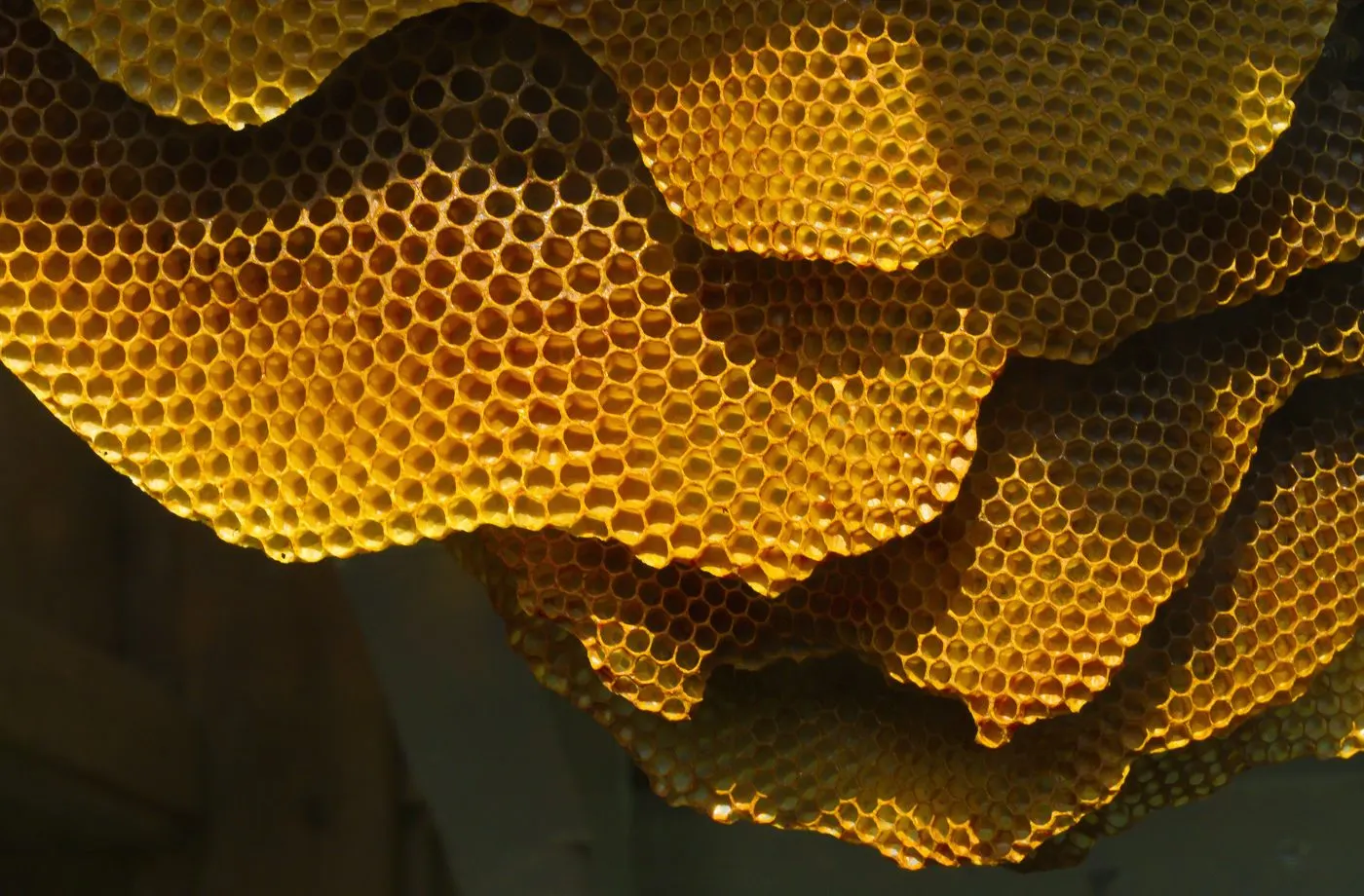
Empty wax combs hanging in layers, lit from one side; the cells sit in offset rows across every sheet.
"Honey Comb Structure" by Gavin Mackintosh from South Molton, United Kingdom — https://commons.wikimedia.org/wiki/File:Honeycomb_structure_(6248780733).jpg — CC BY 2.0 (https://creativecommons.org/licenses/by/2.0/); modified: downscaled from 5066 x 3330 to 1400 x 920 pixels
Push seven identical coins together on a table, one in the middle, and you get the layout of a honeycomb. The six outer coins fit snugly, each touching the center coin and two of its neighbors. That ring of six is most of the answer, and the photographs on this page are enough to check it; the comb itself is best left to the bees.
Bees do not have to measure angles to get hexagons, since the angles follow once the neighbors are in place. How bees place those neighbors, and whether warm wax helps shape the walls, is where the sources disagree.
Why are honeycomb cells hexagons and not circles?
Circles waste space. Equal circles packed in a square grid cover pi/4 of a flat surface, about 78.5%, while the same circles in a hexagonal grid, where each one touches six others, cover pi/(2 sqrt 3), about 90.7% (both computed for this page).
Now give each pair of neighboring cells one shared wall, placed halfway between their centers. A cell with six neighbors gets six walls and becomes a hexagon. On a square grid, that rule gives each cell four walls and a square outline.
Robert Oeder and Dietrich Schwabe put this as two principles in their 2017 paper full text. The hexagonal cross-section, they write, follows from “(1) the hexagonal close packing of the cells and (2) a common wall between all adjacent cells.”
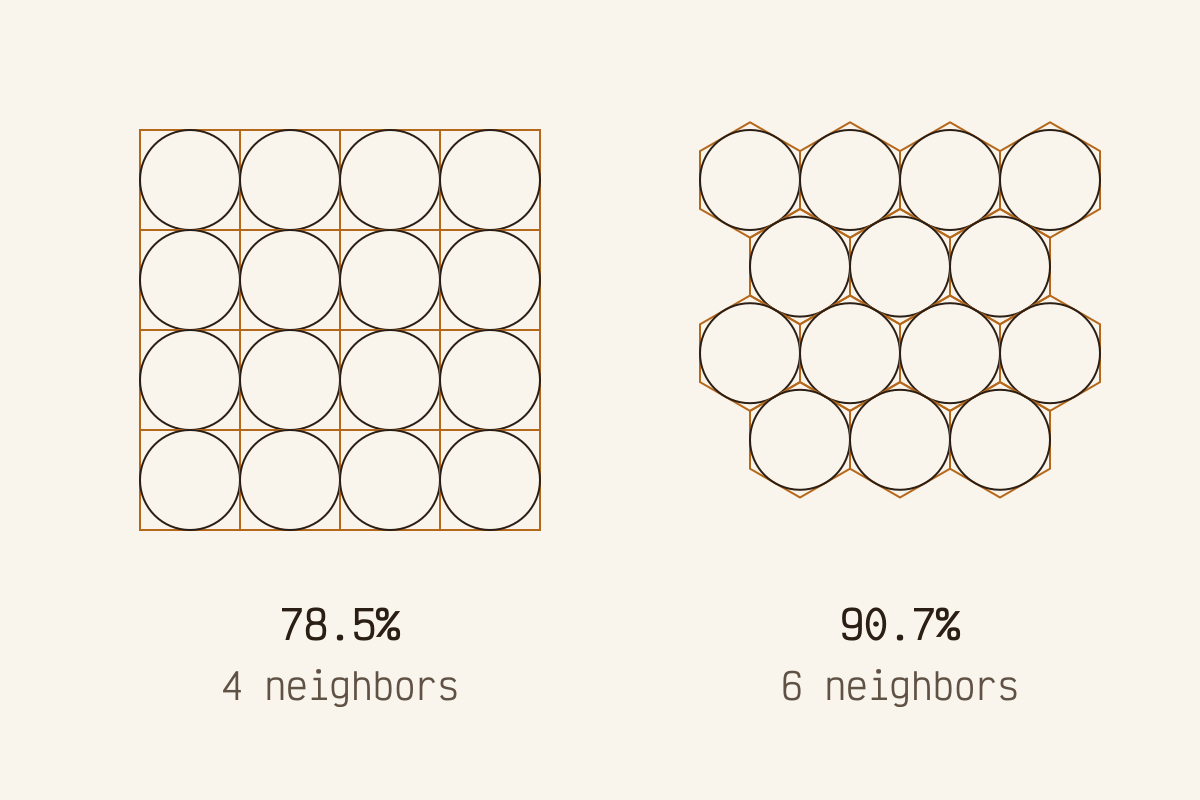
Equal circles packed two ways. With 4 neighbors the walls between them form squares; with 6 neighbors they form hexagons, and the circles cover more of the plane.
Recipe equal circles r=50; square grid 4x4; hexagonal rows 4,3,4,3; cover pi/4 and pi/(2*sqrt(3))
"Equal circles packed two ways" by Spiral, Fern & Honeycomb, https://spiralfernandhoneycomb.com/combs-and-cases/honeycomb-hexagons/, licensed under CC BY 4.0 (https://creativecommons.org/licenses/by/4.0/).
Data: site computation
The harder question is how bees end up with six equal neighbors in the first place.
Do bees build round cells first?
The idea that they do is old. D'Arcy Thompson, in On Growth and Form (1917), doubted that pressure from the bees alone could make such flat walls and constant angles, and he suggested a role for surface tension, the pull that makes a liquid's surface shrink.
“It seems more likely that we have to do with a true surface-tension effect; in other words, that the walls assume their configuration when in a semi-fluid state, while the papery pulp is still liquid, or while the wax is warm under the high temperature of the crowded hive.” (Thompson 1917, p. 333)
“Under these circumstances, the direct efforts of the wasp or bee may be supposed to be limited to the making of a tubular cell, as thin as the nature of the material permits, and packing these little cells as close as possible together.” (Thompson 1917, p. 333)
Pirk and three colleagues revived the idea in 2004 bibliographic. According to Nazzi, they supported it by studying wax that condensed around an array of rubber bungs.
What did the 2013 heating model propose?
A 2013 paper by a team led by Karihaloo at Cardiff University full text showed photographs of an Italian honeybee comb cell that looked round at “birth” and like a rounded hexagon two days later.
In their model, specialist “hot” workers heat the wax near the corner where three cells meet to about 45 °C, and the softened wax flows. The curve at that corner tightens from the cell's 3 mm radius to 1 mm in 36.3 seconds if only the corner is heated, or in 6.1 seconds if the whole cell is.
A fully sharp corner would take an infinitely long time in that model, which the authors gave as the reason real cells keep rounded corners. The same paper reports that only some short, unfinished cells at the bottom of the comb looked round at all, and even those were already hexagonal 0.5 mm from the bottom.
Francesco Nazzi also treated new cells as round at first in his 2016 paper full text. Oeder and Schwabe disagree: on combs taken from the hive during building, they found low cells near the edge that were already hexagonal in cross-section.
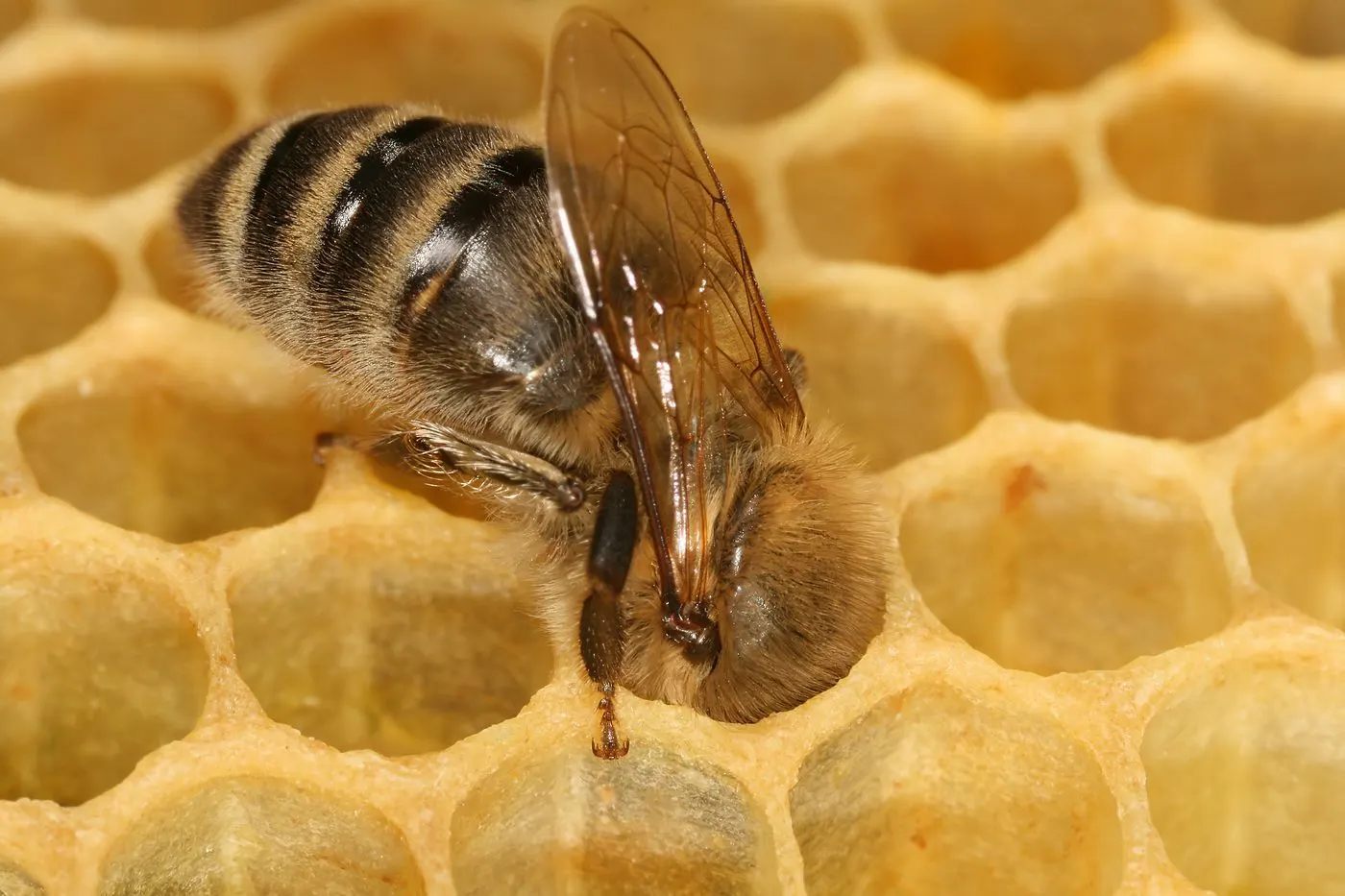
A worker of the Carniolan honeybee, Apis mellifera carnica according to the file page, head-down in a cell; the corners of the cells are rounded.
"Apis mellifera carnica worker honeycomb 2" by Richard Bartz, Munich Makro Freak — https://commons.wikimedia.org/wiki/File:Apis_mellifera_carnica_worker_honeycomb_2.jpg — CC BY-SA 2.5 (https://creativecommons.org/licenses/by-sa/2.5/); modified: downscaled from 3600 x 2400 to 1400 x 933 pixels
How warm does the wax get while bees build?
Bauer and Bienefeld argued in 2013 that bees do not heat the wax enough for it to flow and that they shape the cells mechanically bibliographic. Oeder and Schwabe report that study's measured temperature around the worker bees as 33.6 to 37.6 °C, well below 40 °C, the point where wax is reported to turn from solid to plastic.
Oeder and Schwabe then tested the wax itself. They warmed fresh wax scales in steps from 40 °C to 55 °C over about six hours and saw no change in shape or size. A piece of new comb with free-standing walls, held at 55.5 °C for three hours, showed no change in its walls either.
Oeder and Schwabe also state, citing 2008 measurements by Buchwald and colleagues bibliographic, that beeswax starts to soften at 40 °C and melts at about 64 °C.
Do building combs show traces of tubes?
The pair also looked for traces that tubes would leave behind. Where three round tubes meet, wax-free gaps should remain, about 1 mm across for the larger drone cells, yet on combs taken from the hive during building they found neither the gaps nor even rudimentary tubes.
Using a timing curve from the 2013 model, they estimated the work for one comb of 400 by 200 mm, about 3,900 cells. Rounding all its corners would take about 450 hours of the bees' working time for heating alone, and more once the third dimension is taken into account.
Nazzi did not treat the case as closed. He noted in 2016 that the temperature at which beeswax begins to melt is “very close” to the range Bauer and Bienefeld observed, and he described the formation of the hexagons as “still a matter of debate.”
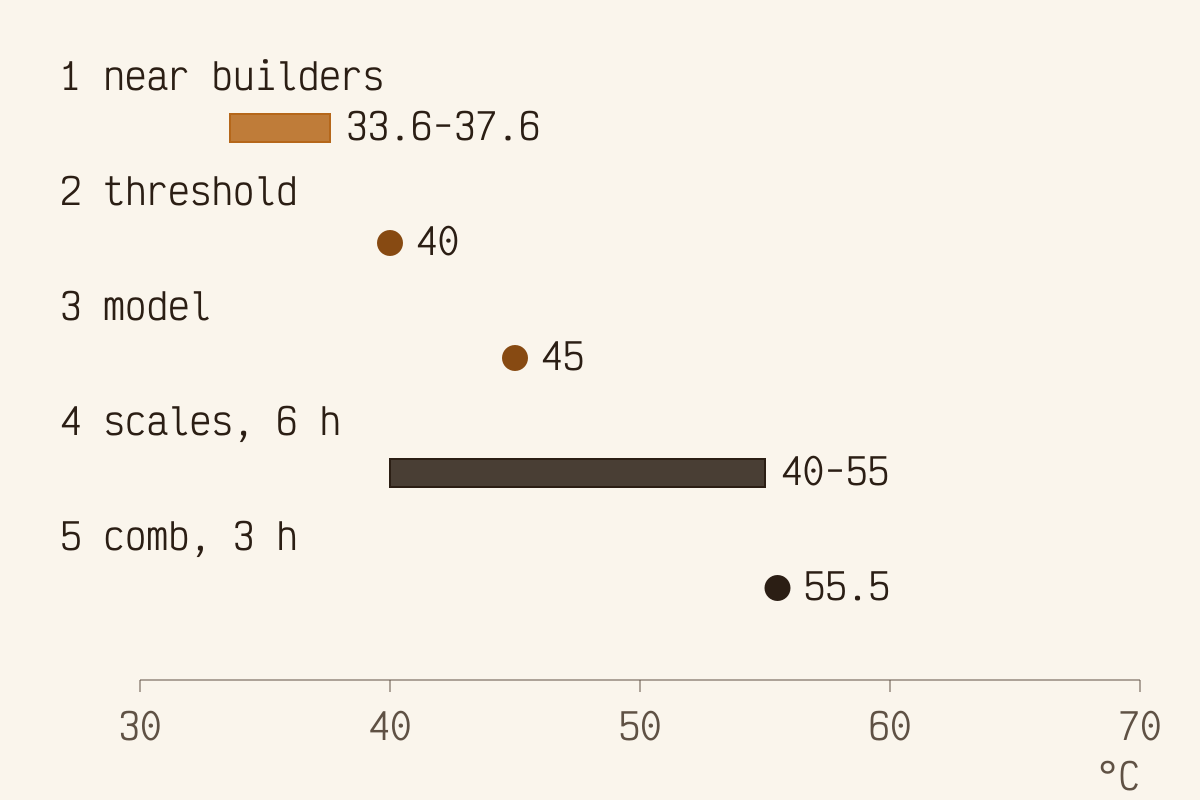
Temperatures in the dispute, by source. The range reported around building bees sits below both the stated threshold and the flow model's value, while wax held at or above both, up to 55.5 °C, kept its shape.
Recipe rows=5: 33.6-37.6, 40, 45, 40-55 (about 6 h), 55.5 (3 h) deg C (ranges as bars, single values as dots); axis 30-70 deg C; rows 1, 2, 4, 5 from Oeder and Schwabe 2017 (row 1 their report of Bauer and Bienefeld 2013), row 3 from Karihaloo and colleagues 2013
Read this figure as text
- Near builders, 33.6 to 37.6 °C: the 2013 study by Bauer and Bienefeld bibliographic, as reported by Oeder and Schwabe 2017 full text.
- Threshold, 40 °C: where wax is reported to turn plastic, Oeder and Schwabe 2017 full text.
- Model, about 45 °C: the wax temperature in the flow model of Karihaloo and colleagues 2013 full text.
- Wax scales, 40 to 55 °C over about 6 hours, no change: Oeder and Schwabe 2017 full text.
- New comb, 55.5 °C for 3 hours, no change: Oeder and Schwabe 2017 full text.
"Wax temperatures in the honeycomb dispute" by Spiral, Fern & Honeycomb, https://spiralfernandhoneycomb.com/combs-and-cases/honeycomb-hexagons/, licensed under CC BY 4.0 (https://creativecommons.org/licenses/by/4.0/).
Data: Oeder and Schwabe 2017, Oberhessische Naturwissenschaftliche Zeitschrift 67 (rows 1, 2, 4, 5; row 1 as their report of Bauer and Bienefeld 2013); Karihaloo, Zhang and Wang 2013, Journal of the Royal Society Interface 10:20130299 (row 3)
If the wax doesn't flow, where do the six sides come from?
Nazzi's 2016 paper in Scientific Reports moved the question to an earlier step. Whatever finishes the corners, he argued, hexagons appear only if cells of one size have first been arranged so that each one has six neighbors.
He then searched the combs of a colony for building errors. In the few he found, a cell without six neighbors did not become a hexagon; it took a polygon shape with as many sides as it had neighbors.
Those misplaced cells are wrong notes, and they reveal the score: count a cell's neighbors and you have counted its sides.
Equal size is the other half of the rule. Nazzi measured cell diameters in five close-up pictures of one comb and found a coefficient of variation, the spread of sizes as a share of the average, of 2.1 ± 0.6%. For the flagellum of the bees' antennae he found 1.5 ± 0.7%, which suggests that a bee's own body could, in principle, serve as its ruler.
From pictures of comb edges, Nazzi proposed a building rule. A new cell's floor starts in the groove between two existing cells, and once the floor is as wide as a cell, the walls go up. In his spreadsheet model the rule built alternating, offset rows, while a version that let a floor start anywhere built aligned rows.
Pictures of real comb tips taken two hours apart showed growth similar to the proposed rule. Nazzi presented it as a possible rule, not a proven one.
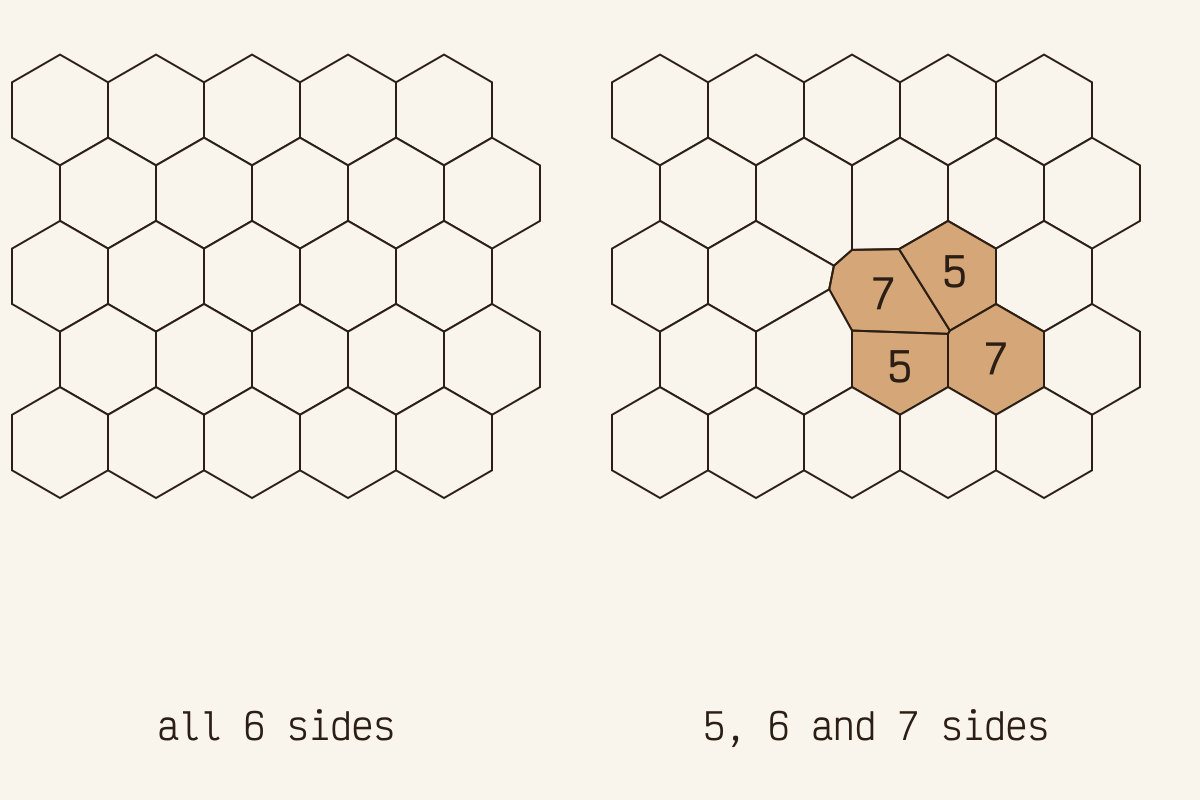
A geometry model, not a bee simulation: each wall sits halfway between two cell centers, so each cell has as many sides as neighbors. Side counts recounted on the drawn cells: 2 five-sided, 21 six-sided, 2 seven-sided.
Recipe grid=triangular, spacing=96; 5x5 cells shown; moved=1 center, 0.6*spacing at 30 deg; walls=Voronoi bisectors
"Sides follow neighbors" by Spiral, Fern & Honeycomb, https://spiralfernandhoneycomb.com/combs-and-cases/honeycomb-hexagons/, licensed under CC BY 4.0 (https://creativecommons.org/licenses/by/4.0/).
Data: site computation
This table as CSV (honeycomb-hexagons-neighbors.csv) (file notes: source and license) Data: site computation
The figure draws rule 2 of the Pattern card's working recipe. That recipe has not been compared with other recipes, so it is not labeled the shortest one; Each figure regrown describes how these figures are rebuilt.
Is the hexagon really the most economical shape?
The economy argument is ancient. Thomas Hales, in the history at the start of his 2001 proof full text, quotes Marcus Terentius Varro, writing around 36 BC, that the geometers prove the hexagon “encloses the greatest amount of space.” Hales also notes that Pappus of Alexandria compared only the three regular shapes that tile a flat surface, the triangle, the square and the hexagon, and found that the hexagon holds the most honey for the same material.
Hales quotes Charles Darwin too, who turned the point into natural selection: the swarm “that wasted least honey in the secretion of wax” would have done best.
Pappus checked only three shapes. The full claim is that no way of dividing a flat surface into equal areas uses less total boundary than regular hexagons. Fejes Tóth proved it for convex cells in 1943, and Hales proved it in general in a paper published in 2001.
The figure below puts numbers on it (computed for this page). For cells of area 1 with shared walls, hexagons need 1.861 units of wall per cell, squares 2.000 and triangles 2.280. So hexagons use 6.9% less wall than squares and 18.4% less than triangles, and a hexagon's outline is only 5.0% longer than a circle of the same area, without the gaps.
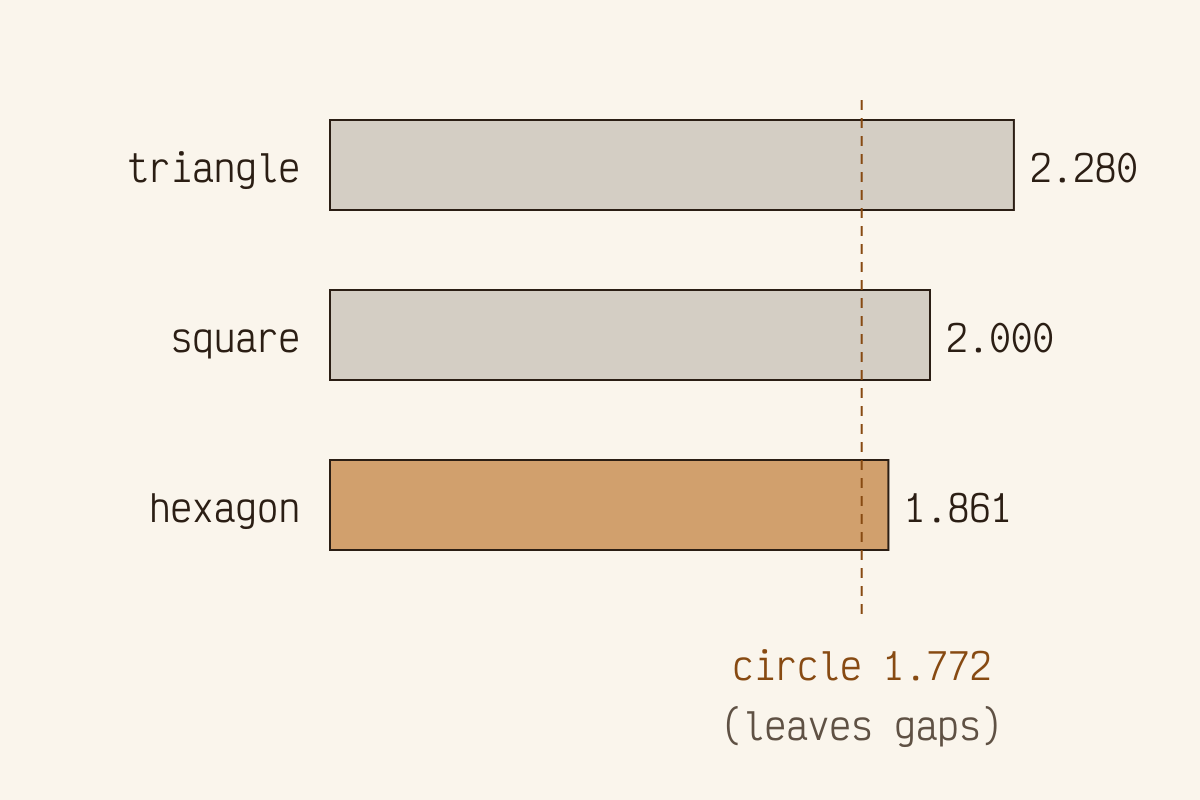
Wall needed per cell at cell area 1, walls shared. The dashed line marks the same measure for a circle of area 1, half its outline, for comparison only, since circles leave gaps. Values recomputed from the formula and matching the article's table (4 of 4).
Recipe regular n-gon, area=1; wall per cell = perimeter/2; n=3,4,6; circle sqrt(pi) for reference
"Wall needed per cell, cell area 1" by Spiral, Fern & Honeycomb, https://spiralfernandhoneycomb.com/combs-and-cases/honeycomb-hexagons/, licensed under CC BY 4.0 (https://creativecommons.org/licenses/by/4.0/).
Data: site computation
| Shape | Wall per cell (area 1, walls shared) | Compared with the hexagon | Tiles the plane |
|---|---|---|---|
| Triangle | 2.280 | 1.225 times | yes |
| Square | 2.000 | 1.075 times | yes |
| Hexagon | 1.861 | 1.000 | yes |
| Circle, reference only | 1.772 | 0.952 times | no, leaves gaps |
Download the wall-length table (CSV) (file notes: source and license) Data: site computation
Economy has limits as an explanation. Hales notes that Fejes Tóth also found the three-dimensional cell, with its base of three rhombuses, is not the most economical shape. Saving wax may explain why a building habit was favored, but it does not say how bees carry it out. Soap films show why films also settle on the shortest walls.
So who makes the hexagon, the bee or the wax?
This page is the evidence file for the honeycomb dispute. The table weighs the three main explanations by what was observed, what each assumes, and what came later. Pirk and colleagues are known here only from the bibliography bibliographic; the other studies in it were all read in full full text.
| Explanation | Observed | Assumes | Later | Reading on this page |
|---|---|---|---|---|
| Bees as geometers (Varro, Pappus, as reported by Hales 2001) | Cells are hexagons; hexagons use the least wall | Bees compare shapes | General proof published in 2001; none of the studies read here shows bees comparing shapes | The geometry holds; the bee-as-mathematician story is not needed |
| The flow idea: warm wax settles into hexagons (Thompson 1917; Pirk et al. 2004; Karihaloo et al. 2013) | Round-looking cells at a comb's edge; a flow model run at about 45 °C | Wax near 40 to 45 °C and free-standing tubes | No change at 55.5 °C for 3 hours and no tubes found (Oeder and Schwabe 2017); Nazzi (2016) calls it unsettled | Not supported as the main mechanism by the measurements read so far |
| Six equal neighbors plus shared walls (Nazzi 2016; Oeder and Schwabe 2017) | Misplaced cells take as many sides as neighbors; cell size varies by about 2% | Bees hold cells to one size, perhaps with a body part as the gauge (Nazzi) | No independent test of the groove rule in the sources read for this page | Best supported; the exact building rule is still a candidate |
The reading here is that the hexagon is a joint product, led by behavior. The bees' part has the more direct evidence: Oeder and Schwabe describe bees molding the wax with their mandibles and adding wax at the rim of each cell. The wax's part is inferred, since warming may help the bees work it, but whether warming ever rounds a corner on its own is unresolved.
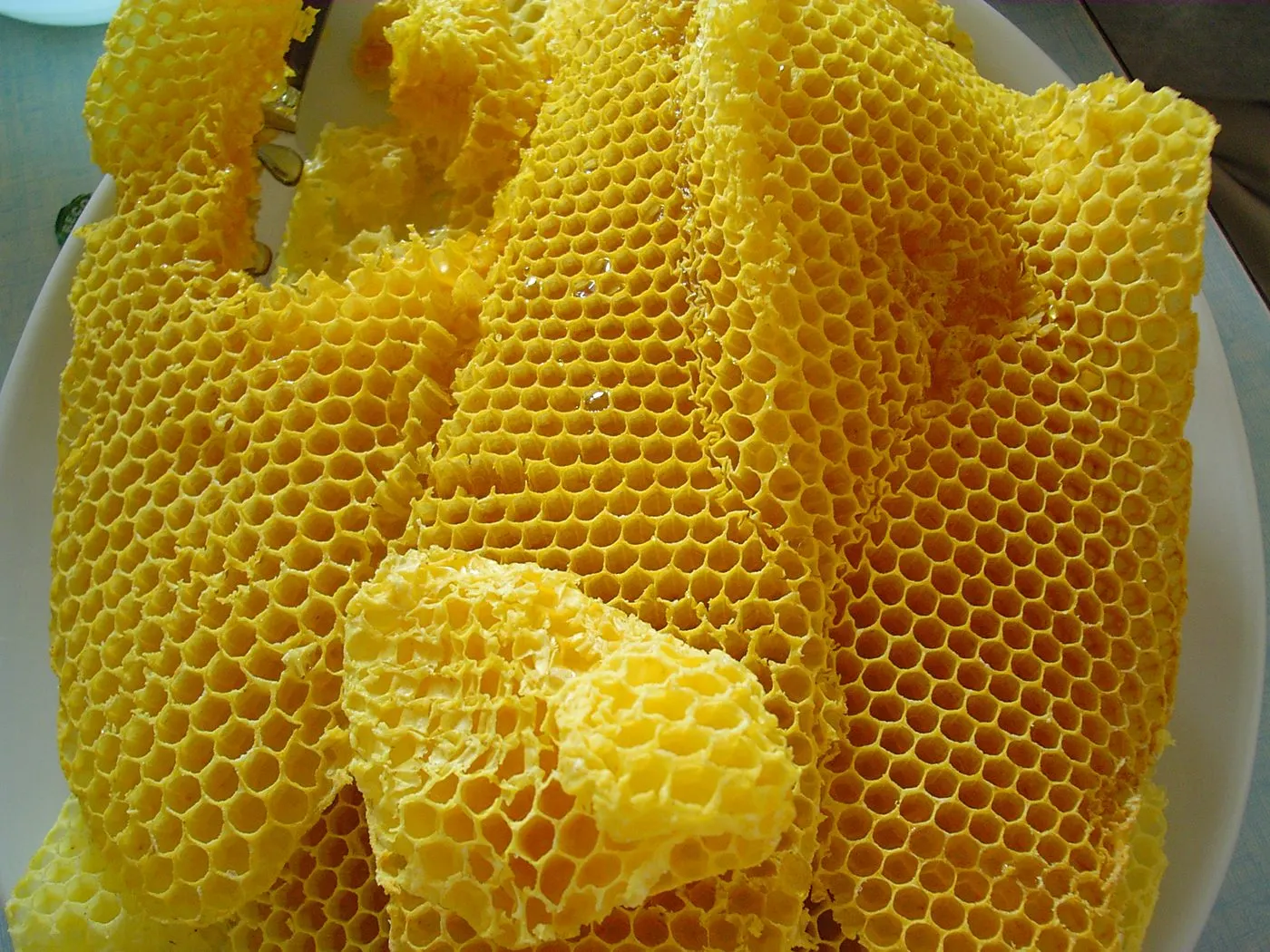
Cut pieces of wax comb, built by black bees according to the file page; torn edges show the cell walls in cross-section.
"Honeycombs - rayons de miel 1" by Emmanuel Boutet — https://commons.wikimedia.org/wiki/File:Honeycombs-rayons-de-miel-1.jpg — CC BY-SA 2.5 (https://creativecommons.org/licenses/by-sa/2.5/); modified: downscaled from 2560 x 1920 to 1400 x 1050 pixels
Are all honeycomb cells the same size?
Within one patch of comb the sizes are close, and Nazzi's measurements put the variation at about 2%. Across a whole comb they are not, because colonies also build larger drone cells. Oeder and Schwabe report that drone cells are more than 40% bigger in cross-section than worker cells and that the two kinds sit side by side on almost all brood combs. They consider such local variety unlikely to come from wax flowing toward a liquid equilibrium.
Cell size also matters to the colony. Nazzi notes that the laying queen deposits one of two kinds of eggs, haploid or diploid, according to the size of the cell. Karihaloo's team notes that the inside of a cell narrows as a comb ages, because its walls thicken.
Other insects build cells too. A mud dauber nest is another insect's cells, made from mud, and the Alhambra is a tiled palace where the count of symmetry groups is disputed.
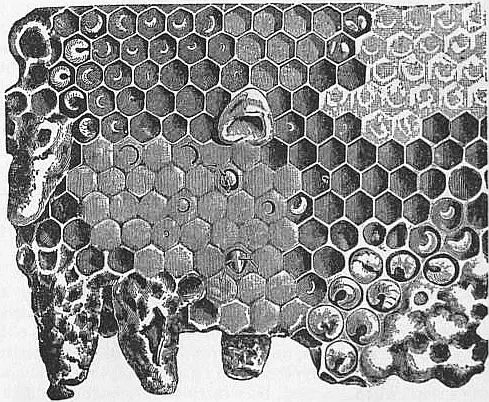
An engraving of a brood comb reproduced in the 1911 Britannica: six-sided cells that appear to differ in size, with rough lumps of wax hanging below.
"Honeycomb, from the article Bee, Encyclopaedia Britannica, 11th edition" by Encyclopædia Britannica, Eleventh Edition, vol. 3, p. 635 (1911) — https://commons.wikimedia.org/wiki/File:1911_Britannica_-_Bee_-_Honeycomb.png — Public domain (US: published 1911 (Encyclopædia Britannica, 11th edition), before 1 January 1931, public domain per the file page; EU: from Cheshire's Bees and Bee-keeping, Scientific and Practical, according to the file page; death year not verified)
Sources
- Nazzi F (2016). The hexagonal shape of the honeycomb cells depends on the construction behavior of bees. Scientific Reports 6:28341. doi:10.1038/srep28341 pmc.ncbi.nlm.nih.gov/articles/PMC4913256/Read: full text; PMC version, CC BY 4.0Text license: CC BY 4.0 (terms)
- Oeder R, Schwabe D (2017). Evidence that no liquid equilibrium process is involved in the comb building of honey bees (Apis mellifera). Oberhessische Naturwissenschaftliche Zeitschrift 67:8–27. doi:10.22029/jlupub-1084 jlupub.ub.uni-giessen.de/items/265931ce-0b4b-4f65-b915-c5b9a…Read: full text; English version in the Giessen university repository (In Copyright; quoted once, otherwise paraphrased)
- Thompson DW (1917). On Growth and Form. Cambridge: at the University Press. Author d. 1948 per Project Gutenberg catalog record; public domain in the US (published 1917) www.gutenberg.org/ebooks/55264Read: full text; pp. 332–333
- Pirk CWW, Hepburn HR, Radloff SE, Tautz J (2004). Honeybee combs: construction through a liquid equilibrium process? Naturwissenschaften 91:350–353. doi:10.1007/s00114-004-0539-3 doi.org/10.1007/s00114-004-0539-3Read: bibliographic; record from the reference list of Nazzi 2016; claims given only as summarized by Nazzi 2016 and Oeder and Schwabe 2017
- Karihaloo BL, Zhang K, Wang J (2013). Honeybee combs: how the circular cells transform into rounded hexagons. Journal of the Royal Society Interface 10(86):20130299. doi:10.1098/rsif.2013.0299 pmc.ncbi.nlm.nih.gov/articles/PMC3730681/Read: full text; PMC version (© 2013 The Author(s), published by the Royal Society, all rights reserved; paraphrased only)
- Bauer D, Bienefeld K (2013). Hexagonal comb cells of honeybees are not produced via a liquid equilibrium process. Naturwissenschaften 100:45–49. doi:10.1007/s00114-012-0992-3 doi.org/10.1007/s00114-012-0992-3Read: bibliographic; record from the reference list of Nazzi 2016; findings given only as reported by Nazzi 2016 and Oeder and Schwabe 2017
- Buchwald R, Breed MD, Greenberg AR (2008). The thermal properties of beeswaxes: unexpected findings. Journal of Experimental Biology 211:121–127. doi:10.1242/jeb.007583 doi.org/10.1242/jeb.007583Read: bibliographic; cited by Oeder and Schwabe 2017
- Hales TC (2001). The Honeycomb Conjecture. Discrete & Computational Geometry 25:1–22. arXiv math/9906042. arxiv.org/abs/math/9906042Read: full text; arXiv preprint, introduction and references
Cite this page
Spiral, Fern & Honeycomb. “Why Are Honeycombs Hexagonal? Likely Six Equal Neighbors.” Published November 23, 2026. https://spiralfernandhoneycomb.com/combs-and-cases/honeycomb-hexagons/ (accessed the day you read it).
- How each figure and source is checked
- Retunings: every correction, dated
- Report an error on this page (contact@spiralfernandhoneycomb.com)
More from Combs & Cases
Paper Wasp Nest: One Study Found Order Only Over Short Range
Picture credit
"Polistes exclamans nest" by Larry D. Moore — https://commons.wikimedia.org/wiki/File:Polistes_exclamans_nest.jpg — CC BY 4.0 (https://creativecommons.org/licenses/by/4.0/); modified: resized to 1600 px wide and saved as WebP
Caddisfly Case: Three Separate Origins in a 2024 Family Tree
Picture credit
"Lepidostoma hirtum larva" by Hallvard Elven, Naturhistorisk museum, Universitetet i Oslo — https://commons.wikimedia.org/wiki/File:Lepidostoma_hirtum_larva.jpg — CC BY 4.0 (https://creativecommons.org/licenses/by/4.0/); modified: cropped to a 3:2 frame around the larva and the front of its case (box 110, 40, 1090, 693 of 2000 x 808, from the original orig-Lepidostoma_hirtum_larva.jpg): the whole larva and about three complete case sections, with the rear of the case left out at the right; original not altered, saved as WebP at the crop's own size, 980 x 653, not enlarged
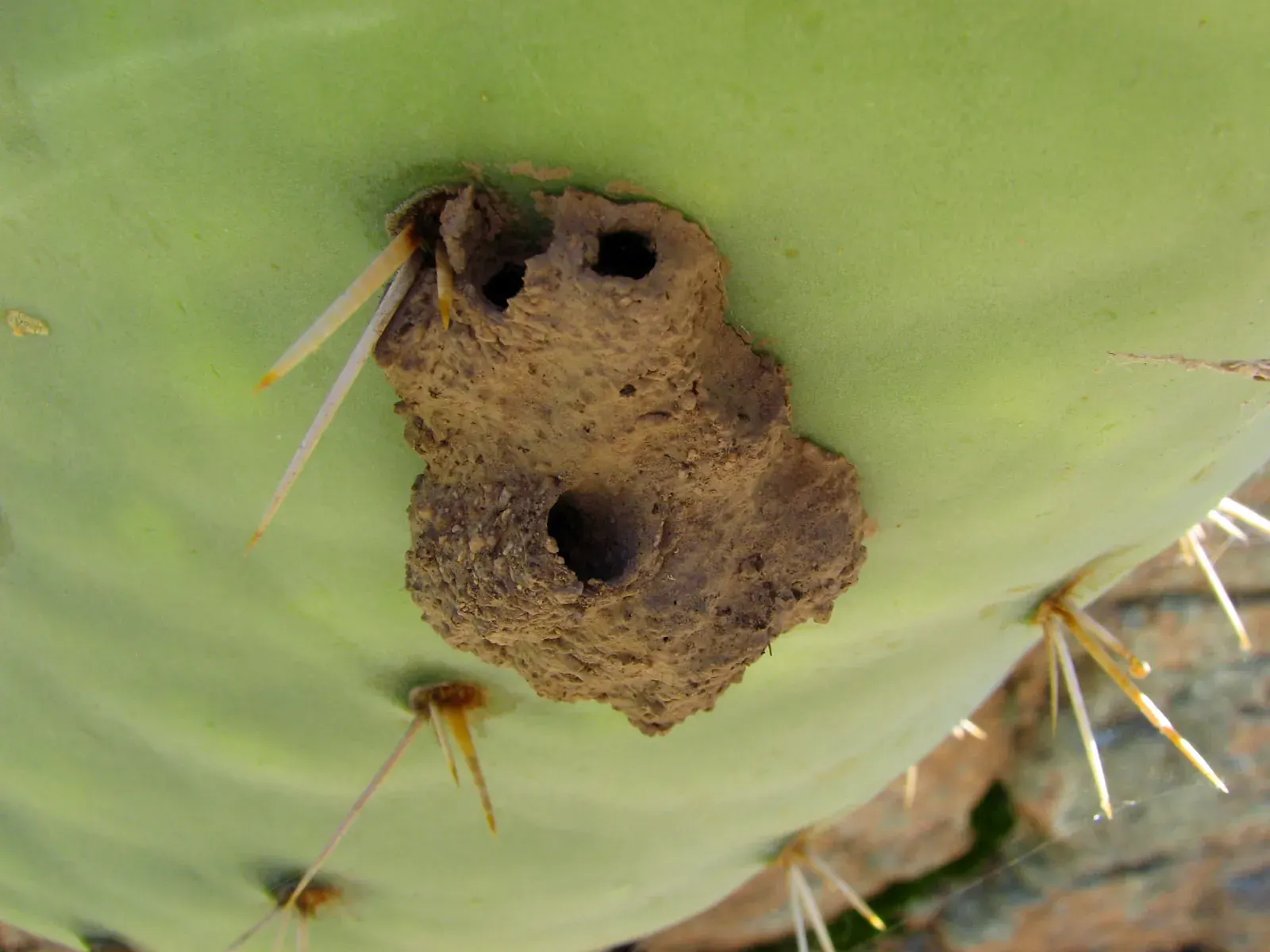
Mud Dauber Nest: Tapping May Pack the Mud Walls Hard
Picture credit
"Mud Dauber Nest" by Katja Schulz — https://commons.wikimedia.org/wiki/File:Mud_Dauber_Nest_-_Flickr_-_treegrow.jpg — CC BY 2.0 (https://creativecommons.org/licenses/by/2.0/); modified: saved as WebP at the original 1600 px width