Caddisfly Case: Three Separate Origins in a 2024 Family Tree
Pattern entry Spiral, Fern & Honeycomb Published
In brief
A caddisfly case is a portable shelter that a caddisfly larva builds underwater from its own silk and local materials such as rock fragments, sticks and leaves. A 2024 phylogenomic study of 207 caddisfly species inferred that portable case making evolved three separate times: in the purse case makers, the tortoise case makers and the tube case makers. In that reconstruction, the ancestor of all living caddisflies was a free-living larva with no portable case or fixed retreat.
Pattern card
- Pattern
- A portable case of grains or plant pieces tied with silk and carried by the larva; tube cases taper toward the back
- Where
- Larvae of case-making caddisflies (Trichoptera), in three lineages: purse, tortoise and tube case makers
- Made by
- behavior: established (Frandsen et al. 2024 full text) · growth: established (Waringer et al. 2022 full text)
- Working recipe
- 2 rules / 0 parameters, for tube cases: tie local particles together with silk into a tube around the body; after each molt, add a wider section at the front opening. Not compared with other recipes
- Key source
- Frandsen et al. 2024, Proceedings of the Royal Society B 291:20240514 full text
This card as CSV file notes: source and license
Data: Frandsen et al. 2024, Proceedings of the Royal Society B 291:20240514, CC BY 4.0; Waringer et al. 2022, Hydrobiologia 849:4259-4271, CC BY 4.0
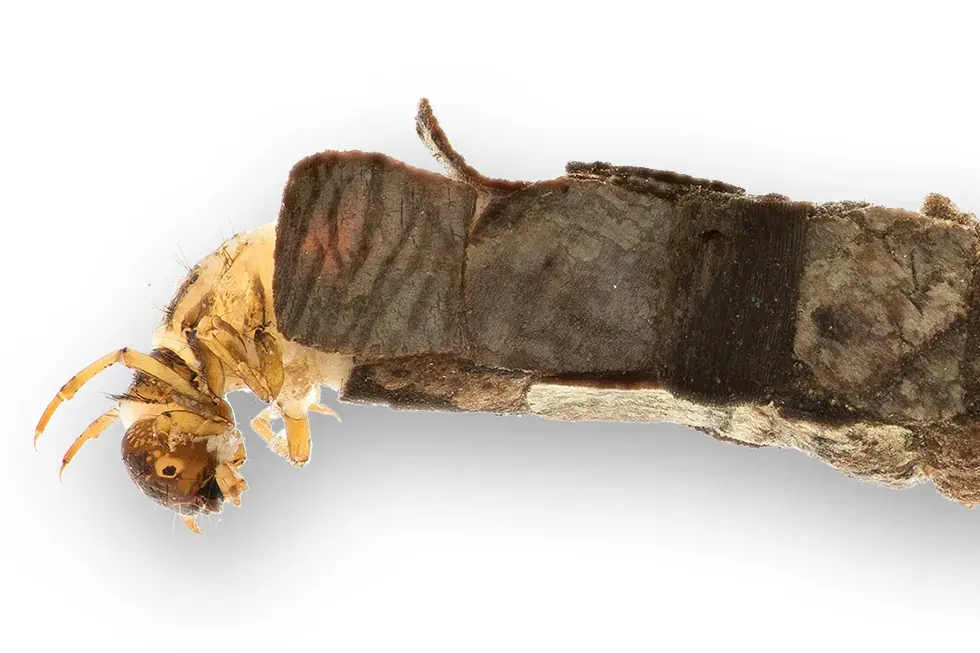
A Lepidostoma hirtum larva in its case, according to the file page: a long tube of flat brown plant pieces laid in rows, with the head and legs reaching out of the front opening.
“Lepidostoma hirtum larva”, Hallvard Elven, Naturhistorisk museum, Universitetet i Oslo; CC BY 4.0.
Full credit
"Lepidostoma hirtum larva" by Hallvard Elven, Naturhistorisk museum, Universitetet i Oslo — https://commons.wikimedia.org/wiki/File:Lepidostoma_hirtum_larva.jpg — CC BY 4.0 (https://creativecommons.org/licenses/by/4.0/); modified: cropped to a 3:2 frame around the larva and the front of its case (box 110, 40, 1090, 693 of 2000 x 808, from the original orig-Lepidostoma_hirtum_larva.jpg): the whole larva and about three complete case sections, with the rear of the case left out at the right; original not altered, saved as WebP at the crop's own size, 980 x 653, not enlarged
Zoom in on the caddisfly case in this photo: each strip of plant matter sits where the larva fixed it. The binding is silk, made in the larva's labial glands, the silk glands that caddisflies share with moths and butterflies. And a tube like this grows at its front end: after a molt, the larger larva adds a new, wider section there. Keep the looking to photographs: these larvae live in streams and lakes, and this page does not ask anyone to turn over stream stones or collect them.
How does a larva build its case?
The 2024 study, by Paul Frandsen and colleagues in Proceedings of the Royal Society B full text, calls caddisflies “perhaps the most common underwater architects.” Most caddisfly larvae, the paper says, build either portable cases or fixed retreats out of local materials, “including small fragments of rocks, sticks and leaves.” Both depend on silk from the larval labial glands.
That silk links caddisflies to moths. Caddisflies (Trichoptera) and moths and butterflies (Lepidoptera) are each other's closest relatives, and the paper cites evidence that the main molecular parts of their silk likely arose in the ancestor of both. Unlike almost all moths, caddisflies are, in the paper's words, “almost exclusively aquatic” as larvae, and the paper counts more than 16,000 described species.
The same paper lists what a case does for its owner. It protects the larva from predators, both as armor and as camouflage, helps it hold its place in fast water, and later shelters the pupa. Portable cases also improved breathing efficiency, the authors write, and let some lineages move into still water.
A tube case does not stay the same size. In a 2022 study of case shape and water flow, Johann Waringer and colleagues full text note that tube cases are tapered “because after larval molts the larger instars add new case sections at the anterior end.” An instar is one growth stage between molts, and the anterior end is the front.
For Allogamus auricollis, which has five larval instars, the paper's text puts the growth in case length at 1.3 to 1.9 times from one molt to the next, while the mean lengths in its Table 1 give about 1.2 for the last molt (13.62 mm to 16.82 mm).
The front is also the working end. The larva's legs reach out of the front opening to grip the bottom, which, the 2022 paper notes, lines the case up with the current.
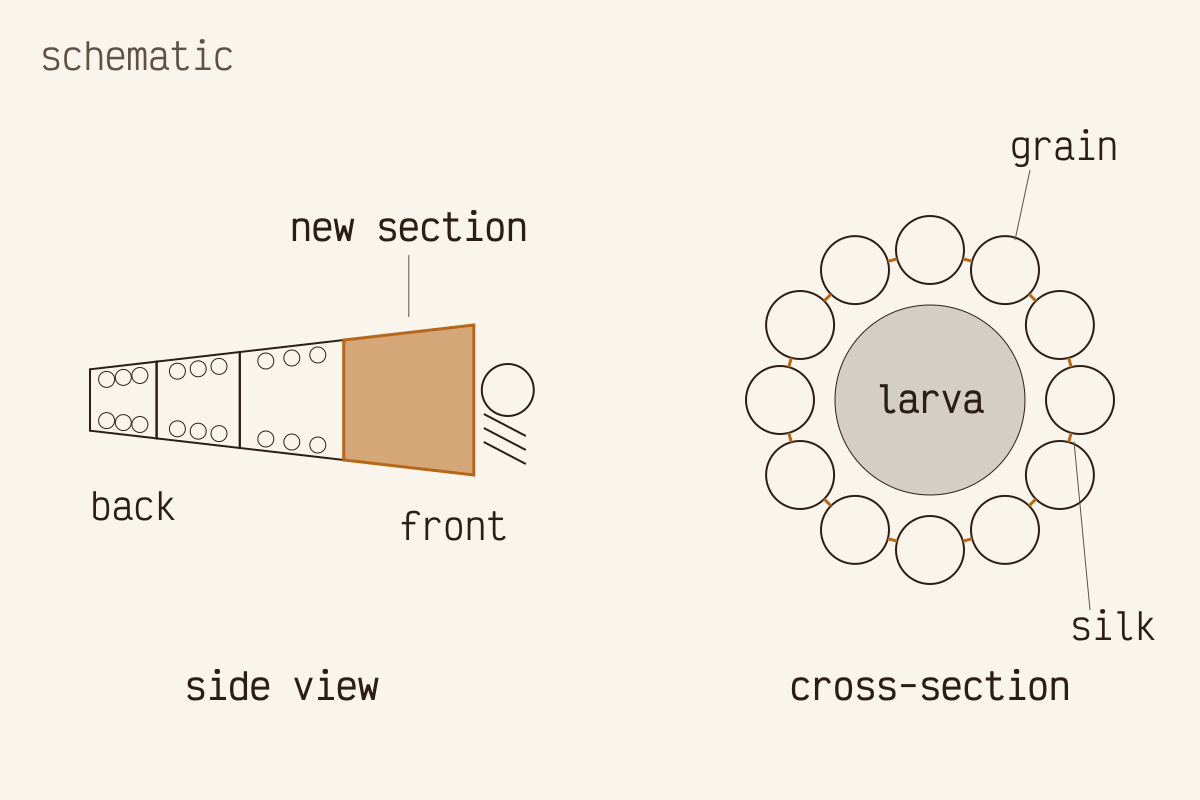
A schematic of a tube case: sections widen toward the front, where the newest one (filled) sits, and a cross-section shows grains tied to their neighbors with silk. Drawn from the 2024 and 2022 papers' text, not their figures.
Recipe schematic; side view: 4 sections, front height 150 and length 130, x0.8 per section toward the back, newest section at the front; cross-section: 12 grains r=34 on a ring R=150, silk ties between neighbors, larva r=95
"A caddisfly tube case in side view and cross-section, schematic" by Spiral, Fern & Honeycomb, https://spiralfernandhoneycomb.com/combs-and-cases/caddisfly-case/, licensed under CC BY 4.0 (https://creativecommons.org/licenses/by/4.0/).
Data: Frandsen et al. 2024, Proceedings of the Royal Society B 291:20240514, CC BY 4.0 (silk and local materials); Waringer et al. 2022, Hydrobiologia 849:4259-4271, CC BY 4.0 (new sections added at the front after molts)
How each schematic on this site is built is explained under Each figure regrown.
What do different caddisflies build with?
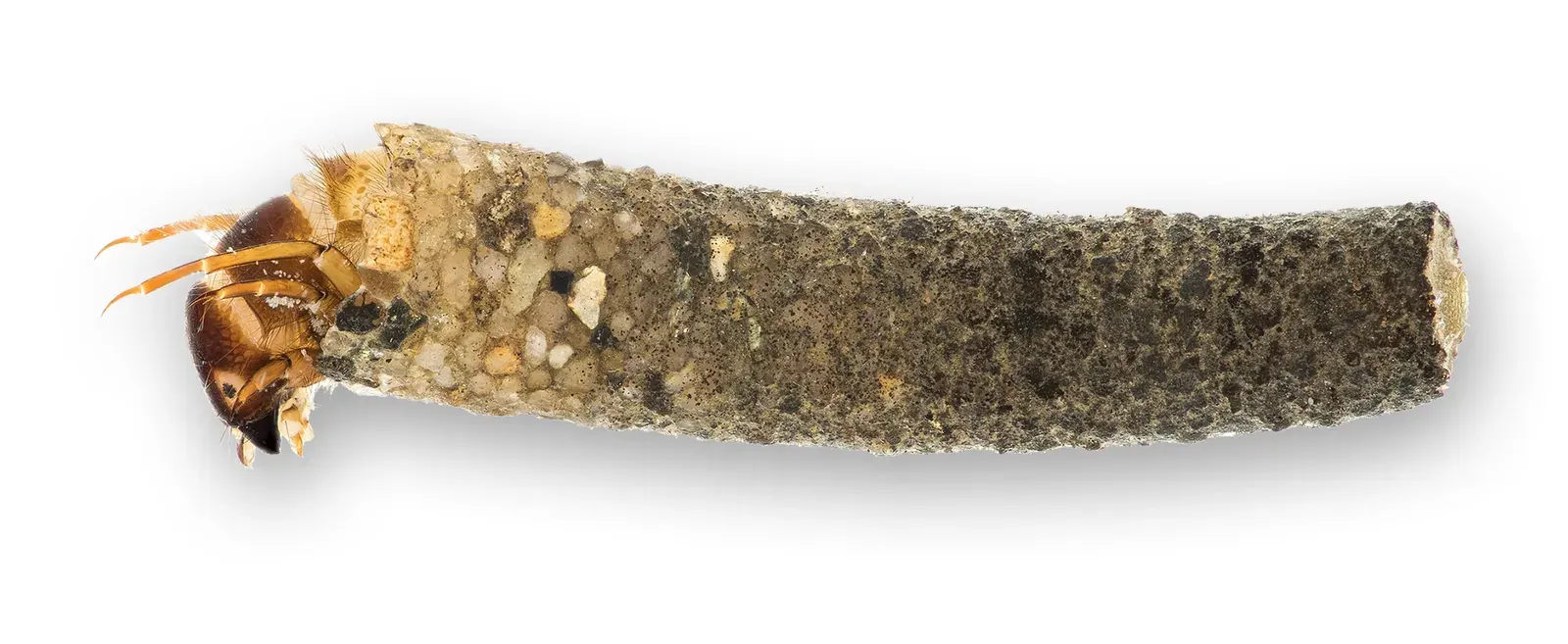
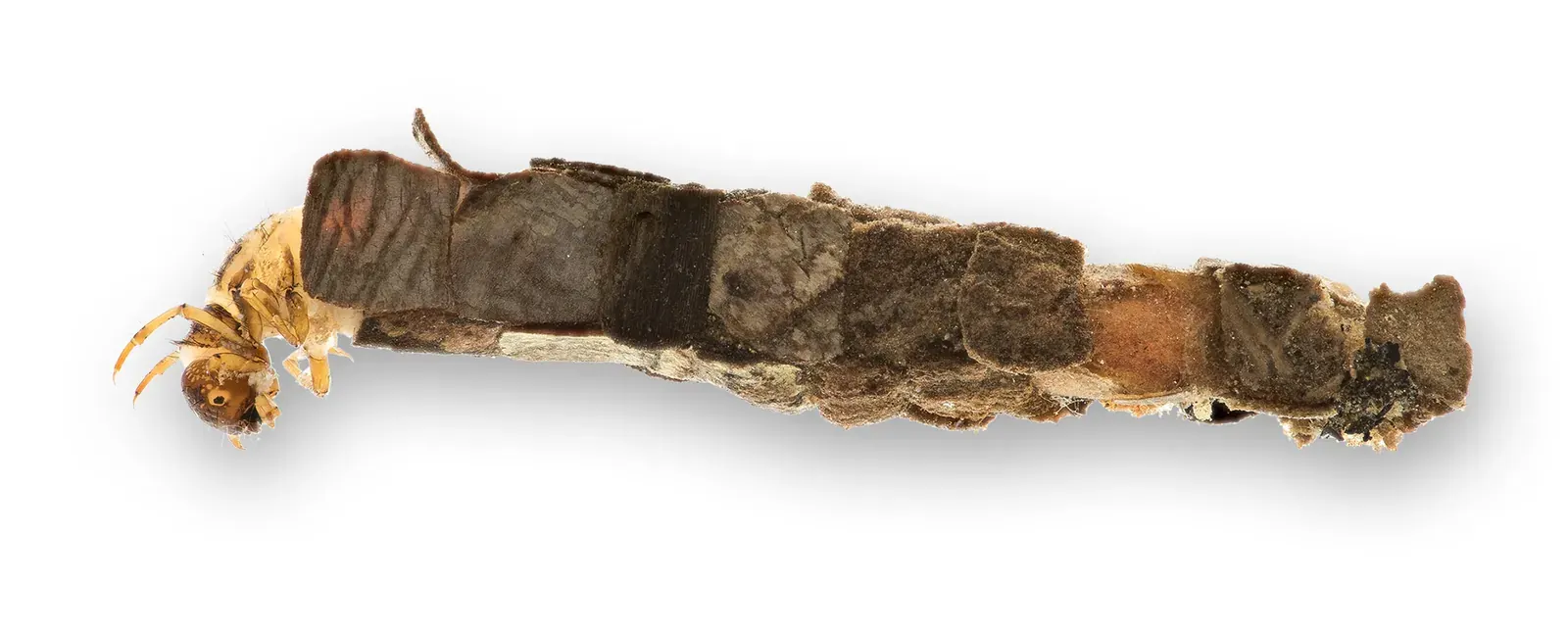
The list of materials is long. Waringer and colleagues name mineral particles of many grain sizes, small shells, woody debris, algal threads, and fragments of plants and freshwater sponges. Cross-sections of the cases run from triangular through four-sided to round, and some cases are shaped like a turtle shell or a purse.
"Sericostoma personatum larva" by Hallvard Elven, Naturhistorisk museum, Universitetet i Oslo — https://commons.wikimedia.org/wiki/File:Sericostoma_personatum_larva.jpg — CC BY 4.0 (https://creativecommons.org/licenses/by/4.0/); modified: resized to 1600 px wide and saved as WebP
"Lepidostoma hirtum larva" by Hallvard Elven, Naturhistorisk museum, Universitetet i Oslo — https://commons.wikimedia.org/wiki/File:Lepidostoma_hirtum_larva.jpg — CC BY 4.0 (https://creativecommons.org/licenses/by/4.0/); modified: resized to 1600 px wide and saved as WebP
Two tube cases built from different materials, as labeled on the file pages: Sericostoma personatum (first) in a tube of fine mineral grains, and Lepidostoma hirtum (second) in a tube of flat plant pieces fitted edge to edge.
The 2024 family tree ties part of this variety to later events. In two tube-case families, Leptoceridae and Limnephilidae, bursts of new species coincided with the use of plant matter for cases. The authors link that change to a move into slow and standing water, helped by tube cases that pass oxygen-rich water over the larva's abdomen and gills.
Insect builders in other materials have their own pages: the mud dauber nest, another tube builder, working in mud, and the honeycomb, built cell by cell.
When did case making evolve?
Frandsen and colleagues built their tree from genetic data for 207 species, covering 48 of the 52 living caddisfly families, and dated it with 33 fossils. By that dating, the first caddisflies appeared about 295 million years ago, in the Permian. The team then reconstructed what the larvae at each branch point most likely built.
The study found three independent origins of portable case making. They sit on the branches leading to the purse case makers (Hydroptiloidea, the microcaddisflies), the tortoise case makers (Glossosomatidae) and the tube case makers (Phryganides). That result contrasts with an earlier, untested idea that purse and tortoise cases share one origin.
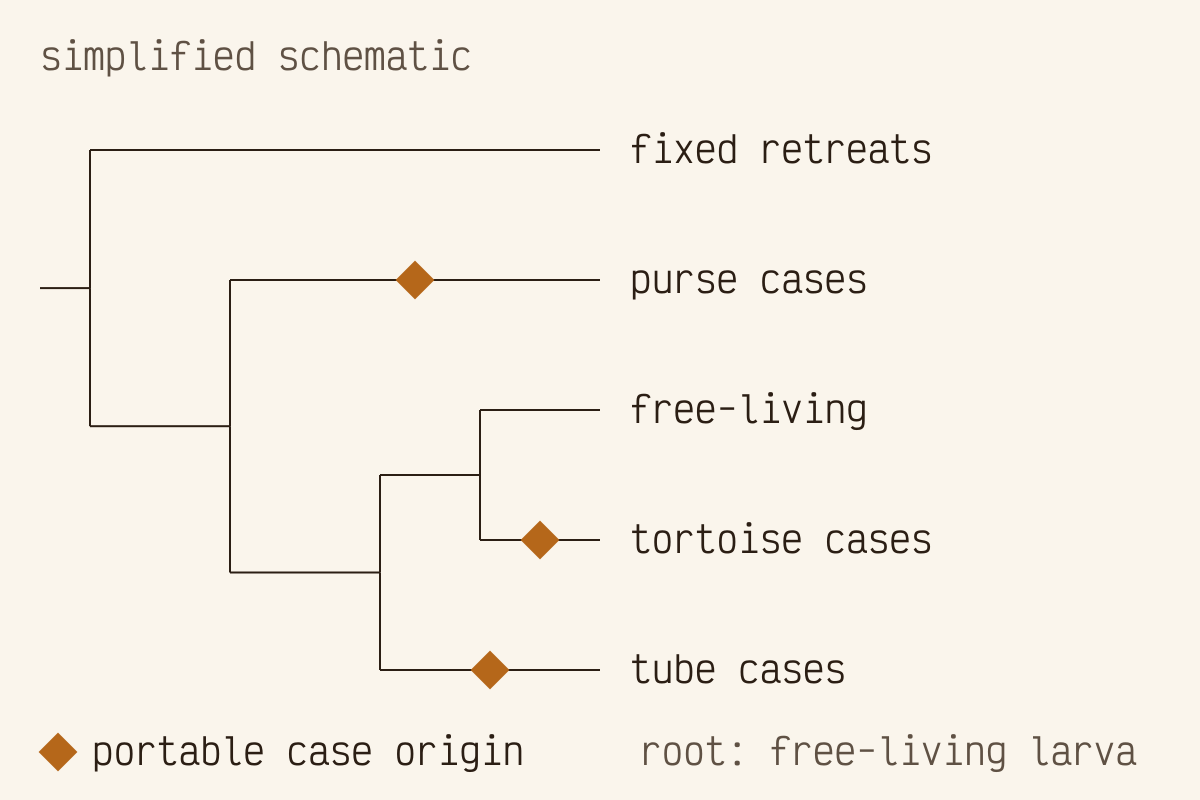
A simplified schematic of the 2024 tree, drawn from the paper's text and not from its figures: fixed retreat makers split off first, then purse case makers, then the free-living families beside the tortoise case makers, next to the tube case makers. Branch lengths carry no time.
Recipe 5 tips: fixed retreats, purse, free-living, tortoise, tube; topology (fixed retreats, (purse, ((free-living, tortoise), tube))); a case origin marked on each branch to purse, tortoise, tube; branch lengths carry no time
Read this figure as text
- Fixed retreat makers (Annulipalpia): fixed structures, no portable case.
- Purse case makers (Hydroptiloidea): portable case origin 1; purse cases are built only by final-instar larvae.
- Free-living families (Rhyacophilidae and Hydrobiosidae): no case.
- Tortoise case makers (Glossosomatidae): portable case origin 2.
- Tube case makers (Phryganides): portable case origin 3.
"Separate origins of portable caddisfly cases in the 2024 study, simplified schematic" by Spiral, Fern & Honeycomb, https://spiralfernandhoneycomb.com/combs-and-cases/caddisfly-case/, licensed under CC BY 4.0 (https://creativecommons.org/licenses/by/4.0/).
Data: Frandsen et al. 2024, Proceedings of the Royal Society B 291:20240514, CC BY 4.0 (tree topology and case origins, from the text)
This table as CSV (caddisfly-case-origins.csv) (file notes: source and license) Data: Frandsen et al. 2024, Phylogenomics recovers multiple origins of portable case making in caddisflies, Proceedings of the Royal Society B 291:20240514, CC BY 4.0, https://pmc.ncbi.nlm.nih.gov/articles/PMC11285404/
In the authors' reconstruction, the ancestor of all living caddisflies was a free-living larva that built a dome-shaped shelter only when it was about to pupate. In that account, selection then favored building the shelter earlier in larval life.
According to the study, three lineages turned the early shelter into a portable case. The score was one pupal shelter, and the study found it arranged into a case three times over.
Some questions stay open. The branching order among the two free-living families and the tortoise case makers differed between datasets and methods, although the group that joins them was strongly supported. The study also found that the main bursts of new species did not coincide with the origin of the case: they came later, with other innovations such as the move into still water. Portable case makers still account for more than half of described caddisfly species, according to the paper.
Sources
- Frandsen PB, Holzenthal RW, Espeland M, et al. (2024). Phylogenomics recovers multiple origins of portable case making in caddisflies (Insecta: Trichoptera), nature's underwater architects. Proceedings of the Royal Society B 291(2026):20240514. doi:10.1098/rspb.2024.0514. pmc.ncbi.nlm.nih.gov/articles/PMC11285404/Read: full text; Abstract, Background, Results, Discussion and MethodsText license: CC BY 4.0 (terms)
- Waringer J, Vitecek S, Martini J, Zittra C, Vieira A, Kuhlmann HC (2022). Case design and flow resistance in high-alpine caddisfly larvae (Insecta, Trichoptera). Hydrobiologia 849(19):4259-4271. doi:10.1007/s10750-022-04981-y. pmc.ncbi.nlm.nih.gov/articles/PMC9613749/Read: full text; Introduction, Materials and methods, ResultsText license: CC BY 4.0 (terms)
- Boettiger A, Ermentrout B, Oster G (2009). The neural origins of shell structure and pattern in aquatic mollusks. Proceedings of the National Academy of Sciences of the USA 106(16):6837-6842. doi:10.1073/pnas.0810311106. pmc.ncbi.nlm.nih.gov/articles/PMC2672551/Read: full text; Introduction, Results (all subsections) and Discussion, paraphrased
Cite this page
Spiral, Fern & Honeycomb. “Caddisfly Case: Three Separate Origins in a 2024 Family Tree.” Published November 23, 2026. https://spiralfernandhoneycomb.com/combs-and-cases/caddisfly-case/ (accessed the day you read it).
- How each figure and source is checked
- Retunings: every correction, dated
- Report an error on this page (contact@spiralfernandhoneycomb.com)
More from Combs & Cases
Why Are Honeycombs Hexagonal? Likely Six Equal Neighbors
Picture credit
"Honey Comb Structure" by Gavin Mackintosh from South Molton, United Kingdom — https://commons.wikimedia.org/wiki/File:Honeycomb_structure_(6248780733).jpg — CC BY 2.0 (https://creativecommons.org/licenses/by/2.0/); modified: downscaled from 5066 x 3330 to 1400 x 920 pixels
Paper Wasp Nest: One Study Found Order Only Over Short Range
Picture credit
"Polistes exclamans nest" by Larry D. Moore — https://commons.wikimedia.org/wiki/File:Polistes_exclamans_nest.jpg — CC BY 4.0 (https://creativecommons.org/licenses/by/4.0/); modified: resized to 1600 px wide and saved as WebP
Mud Dauber Nest: Tapping May Pack the Mud Walls Hard
Picture credit
"Mud Dauber Nest" by Katja Schulz — https://commons.wikimedia.org/wiki/File:Mud_Dauber_Nest_-_Flickr_-_treegrow.jpg — CC BY 2.0 (https://creativecommons.org/licenses/by/2.0/); modified: saved as WebP at the original 1600 px width