Mud Dauber Nest: Tapping May Pack the Mud Walls Hard
Pattern entry Spiral, Fern & Honeycomb Published
In brief
A mud dauber nest is one or more mud tubes, the brood cells, that a solitary wasp builds one soil ball at a time and stocks with paralyzed spiders. A 2022 study of 131 black and yellow mud dauber nests from Louisiana found walls of mostly hard or very stiff silty soil, which the authors call well graded, with a dry density comparable to the same soil packed in a standard lab compaction test. The authors credit that density partly to how the wasp builds: repeated tapping with her front legs and jaws, which they compare to vibratory compaction.
Pattern card
- Pattern
- Tube-shaped mud cells, each sealed; in black and yellow mud dauber nests, laid side by side, with walls of hard, dense silty soil
- Where
- Nests of Sceliphron mud daubers on sheltered surfaces; soil measured in 131 black and yellow mud dauber nests from southern Louisiana (2022)
- Made by
- behavior: candidate (Park et al. 2022 full text) · packing: candidate (Park et al. 2022 full text)
- Working recipe
- 2 rules / 1 parameter: plaster a ball of damp, well-graded silty soil onto the cell wall as a layer; tap the layer repeatedly, like vibratory compaction, then let it dry (parameter: soil moisture). From Park et al. 2022; not compared with other recipes
- Key source
- Park, Saleh, Lin, Alqrinawi & Lord 2022, Scientific Reports 12:2192 full text
This card as CSV file notes: source and license
Data: Park, Saleh, Lin, Alqrinawi & Lord 2022, Scientific Reports 12:2192, CC BY 4.0
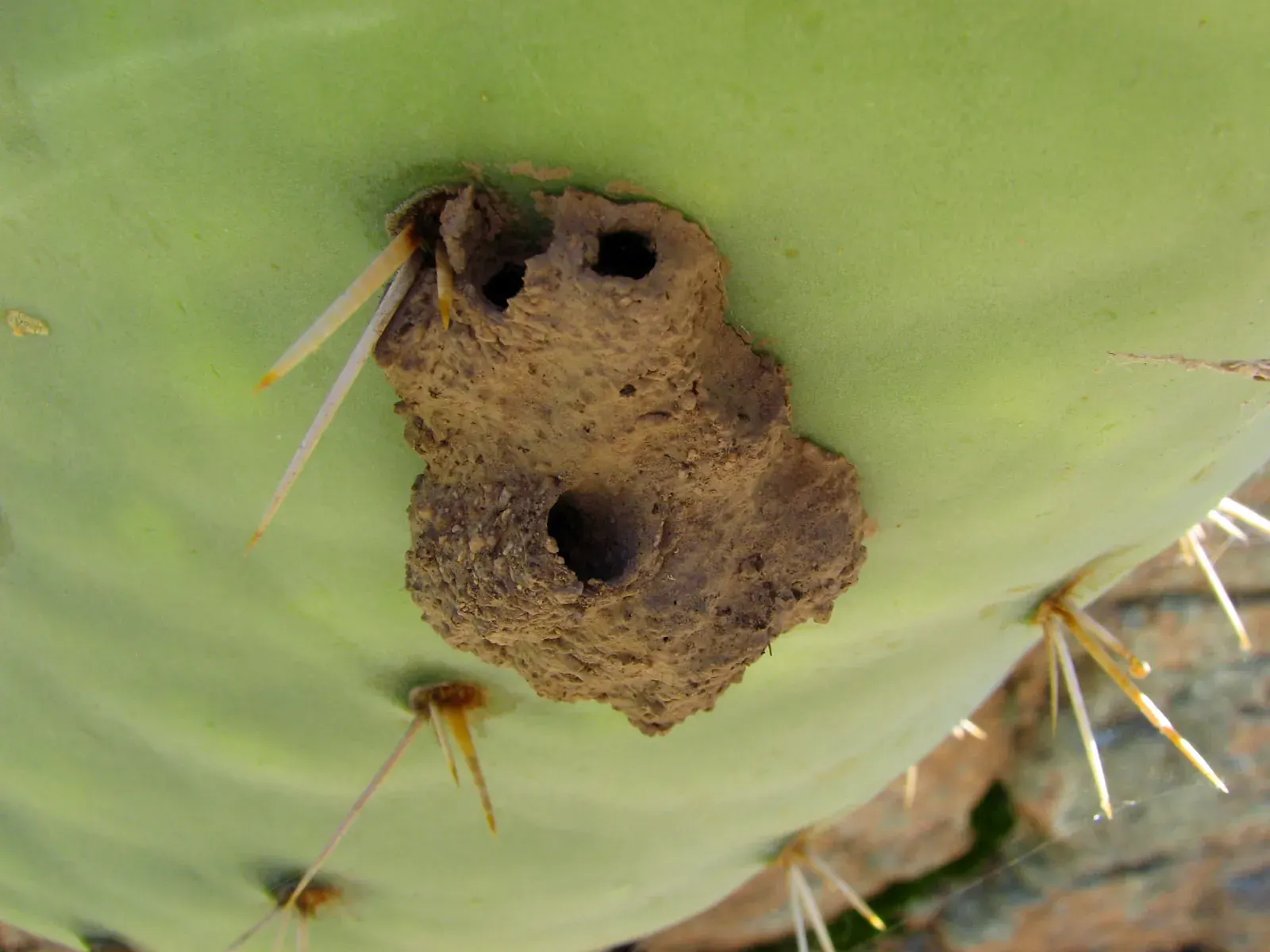
A mud nest on a cactus pad at Arroyo Chico, Tucson, Arizona, in 2008, according to the file page; three round openings show in the dried mud.
"Mud Dauber Nest" by Katja Schulz — https://commons.wikimedia.org/wiki/File:Mud_Dauber_Nest_-_Flickr_-_treegrow.jpg — CC BY 2.0 (https://creativecommons.org/licenses/by/2.0/); modified: saved as WebP at the original 1600 px width
Roll a pea-sized ball of damp garden soil between your fingers and press it flat. A female mud dauber starts each load the same way, with a ball of damp soil carried to the nest in her front legs and jaws. There she presses it onto the cell wall and taps it over and over, buzzing as she works, by the 2022 study's account of earlier work. Keep the experiment to garden soil; for the nests, the photographs and the plate on this page are enough.
What does a mud dauber nest look like?
The black and yellow mud dauber, Sceliphron caementarium, builds a nest of several tube-shaped brood cells laid side by side, according to the 2022 study by Joon S. Park and colleagues in Scientific Reports full text. The study's 131 nests, from five sites in southern Louisiana, measured 2 to 12 cm long, 3 to 7 cm wide and 1 to 4 cm high, with up to 11 cells in a nest.
Each cell is a nursery. Summarizing earlier studies, the same paper says the female provisions a finished cell with paralyzed spiders, up to 25 of them, lays one egg on one spider and caps the cell with more soil before starting the next; by that summary, one cell takes about 30 to 40 soil-ball trips.
Some mud daubers build a single cell instead of a block. Sceliphron formosum, an Australian species described in a 2022 paper in Insects full text, builds single-celled nests about 3 to 3.5 cm long, shaped, in the authors' words, “like sweet potatoes or yams.”
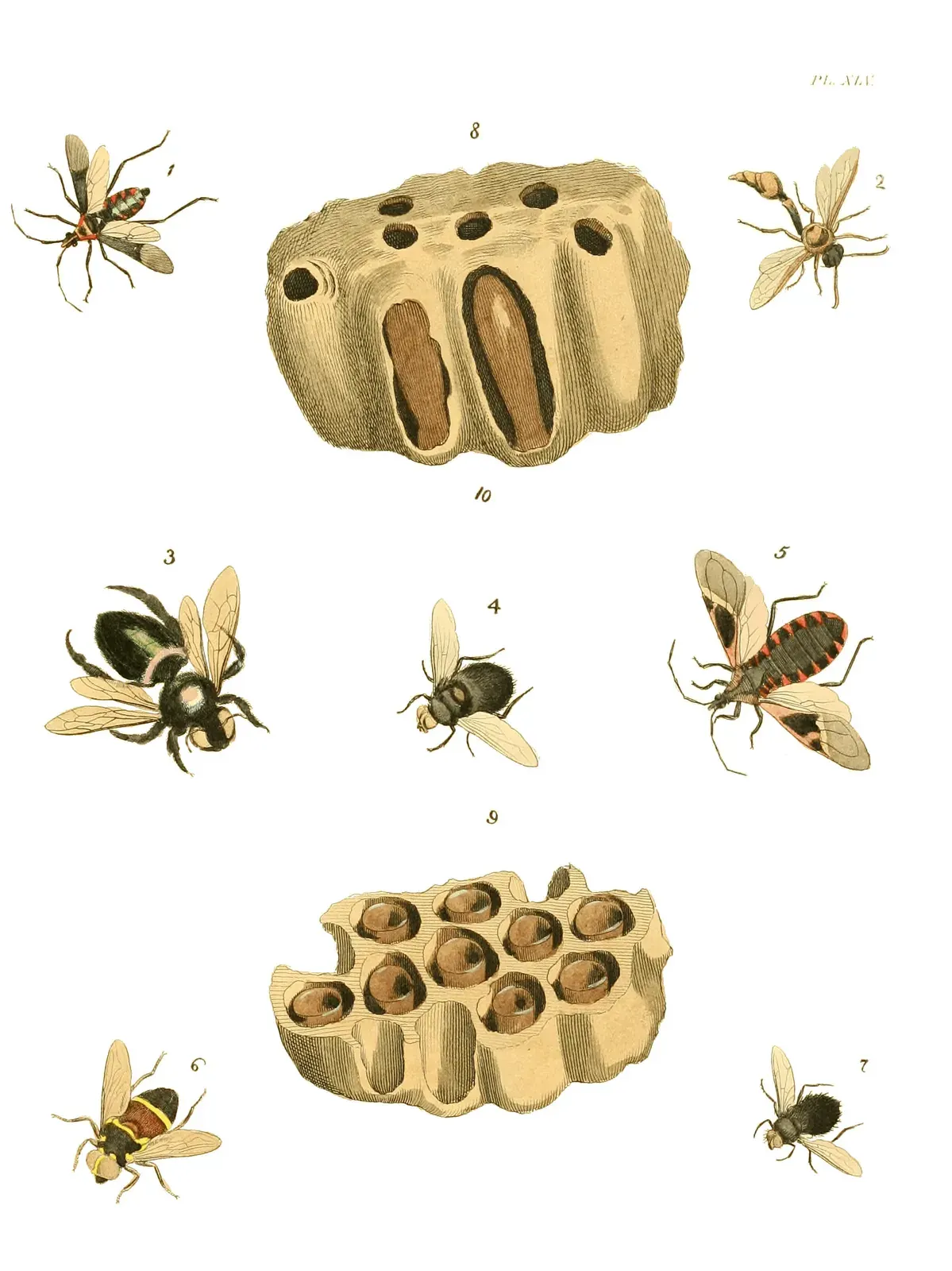
Plate XLV of Illustrations of Exotic Entomology, Vol. I, from the 1837 edition with text by John Obadiah Westwood and plates by Dru Drury dated 1770; figures 8 to 10 show the nest, a section through it and two exposed cocoons of the species now called Sceliphron caementarium, according to the file page.
“Plate XLV, Illustrations of Exotic Entomology (1837 edition, plate dated 1770)”, Dru Drury (plates); John Obadiah Westwood (text); public domain.
Full credit
"Plate XLV, Illustrations of Exotic Entomology (1837 edition, plate dated 1770)" by Dru Drury (plates); John Obadiah Westwood (text) — https://commons.wikimedia.org/wiki/File:Illustrations_of_Exotic_Entomology_I_45.jpg — Public domain (EU: death year not verified (file page states Dru Drury 1725-1803); text by John Obadiah Westwood d. 1893 per library catalog record; US: published before 1931 (plate dated 1770, reproduced from the 1837 edition edited by Westwood; PD-Gutenberg template on the file page); upstream not traced); modified: resized to 1600 px high and saved as WebP; whole plate shown
Dru Drury's engraved plate scanned page draws the same arrangement. In figure 8, round openings line the top of a block of tubes. Two of its tubes are drawn open along their length with the cocoons inside, and the number 10 under the block marks them; in figure 9, a cut across the block shows round cells packed edge to edge.
Other builders on this site work in other materials: the caddisfly case, a tube a larva ties from grains or plant bits with its own silk, and the honeycomb, built cell by cell.
Where does the mud come from?
The female digs soil near the nest site with vibrating jaws, forms it into a ball and carries it back, according to the 2022 Louisiana paper's summary of earlier work. At the nest she rolls the ball into a layer on the cell wall.
Where the paper compared nest soil with the ground nearby, the two did not match. In the Louisiana nests, sand made up 22.5 to 45.5% of the soil, silt 44.9 to 68.8% and clay 8 to 13.4%. At location A, the nest soil had 8.5% more sand, 27.5% more silt and 36% less clay than a control soil collected nearby, in the paper's figures. The authors read this as a sign that the wasps can sort and collect particles of a certain size and type.
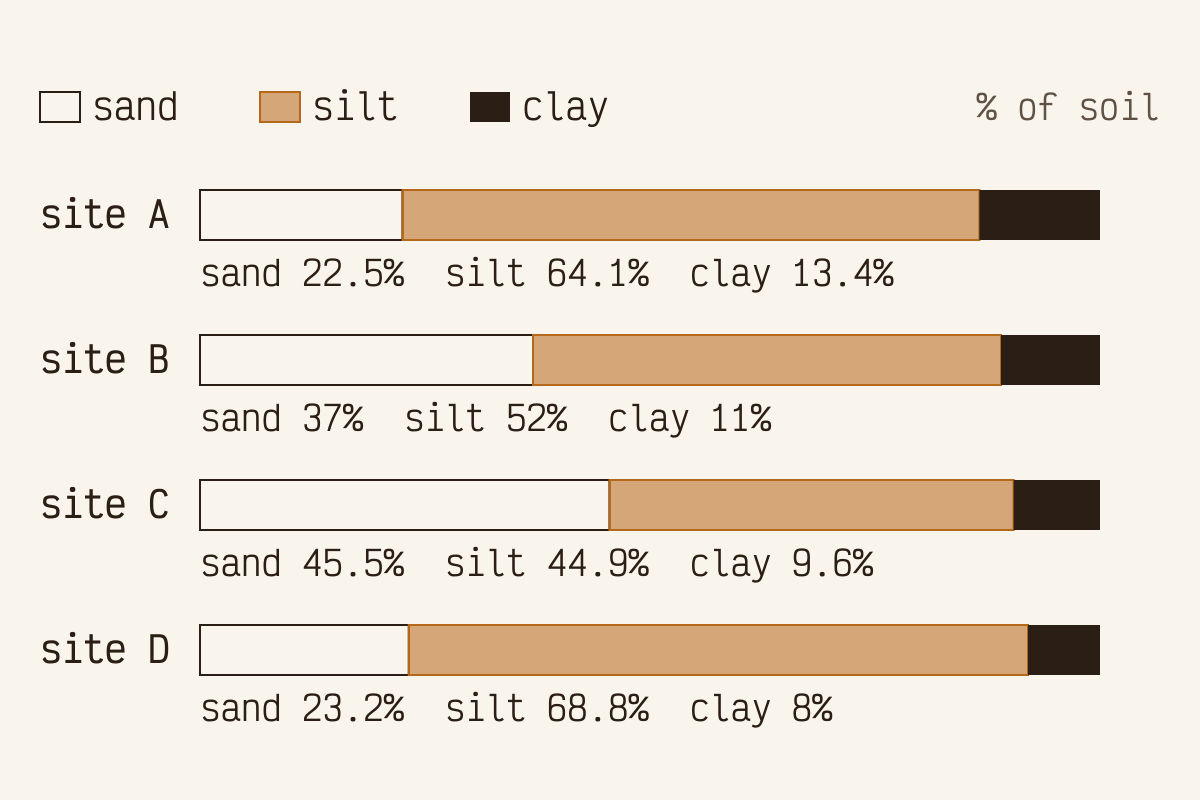
Sand, silt and clay in mud dauber nest soil at four collection sites in southern Louisiana, drawn from the values published in the 2022 study, not traced from its figures.
Recipe stacked bars, 9 units per percent; site A 22.5/64.1/13.4, B 37/52/11, C 45.5/44.9/9.6, D 23.2/68.8/8 (sand/silt/clay %); each site sums to 100
Read this figure as text
- Site A: sand 22.5%, silt 64.1%, clay 13.4%.
- Site B: sand 37%, silt 52%, clay 11%.
- Site C: sand 45.5%, silt 44.9%, clay 9.6%.
- Site D: sand 23.2%, silt 68.8%, clay 8%.
"Mud dauber nest soil: sand, silt and clay at four Louisiana sites" by Spiral, Fern & Honeycomb, https://spiralfernandhoneycomb.com/combs-and-cases/mud-dauber-nest/, licensed under CC BY 4.0 (https://creativecommons.org/licenses/by/4.0/).
Data: Park, Saleh, Lin, Alqrinawi & Lord 2022, Scientific Reports 12:2192, CC BY 4.0 (grain-size fractions)
In engineering terms, a soil is well graded when its grains come in a wide distribution of sizes, so that small particles can fill the spaces between larger ones; the paper places the nest soils in that class, although one of its own grading numbers, the coefficient of curvature, runs as low as 0.5, under the 1 to 4 range that class asks for.
How each chart on this site is drawn is explained under Each figure regrown.
Why is the mud so hard?
The study pushed a small probe 6 mm into the nests, 711 times in all, to measure penetration resistance, the pressure needed to drive the tip in; the median was 408 kPa. By the paper's consistency classes, 51% of samples were hard, 39% very stiff and 10% stiff.
Dry density, the mass of soil grains in a given volume once the water is gone, told the same story: the middle half of the nests ran from 1,483 to 1,699 kg/m³, with a median of 1,588 kg/m³.
To judge those numbers, the authors compared them with nest soil from location A packed in Proctor tests, standard laboratory methods that compact soil in a mold by dropping a rammer on it. The standard test, with an effort of 600 kJ/m³, reached a highest dry density of 1,691 kg/m³, and the modified test, at 2,700 kJ/m³, reached 1,871 kg/m³.
The nests' middle half sits around the standard result. Samples packed in the standard test also resisted the probe about as much as the nests did, and from that comparison the authors call the tapping “effective to compact soils.”
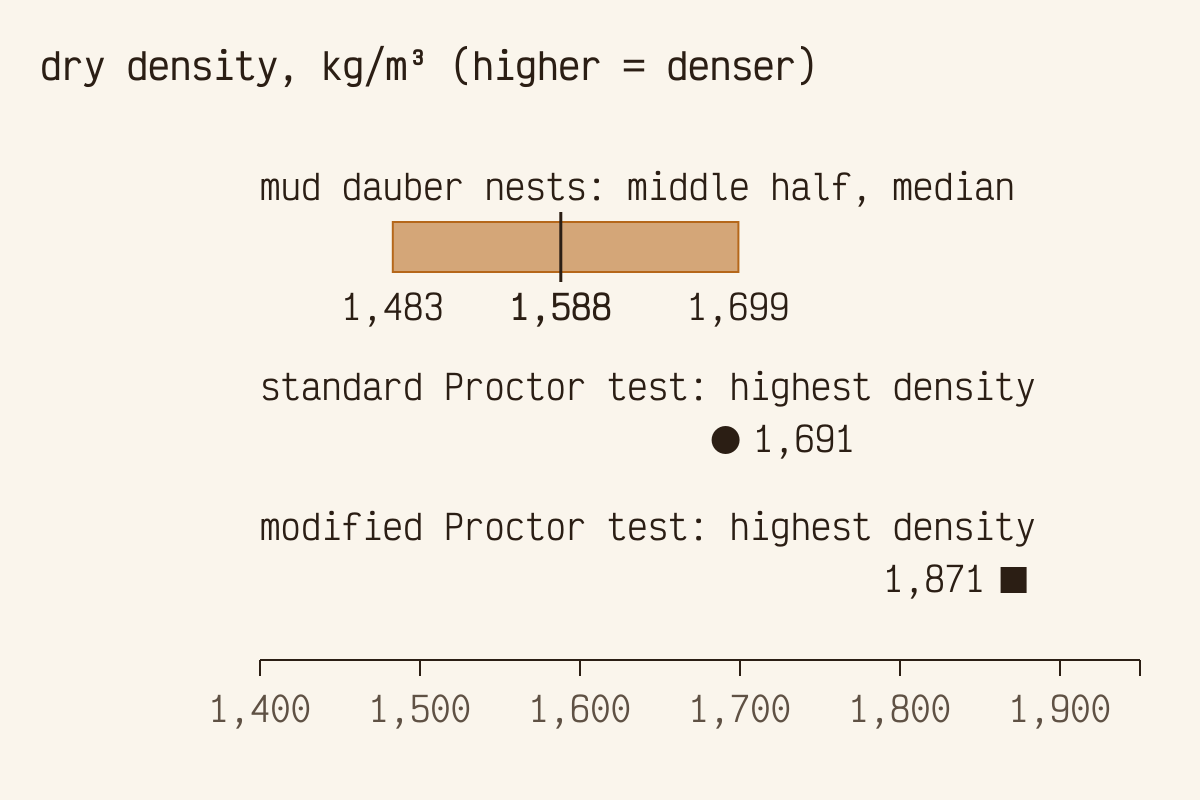
Dry density of mud dauber nests compared with nest soil from location A packed in two standard lab tests, drawn from data published in the 2022 study; the nest bar spans the middle half of the measured nests.
Recipe axis 1400-1950 kg/m3; nests Q1=1483, median=1588, Q3=1699; standard Proctor max=1691 (600 kJ/m3); modified Proctor max=1871 (2700 kJ/m3)
"Mud dauber nest soil compared with lab-compacted soil: dry density" by Spiral, Fern & Honeycomb, https://spiralfernandhoneycomb.com/combs-and-cases/mud-dauber-nest/, licensed under CC BY 4.0 (https://creativecommons.org/licenses/by/4.0/).
Data: Park, Saleh, Lin, Alqrinawi & Lord 2022, Scientific Reports 12:2192, CC BY 4.0 (dry densities)
The paper names four reasons the walls end up hard and dense:
- The repeated tapping, which the authors compare to vibratory compaction.
- Strong capillary pull between grains, because the dry nests hold little water (0.65 to 4.12% moisture).
- The well-graded mix of sand, silt and clay.
- Clay minerals that coat and cement the larger grains.
One test pointed away from saliva: when nest soil was crushed and packed again in the standard test to a similar density and moisture, its penetration resistance matched the nests', and the authors concluded that saliva does not significantly add to the strength.
Because the study measured finished nests and laboratory-packed soil without testing tapping on its own, this site lists the tapping as a candidate cause. The score has four steps: ball, layer, tap, dry.
| Measure (black and yellow mud dauber nests, 2022 study full text) | Value |
|---|---|
| Nests collected | 131 |
| Penetration resistance, median | 408 kPa |
| Dry density, middle half | 1,483 to 1,699 kg/m³ |
| Dry density, median | 1,588 kg/m³ |
| Standard Proctor test on location A soil, highest dry density | 1,691 kg/m³ |
| Modified Proctor test on location A soil, highest dry density | 1,871 kg/m³ |
| Moisture content, range | 0.65 to 4.12% |
This table as CSV (mud-dauber-nest-soil.csv) (file notes: source and license) Data: Park, Saleh, Lin, Alqrinawi & Lord 2022, Investigating physical and mechanical properties of nest soils used by mud dauber wasps from a geotechnical engineering perspective, Scientific Reports 12:2192, CC BY 4.0, https://pmc.ncbi.nlm.nih.gov/articles/PMC8828900/
Who else moves into an old nest?
A finished nest does not stay with its builder. In the 2022 Insects study, David Yuan and colleagues gathered 698 Sceliphron formosum nests around Canberra, Australia, from August to October 2018. They reared what was inside the 655 nests that held live insects, from 53 sites.
Only 24.7% of those nests held the builder itself. In 58.6%, the tenant was a secondary user that had moved in after the mud dauber left: Pison wasps in 266 nests, potter wasps in 101, and two bees, Hylaeus nubilosus and Megachile aurifrons. Parasitoids, by-catch carried in on spiders and scavenging Anthrenus beetles made up most of the rest.
In all, the study recorded 16 families and 23 species of insects from three orders: Hymenoptera, Diptera and Coleoptera. In the authors' words, “not only do S. formosum larvae use the nests, but parasitoids and any opportunistic insects also utilize the empty nests as shelters.” They propose that the wasp may act as a keystone species in towns, a question they frame as a first step, not a settled result.
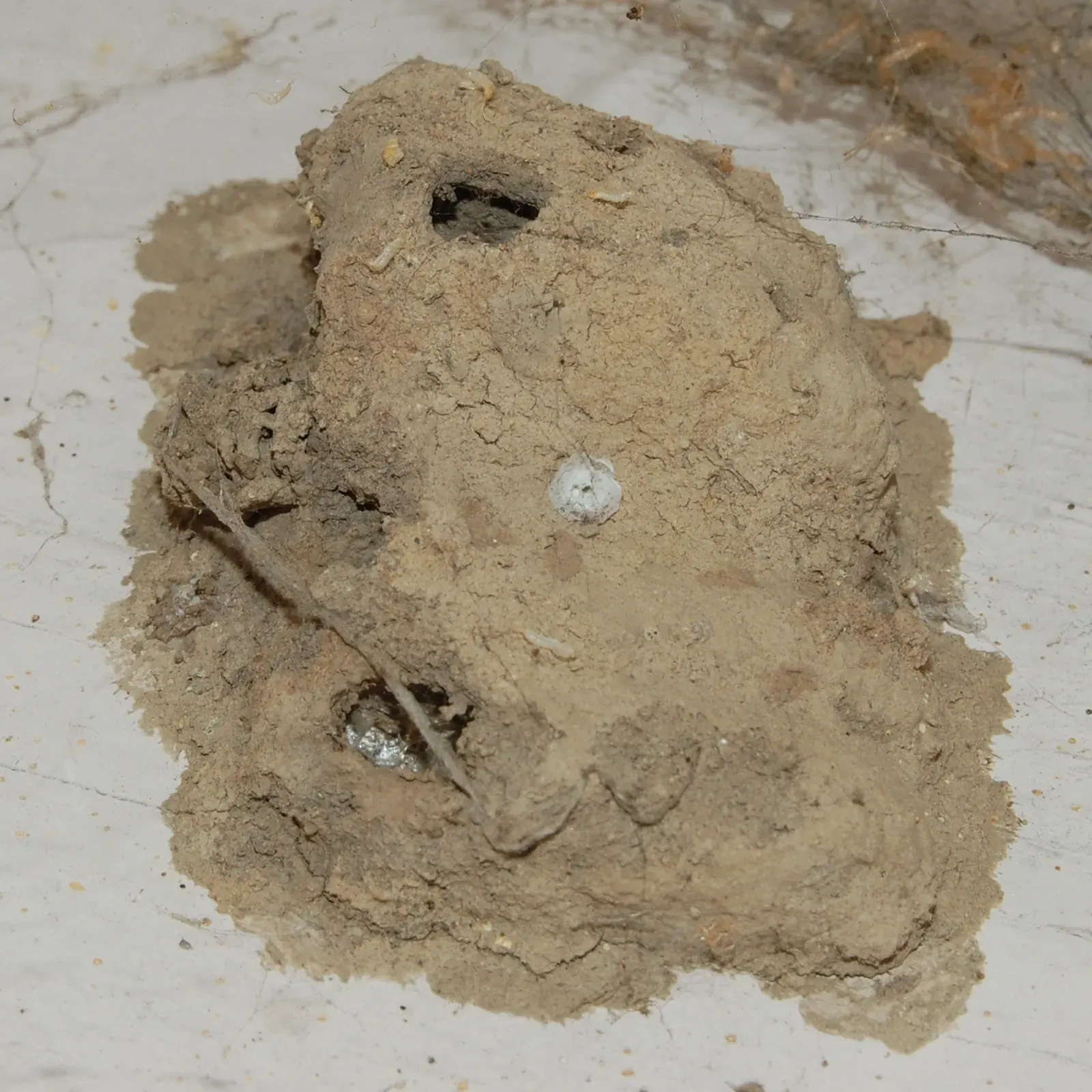
A black and yellow mud dauber nest (Sceliphron caementarium) in San Jose, California, in 2010, according to the file page; dark openings show in the weathered mud.
"Sceliphron caementarium nest" by Eugene Zelenko — https://commons.wikimedia.org/wiki/File:Sceliphron_caementarium-Nest-1.jpg — CC BY-SA 4.0 (https://creativecommons.org/licenses/by-sa/4.0/); modified: saved as WebP at the original 1600 px width
This nest is from the black and yellow mud dauber, which builds several cells side by side, not from the single-celled Australian species in the study, so it shows only what an old mud nest can look like.
| Group (Sceliphron formosum nests, 2022 study full text) | Nests occupied |
|---|---|
| Nest builder, Sceliphron formosum | 162 |
| Pison wasps (Crabronidae) | 266 |
| Potter wasps (Eumeninae) | 101 |
| Hylaeus nubilosus bee | 15 |
| Megachile aurifrons bee | 2 |
| Anthrenus beetles (scavengers) | 33 |
This table as CSV (mud-dauber-nest-associates.csv) (file notes: source and license) Data: Yuan, Beckman, Florez Fernandez & Rodriguez 2022, Nest Ecology and Prey Preference of the Mud Dauber Wasp Sceliphron formosum, Insects 13(12):1136, CC BY 4.0, https://pmc.ncbi.nlm.nih.gov/articles/PMC9784124/
Sources
- Park JS, Saleh NS, Lin H, Alqrinawi H, Lord NP (2022). Investigating physical and mechanical properties of nest soils used by mud dauber wasps from a geotechnical engineering perspective. Scientific Reports 12:2192. doi:10.1038/s41598-022-06162-2. pmc.ncbi.nlm.nih.gov/articles/PMC8828900/Read: full text; Introduction, Methods, Results and DiscussionsText license: CC BY 4.0 (terms)
- Yuan D, Beckman J, Florez Fernandez J, Rodriguez J (2022). Nest Ecology and Prey Preference of the Mud Dauber Wasp Sceliphron formosum (Hymenoptera: Sphecidae). Insects 13(12):1136. doi:10.3390/insects13121136. pmc.ncbi.nlm.nih.gov/articles/PMC9784124/Read: full text; Simple Summary, Methods, Results (Table 3) and DiscussionText license: CC BY 4.0 (terms)
- Drury D (plates, 1770); Westwood JO (text, 1837). Illustrations of Exotic Entomology, Vol. I, Plate XLV, figs. 8-10. Public domain (plates published 1770, text 1837; Drury death year not verified; Westwood d. 1893 per library catalog record). commons.wikimedia.org/wiki/File:Illustrations_of_Exotic_E…Read: scanned page; Plate XLV, figs. 8-10 viewed on the scan; the plate key and species name are as transcribed on the file page

Cite this page
Spiral, Fern & Honeycomb. “Mud Dauber Nest: Tapping May Pack the Mud Walls Hard.” Published November 23, 2026. https://spiralfernandhoneycomb.com/combs-and-cases/mud-dauber-nest/ (accessed the day you read it).
- How each figure and source is checked
- Retunings: every correction, dated
- Report an error on this page (contact@spiralfernandhoneycomb.com)
More from Combs & Cases
Why Are Honeycombs Hexagonal? Likely Six Equal Neighbors
Picture credit
"Honey Comb Structure" by Gavin Mackintosh from South Molton, United Kingdom — https://commons.wikimedia.org/wiki/File:Honeycomb_structure_(6248780733).jpg — CC BY 2.0 (https://creativecommons.org/licenses/by/2.0/); modified: downscaled from 5066 x 3330 to 1400 x 920 pixels
Paper Wasp Nest: One Study Found Order Only Over Short Range
Picture credit
"Polistes exclamans nest" by Larry D. Moore — https://commons.wikimedia.org/wiki/File:Polistes_exclamans_nest.jpg — CC BY 4.0 (https://creativecommons.org/licenses/by/4.0/); modified: resized to 1600 px wide and saved as WebP
Caddisfly Case: Three Separate Origins in a 2024 Family Tree
Picture credit
"Lepidostoma hirtum larva" by Hallvard Elven, Naturhistorisk museum, Universitetet i Oslo — https://commons.wikimedia.org/wiki/File:Lepidostoma_hirtum_larva.jpg — CC BY 4.0 (https://creativecommons.org/licenses/by/4.0/); modified: cropped to a 3:2 frame around the larva and the front of its case (box 110, 40, 1090, 693 of 2000 x 808, from the original orig-Lepidostoma_hirtum_larva.jpg): the whole larva and about three complete case sections, with the rear of the case left out at the right; original not altered, saved as WebP at the crop's own size, 980 x 653, not enlarged