Mud Cracks: In Lab Clay Dried Again, T Joints Drift Toward Y
Pattern entry Spiral, Fern & Honeycomb Published
In brief
When a layer of mud dries for the first time, each new crack runs until it meets an older one and tends to join it at a right angle, so most joints look like the letter T. In laboratory clay that was wetted and dried again and again, a 2013 review by Lucas Goehring reports that the angles at the joints moved toward the 120 degrees of a three-way Y full text. Over many cycles, the review argues, a network of rough rectangles can drift toward one of more evenly angled, hexagon-like cells.
Pattern card
- Pattern
- First cracks tend to meet older cracks at right angles (T joints); in laboratory clay wetted and dried again and again, the joints drift toward three-way Y joints near 120 degrees
- Where
- Drying mud, clay and starch layers; mud cracks kept in old rock
- Made by
- growth: established (Goehring 2013 full text)
- Working recipe
- 2 rules / 0 parameters: each new crack grows until it meets an older one and tends to turn to meet it at a right angle; on each later drying the cracks reopen near the old paths, in a changing order
- Key source
- Goehring 2013, Evolving fracture patterns, Phil. Trans. R. Soc. A 371, 20120353 full text
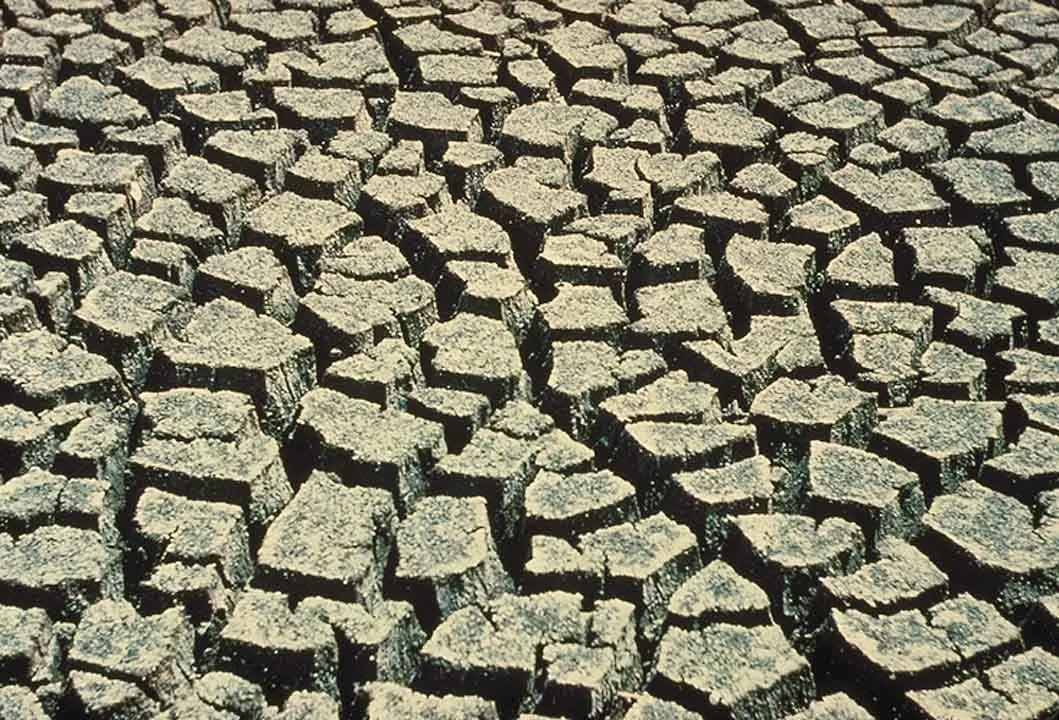
Dried mud broken into thick slabs, from the Everglades National Park photo collection, according to the file page.
"Dry Mud, NPSPhoto" by Everglades NPS from Homestead, Florida, United States — https://commons.wikimedia.org/wiki/File:Dry_Mud,_NPSPhoto_(9257940252).jpg — Public domain (Work of a National Park Service employee made as part of official duties; public domain in the United States under 17 U.S.C. §105; outside the United States the Commons PD-USGov-NPS template is the only basis given; upstream not traced)
Pour a thin layer of cornstarch and water into a dish and leave it to dry. The dried layer breaks into pieces, and the way its cracks meet keeps a partial record of the order in which they formed. According to the 2013 review, experiments in thin starch layers have shown that this timing is written into the shape of the T joints. A dish on the kitchen counter shows the same first step as a dried pond bed, with no need to walk onto one.
Why do new mud cracks meet in T's?
Drying mud shrinks. The ground under it does not, so the thin layer comes under tension until it breaks. Goehring's review sets out why the first breaks line up the way they do: a crack relieves stress better at right angles to its own face than along it. A later crack growing toward an older one therefore tends to curve to meet it at a right angle, the direction that releases the most stored energy as it grows.
Such a meeting makes a T. The older crack runs straight through, and the newer one stops against it.
In the review's words, these T-junctions “encode time information that can be used to partially reconstruct the order in which cracks form” (Goehring 2013, section 2). Cracking also stops before the pieces get very small. For a soft layer stuck to a hard base, the review reports that experiments found the crack spacing levels off at about 3 times the thickness of the layer, so thicker mud makes larger pieces.
What does repeated cracking look like in a drawing?
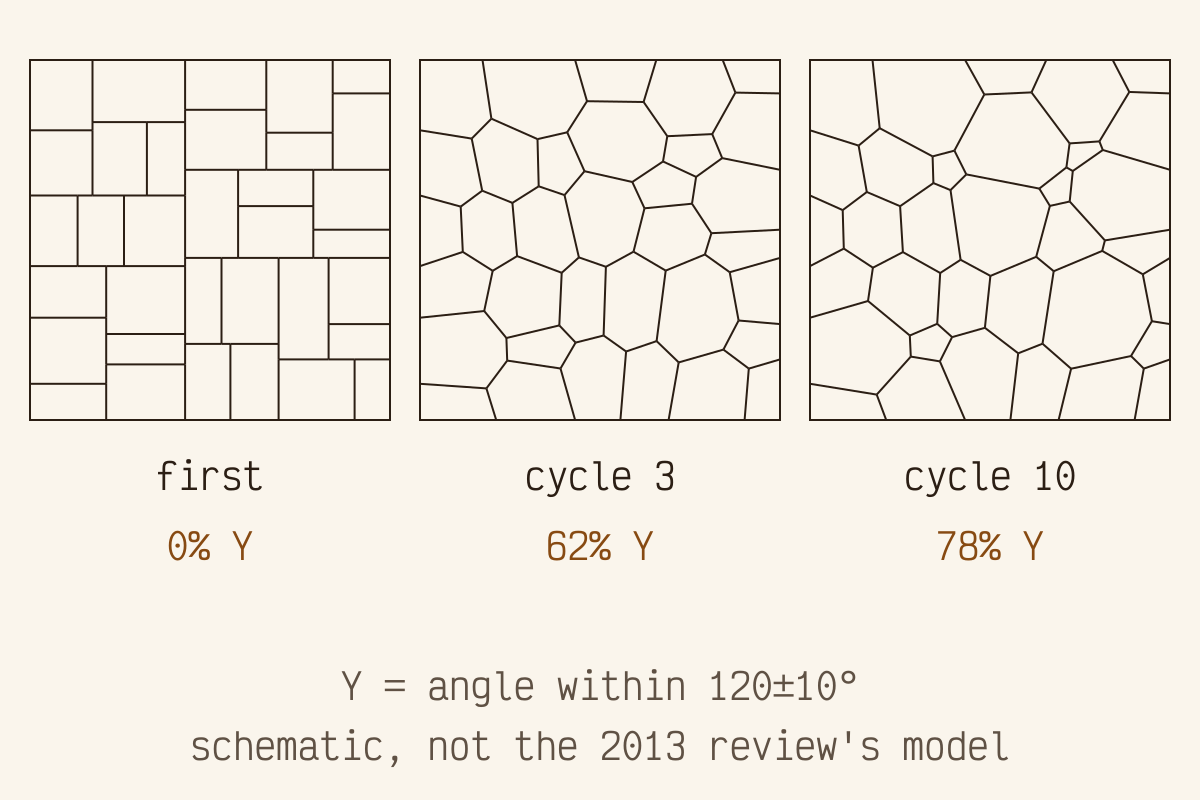
This site's schematic, not the 2013 review's model or data: 33 straight cuts make each joint a T, then 10 cycles reshape them. In the schematic, angles within 10 degrees of 120 rise from 0% to 62% after cycle 3 and 78% after cycle 10; no two cracks cross and every cell keeps a positive area after 10 cycles.
Recipe unit square, 33 straight cuts (seed 8), each across the largest cell, perpendicular to its longer bounding-box side (vertical on a tie), at a uniform 0.3 to 0.7 of that side, ending >= 0.02 from earlier junctions (else redrawn, up to 200 tries); square-edge junctions fixed; each cycle every inner junction moves alpha=0.35 toward its neighbors' Fermat point (shuffled order, seed 108); cycles=10
Read this figure as text
- First drying in the schematic: all 46 inner joints are T's, with angles of 90 and 180 degrees, and 0% of angles fall within 120 plus or minus 10 degrees.
- After cycle 3 of the schematic: 62% of angles fall within 120 plus or minus 10 degrees.
- After cycle 10 of the schematic: 78% of angles fall within 120 plus or minus 10 degrees.
"Mud cracks, T junctions turning to Y (schematic)" by Spiral, Fern & Honeycomb, https://spiralfernandhoneycomb.com/tilings/mud-cracks/, licensed under CC BY 4.0 (https://creativecommons.org/licenses/by/4.0/).
Data: site computation
The drawing is a geometric stand-in for the change the review describes, not an experiment. Each cycle nudges every inner joint 0.35 of the way toward the point where its three cracks would meet at 120 degrees, and that 0.35 is a setting chosen for this page, not a measured rate. All 11 rows, from first drying to cycle 10, are in the data file.
Joint angles in the schematic, cycle by cycle (CSV) (file notes: source and license) Data: site computation
Do repeated cracks turn into hexagons?
The review sets out three conditions for a crack network to change over time. The cracks have to open again and again, the old crack paths have to act as lines of weakness that guide the next ones, and the order in which the cracks open has to be free to change from one cycle to the next. If the layer forgets its old cracks, each drying makes a fresh pattern of rectangles; if it remembers them too well, the same pattern repeats.
When all three hold, the review argues, the joints drift. A crack that reopens near an old joint is pulled slightly off its first path, so the joint shifts and its angles even out. If each branch of a joint gets to crack first equally often, symmetry leaves three equal angles of 120 degrees: a Y.
To test this, Goehring dried layers of bentonite clay in glass dishes under a heat lamp, misted them with water, and dried them again. In four dishes between 2.6 and 6.3 mm thick, followed over 10 wetting and drying cycles, the joints moved most in the first 3 or 4 cycles and then drifted more slowly. The angles where cracks met showed “a gradual but systematic equalisation of the crack angles towards 120°” (Goehring 2013, section 4).
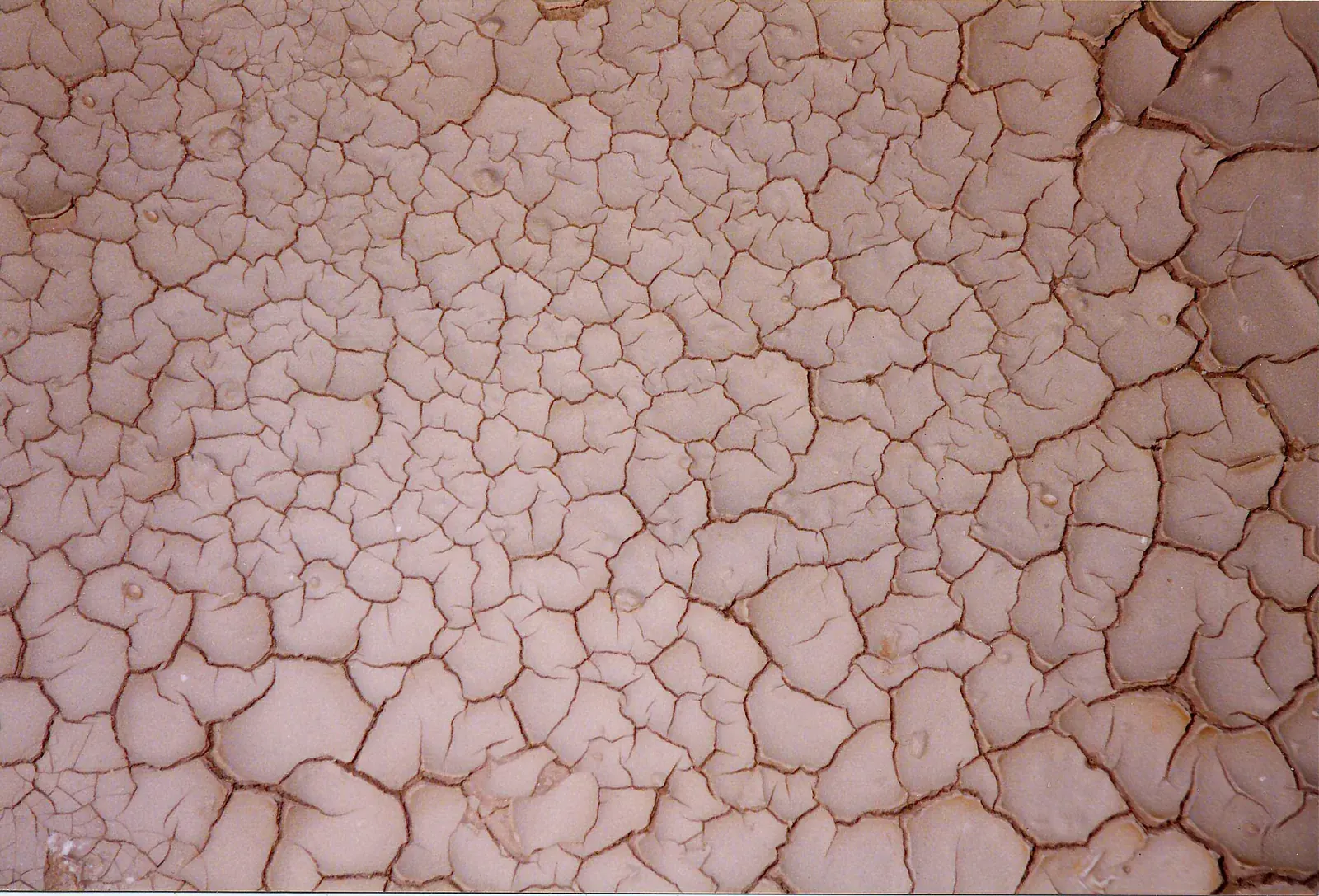
Drying mud on the floor of a shallow pool in Sicily, dated 1998 on the file page, which describes the cracks in the center as mainly 120-degree cracks.
"Drying mud with 120 degree cracks, Sicily" by Ian Alexander — https://commons.wikimedia.org/wiki/File:Drying_mud_with_120_degree_cracks,_Sicily.jpg — CC BY-SA 3.0 (https://creativecommons.org/licenses/by-sa/3.0/); modified: scaled down to 1600 x 1087 pixels and saved as WebP; no crop, no color change
A figure in the same review sets two laboratory mud-crack patterns side by side: one after a single drying, and one after twenty-five cycles of wetting, drying and cracking. The review credits that image to an earlier study by the same group, published in Soft Matter in 2010 bibliographic.
Why six neighbors either way?
Hexagons are not needed for six neighbors, though. The review points out that as long as cracks do not cross and only three meet at each joint, Euler's formula sets the average number of neighbors of a piece at six, in a network of T's as much as in a network of Y's. What repeated drying changes is the angles at the joints.
That is a different rule from the Voronoi diagram, which splits a plane by nearest neighbor and builds each cell around a seed point.
What can old mud cracks tell you?
Mud cracks can outlast the mud. The National Park Service page on the geology of Wupatki National Monument in Arizona lists “ancient mud cracks”, along with ripple marks and the imprints of shells, among the signs that its Permian and Triassic rocks record “a much wetter landscape” full text. A drying crack needs a wet layer that then dries, so a cracked bed in rock points to a surface that once dried out.
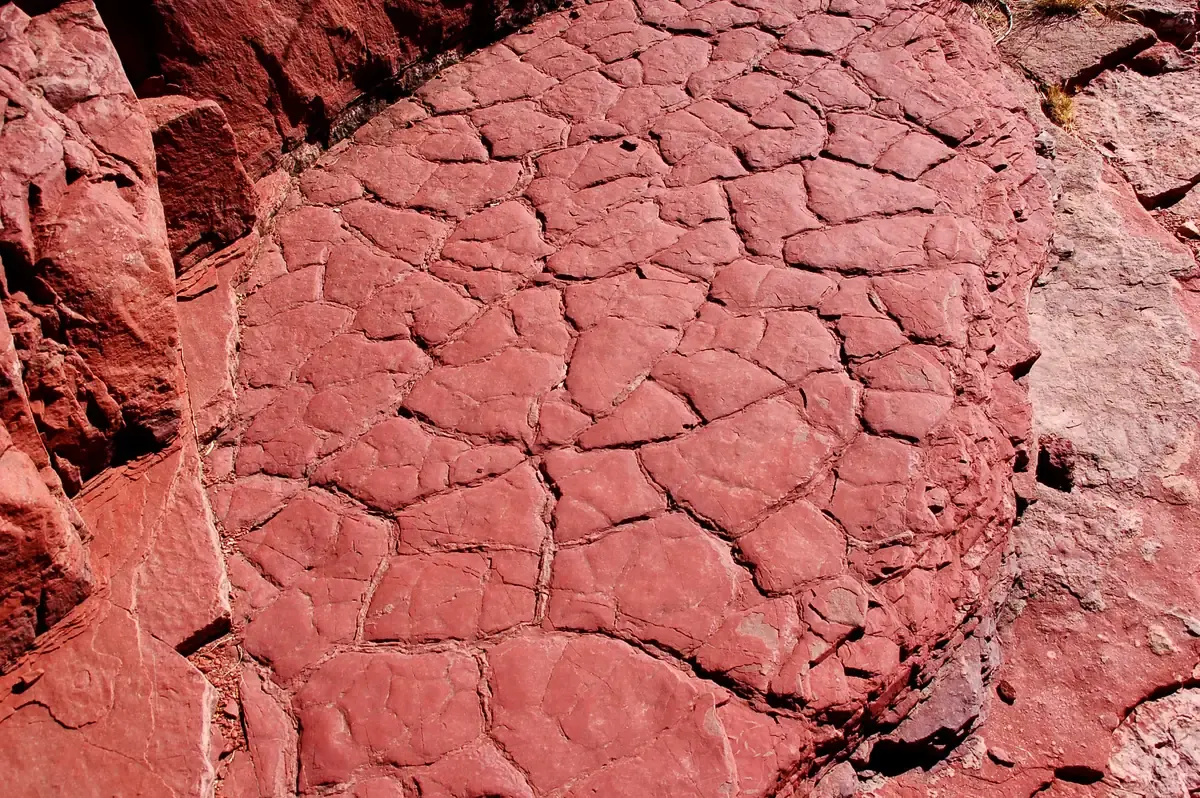
A bed of the Hakatai Shale in Grand Canyon National Park. The file page describes the formation as laid down while a shallow sea gave way to coastal mud flats, with mudcracks among its features.
"Grand Canyon Supergroup Hakatai Shale 0002" by NPS photo by Carl Bowman, Grand Canyon National Park — https://commons.wikimedia.org/wiki/File:Grand_Canyon_Supergroup_Hakatai_Shale_0002_-_Flickr_-_Grand_Canyon_NPS.jpg — CC BY 2.0 (https://creativecommons.org/licenses/by/2.0/); modified: scaled down to 1200 x 798 pixels and saved as WebP (quality 65, to keep the web copies under 250,000 bytes); no crop, no color change
The 2013 review adds what the joints themselves may record. T-shaped joints keep part of the order in which the cracks formed. A hexagonal pattern, by the review's model, must have had the chance to evolve over many opening cycles.
The reverse need not hold. A crack pattern may heal enough between openings to erase its memory and start over, so a network of T's is not necessarily young. The same review applies its model to cracks in frozen ground and in cooling lava, subjects outside this page.
Wet mud has other fates, too. The mud dauber nest is mud packed into walls by a wasp.
Sources
- Goehring L (2013). Evolving fracture patterns: columnar joints, mud cracks, and polygonal terrain. Philosophical Transactions of the Royal Society A 371:20120353. doi:10.1098/rsta.2012.0353. arXiv 1211.6762. arxiv.org/abs/1211.6762Read: full text; arXiv v2 (13 June 2013), abstract, sections 1 to 4 and Figures 1 to 6
- National Park Service. Geologic Formations, Wupatki National Monument. Last updated August 6, 2024. www.nps.gov/wupa/learn/nature/geologicformation…Read: full text; the web page text
Cite this page
Spiral, Fern & Honeycomb. “Mud Cracks: In Lab Clay Dried Again, T Joints Drift Toward Y.” Published November 23, 2026. https://spiralfernandhoneycomb.com/tilings/mud-cracks/ (accessed the day you read it).
- How each figure and source is checked
- Retunings: every correction, dated
- Report an error on this page (contact@spiralfernandhoneycomb.com)
More from Tiles, Cracks & Foams
Alhambra Patterns: The Symmetry Count Depends on the Rules
Picture credit
"Plate 43, The Grammar of Ornament (1868)" by Owen Jones — https://commons.wikimedia.org/wiki/File:Owen_Jones_-_Grammar_of_Ornament_-_1868_-_plate_043_-_300ppi.jpg — Public domain (EU: Owen Jones d. 1874 per library catalog record; US: published before 1931 (1868); scanned from a later reprint of the 1868 folio edition, according to the file page); modified: whole plate resized from 2433 x 3807 to 820 x 1283 pixels and saved as WebP
Soap Film: In Stable Dry Foam, Walls Meet in Threes at 120°
Picture credit
"Bubbles forming a geometric pattern" by TheresNothingOutThere — https://commons.wikimedia.org/wiki/File:Bubbles_forming_a_geometric_pattern.jpg — CC BY 4.0 (https://creativecommons.org/licenses/by/4.0/); modified: rotated upright by the camera's orientation tag, scaled down to 1200 x 1600 pixels and saved as WebP (quality 55, to keep the web copies under 250,000 bytes)

Voronoi Diagram: Nothing in the Rule Asks for Hexagons
Picture credit
"Dragonfly close up macro photo" by U.S. Fish and Wildlife Service — https://commons.wikimedia.org/wiki/File:Dragonfly_close_up_macro_photo.jpg — Public domain (Work of a U.S. Fish and Wildlife Service employee made as part of official duties; public domain in the United States under 17 U.S.C. §105; outside the United States the Commons PD-USGov-FWS template is the only basis given; upstream not traced (the file page cites a stock-image site as its source)); modified: cropped to remove the inset thumbnail at top left (the top 160 px strip of the 2,048 x 1,312 original), scaled to 1600 x 900 and saved as WebP; no color change