Voronoi Diagram: Nothing in the Rule Asks for Hexagons
Pattern entry Spiral, Fern & Honeycomb Published
In brief
A Voronoi diagram splits a flat surface among seed points: each cell holds the points closer to its own seed than to any other, and each wall lies halfway between two neighboring seeds. In this page's drawing, 25 rounds of Lloyd relaxation evened out 36 seeds and raised the six-sided share of inner cells from 25% (3 of 12) to 73% (8 of 11). Dragonfly cross-veins are a candidate example: a 2018 study by Jordan Hoffmann and colleagues full text found they resemble a Voronoi pattern of evenly spaced seeds, without proving the mechanism.
Pattern card
- Pattern
- A plane split into cells around seed points: each cell holds the points closer to its own seed than to any other, and each wall lies on the halfway line between two neighboring seeds
- Where
- Secondary veins of dragonfly and damselfly wings, as a candidate model; drawings that resemble honeycomb walls and gaps between tree crowns
- Made by
- packing: simulation-only · growth: candidate (Hoffmann et al. 2018 full text)
- Working recipe
- 2 rules / 2 parameters: give each point to its nearest seed; move each seed to the center of its cell and redraw; parameters: number of seeds, number of rounds
- Key source
- Hoffmann et al. 2018, A simple developmental model recapitulates complex insect wing venation patterns, PNAS 115(40):9905-9910 full text
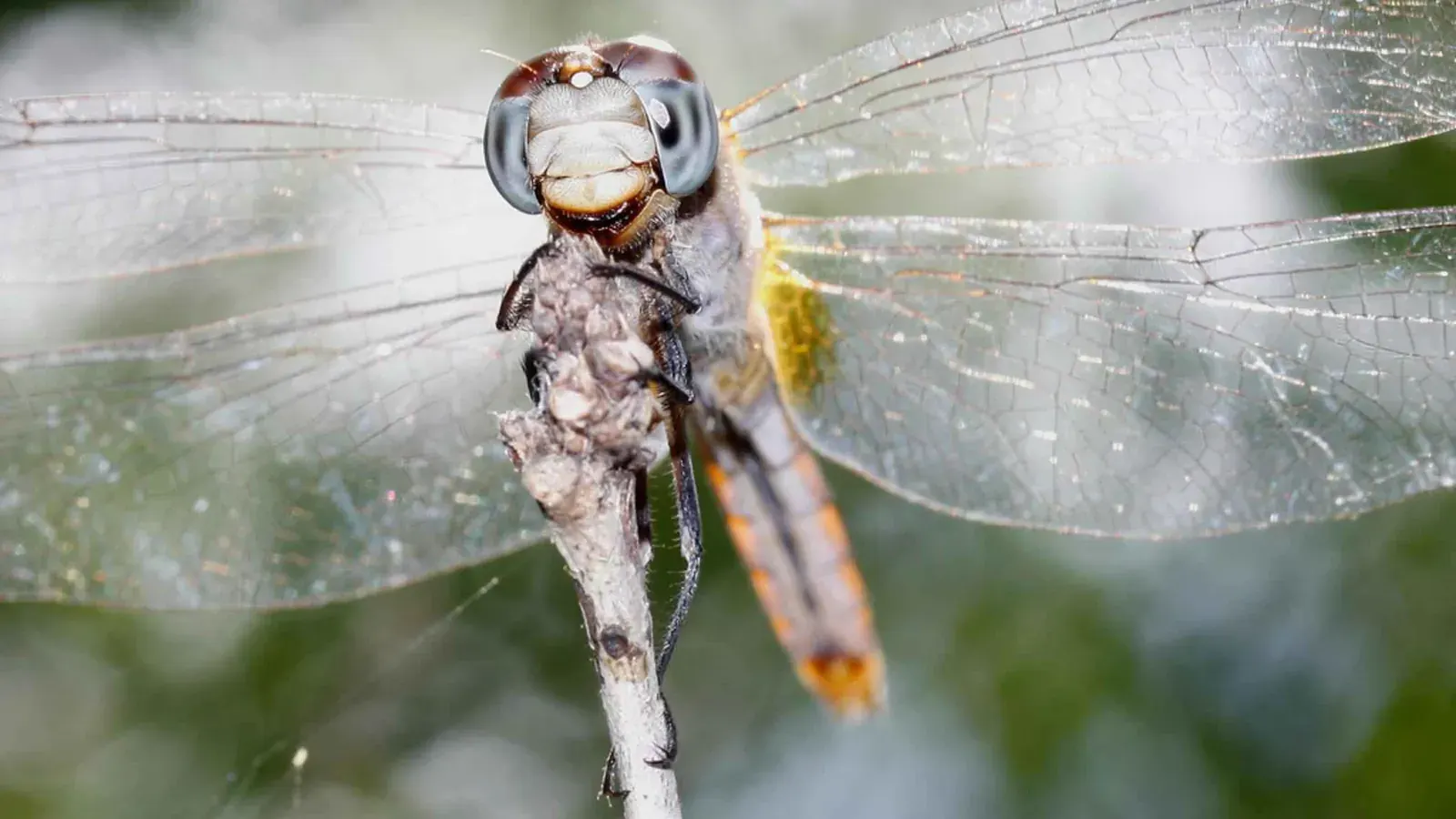
A dragonfly resting on a twig, its wings divided by fine veins into small many-sided cells. A U.S. Fish and Wildlife Service photograph, according to the file page.
“Dragonfly close up macro photo”, U.S. Fish and Wildlife Service; public domain.
Full credit
"Dragonfly close up macro photo" by U.S. Fish and Wildlife Service — https://commons.wikimedia.org/wiki/File:Dragonfly_close_up_macro_photo.jpg — Public domain (Work of a U.S. Fish and Wildlife Service employee made as part of official duties; public domain in the United States under 17 U.S.C. §105; outside the United States the Commons PD-USGov-FWS template is the only basis given; upstream not traced (the file page cites a stock-image site as its source)); modified: cropped to remove the inset thumbnail at top left (the top 160 px strip of the 2,048 x 1,312 original), scaled to 1600 x 900 and saved as WebP; no color change
Drop ten dots on a sheet of paper and draw a line halfway between each pair of neighbors. Trim the lines where they cross, and they close into cells, one around each dot. Nothing in that rule asks for hexagons, yet in this page's drawing, when the dots were spread more evenly, more of the cells came out six-sided.
A pencil and a ruler are all the experiment needs.
How do you draw a Voronoi diagram?
The rule has one idea: each point on the paper belongs to the seed it is closest to. Two seeds split the paper along a single line, the perpendicular bisector, which crosses the gap between them at its midpoint and at a right angle. Points on one side are nearer the first seed, and points on the other side are nearer the second.
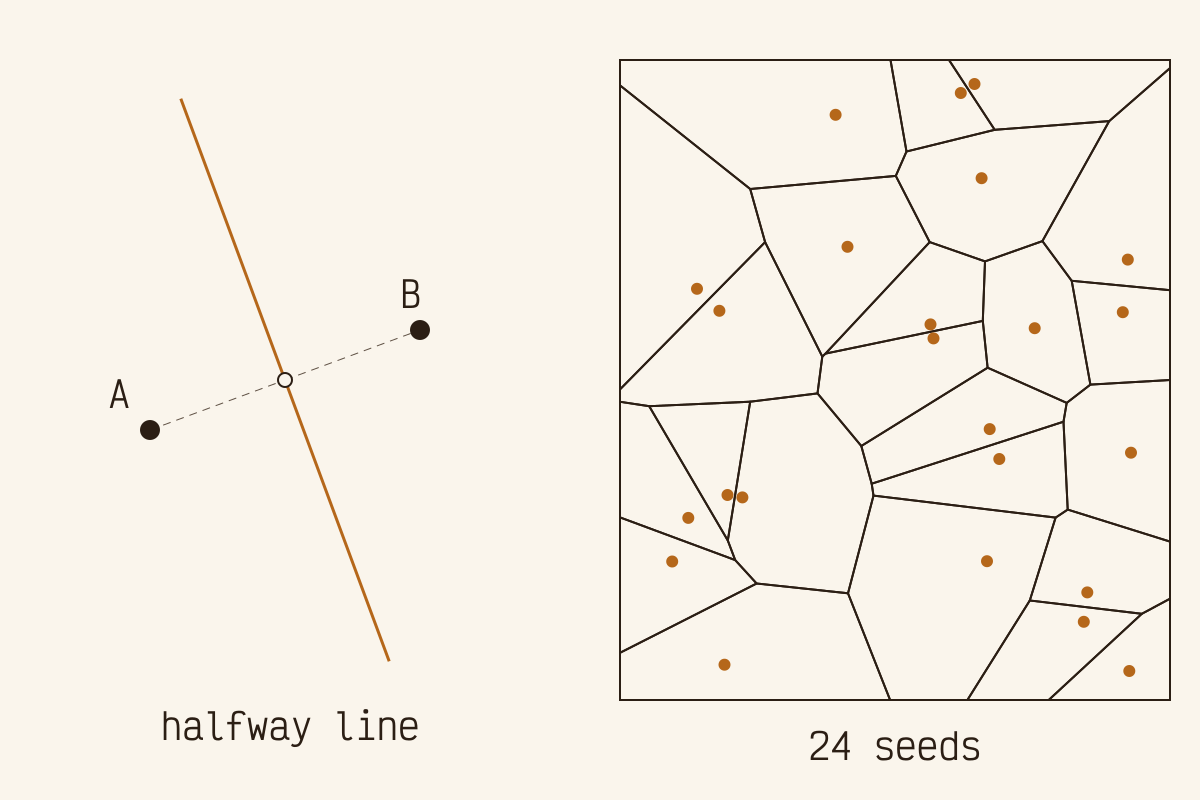
Left: two seeds and the halfway line between them. Right: 24 scattered seeds and their cells, cut from a rectangular frame by halfway lines. The cell method was cross-checked against an independent Voronoi computation (589 cells, vertex difference under 1e-10).
Recipe seeds=24, drawn uniformly in a 500 x 600 box inside a 550 x 640 frame; seed=16; cells by halfway lines (half-plane clipping)
"Voronoi cells from halfway lines" by Spiral, Fern & Honeycomb, https://spiralfernandhoneycomb.com/tilings/voronoi-diagram/, licensed under CC BY 4.0 (https://creativecommons.org/licenses/by/4.0/).
Data: site computation
With many seeds, the drawing goes in four steps:
- Mark the seeds.
- For each pair of nearby seeds, draw the halfway line between them.
- Keep only the stretch of each line that is closer to those two seeds than to any other seed, and erase the rest.
- The kept stretches are the walls. Each seed ends up inside one cell, with the edge of the paper closing off the outer ones, and each corner where walls meet sits at the same distance from three seeds.
This page drew the 24-seed figure that way, cutting each cell down by one halfway line at a time. At each inner corner in the figure, the distances to the three nearest seeds differ by less than 1e-11 drawing units, and the nine cells that stay clear of the frame agree with a separate calculation.
How does a Voronoi diagram relate to Delaunay triangles?
The diagram has a partner. Join each pair of scattered seeds whose cells share a wall, and the joins form triangles: the Delaunay triangulation, in which no seed lies inside the circle through any triangle's three corners. For the 24 seeds in the figure, the 61 joins match an independent Delaunay calculation, and none of those circles holds another seed.
The diagrams carry the name of G. Voronoi, whose 1908 paper on quadratic forms is cited by the 2018 wing study bibliographic.
Why do evenly spread seeds make hexagons?
A cell has one side for each neighbor it shares a wall with. Scattered seeds crowd together in some places and leave gaps in others, so their cells come in many sizes and side counts. Seeds on a triangular grid have six neighbors each, and in a check run for this page, all 28 inner cells of such a grid came out as regular hexagons.
One way to even out the seeds is Lloyd relaxation: move each seed to the center of its own cell, redraw the cells, and repeat. The 2018 wing study used this step, which it calls Voronoi iteration, and cites the method to a 1982 paper by S. Lloyd bibliographic.
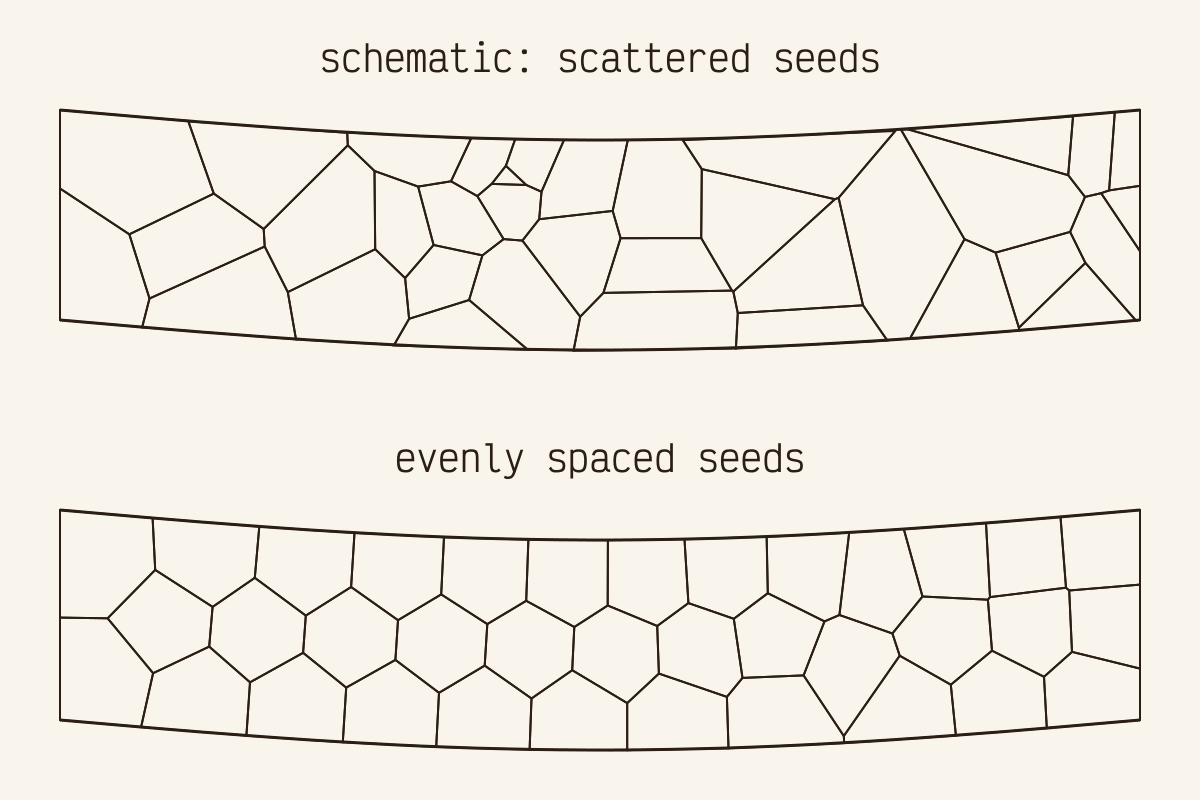
A schematic drawn from the rule alone, no wing image used: 36 seeds between two curved lines, as first scattered (top) and after 25 Lloyd rounds (bottom). Six-sided inner cells rise from 3 of 12 to 8 of 11 in this drawing.
Recipe schematic band, x 60-1140, edges y=110 and y=320, each +30*sin(pi*(x-60)/1080); seeds=36, x drawn uniformly, then y uniformly between the edges; seed=160; Lloyd rounds=0 and 25; band edges cut along each cell's tangent
"Voronoi cells between two curved lines, before and after relaxation (schematic)" by Spiral, Fern & Honeycomb, https://spiralfernandhoneycomb.com/tilings/voronoi-diagram/, licensed under CC BY 4.0 (https://creativecommons.org/licenses/by/4.0/).
Data: site computation
In this page's drawing, the share of six-sided inner cells went from 25% to 73% after 25 Lloyd rounds, and the mean number of sides from 5.08 to 5.91. The spread of areas across all 36 cells shrank too: the coefficient of variation, the standard deviation divided by the mean, fell from 0.55 to 0.109 in the same drawing.
Inner cells are the ones whose walls are all halfway lines, touching neither curved line nor either end of the band, so the counts are small, and a different seed number would give somewhat different shares.
| Seeds | Lloyd rounds | Inner cells | Six-sided | Mean sides | Area variation (all cells) |
|---|---|---|---|---|---|
| 36 scattered | 0 | 12 | 3 (25%) | 5.08 | 0.55 |
| 36 relaxed | 25 | 11 | 8 (73%) | 5.91 | 0.109 |
Cell counts for this page's two drawings (CSV) (file notes: source and license) Data: site computation
Are dragonfly wings Voronoi diagrams?
Not quite. One study argues that part of the wing follows a similar rule. Jordan Hoffmann, Seth Donoughe, Kathy Li, Mary Salcedo and Chris Rycroft, writing in PNAS in 2018 full text, compiled the vein patterns of 468 wings from 232 insect species, including published tracings from 215 species of dragonflies and damselflies (the order Odonata).
The study splits the veins into two kinds. Primary veins sit in matching places on the left and right wings, while secondary veins, the many small cross-veins, form a different pattern on each wing, even between the two wings of one insect.
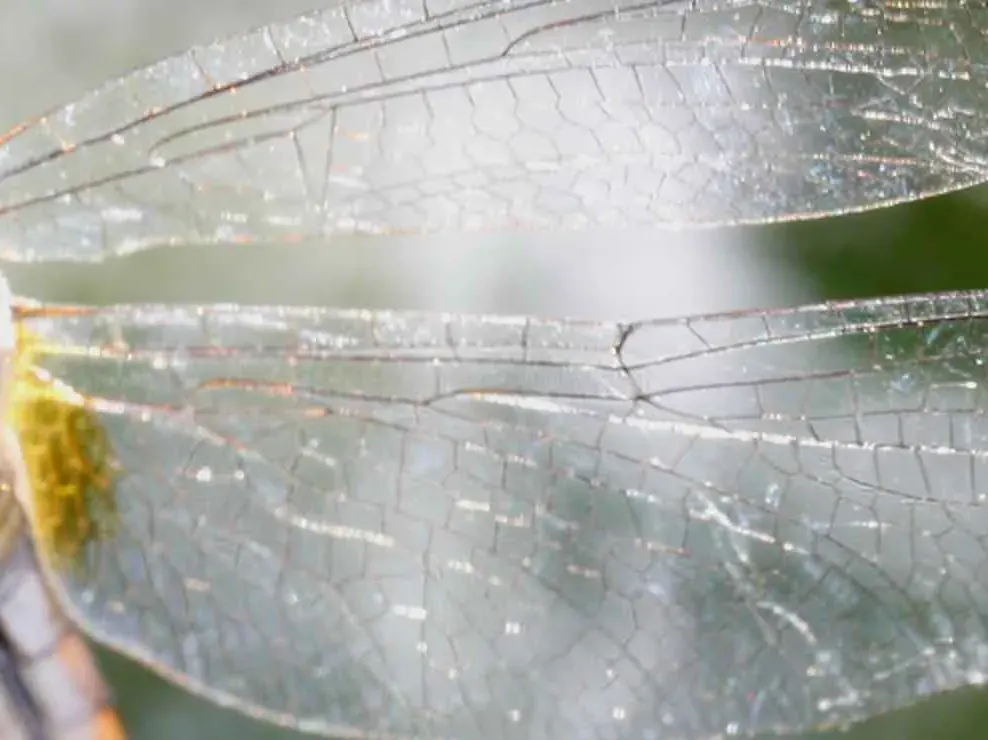
The pair of wings on the right side of the photograph above. Long veins run toward the wing tips, and the short cross-veins between them close into small polygons of different shapes. This page did not trace or measure the veins in the photograph.
“Dragonfly close up macro photo (detail of the wings on the right of the image)”, U.S. Fish and Wildlife Service; public domain.
Full credit
"Dragonfly close up macro photo (detail of the wings on the right of the image)" by U.S. Fish and Wildlife Service — https://commons.wikimedia.org/wiki/File:Dragonfly_close_up_macro_photo.jpg — Public domain (Work of a U.S. Fish and Wildlife Service employee made as part of official duties; public domain in the United States under 17 U.S.C. §105; outside the United States the Commons PD-USGov-FWS template is the only basis given; upstream not traced (the file page cites a stock-image site as its source)); modified: cropped to the pair of wings on the right of the image (the dragonfly faces the camera, so these are its left wings; x 1060-2048, y 160-900 of the 2,048 x 1,312 original), which also leaves out the inset thumbnail at top left; saved as WebP at 988 x 740; no color change
The study lists what these cross-veins have in common. Secondary veins that end in open space are very rare, straight 180-degree joints are rare, and each small cell tends to be about the size of its neighbors. Between closely spaced primary veins the cells tend to be rectangles; where the primary veins are far apart, pentagons and hexagons dominate. The authors call these features “conspicuously similar to those of a Voronoi tessellation of evenly spaced seeds.”
What does the wing model do?
The model works in steps. The primary veins come first. Then evenly spaced centers of a blocking signal appear between them, spaced with the same relaxation step shown above. Next, cross-veins form where the signal is weakest, along lines well approximated by Voronoi cells, and last, the growing wing stretches the pattern.
Without the stretching step, the simulated cells came out rounder than real ones. With it, the simulated hindwing of the dragonfly Dromogomphus spinosus had cell areas, roundness and a base-to-tip trend similar to the real wing's. The same model reproduced most of the cross-vein patterns of a lacewing and a grasshopper, though it was less accurate in some regions, such as cells along the trailing edge, which are less round in the real wings.
The study also states what it has not shown. The model is consistent with the wing measurements, the authors write, but it has not been shown to capture a specific molecular mechanism, and it is systematically inaccurate in wing regions where cell sizes change steeply or where cross-veins line up in rows. That makes the Voronoi rule a candidate mechanism for the cross-veins, not an established one.
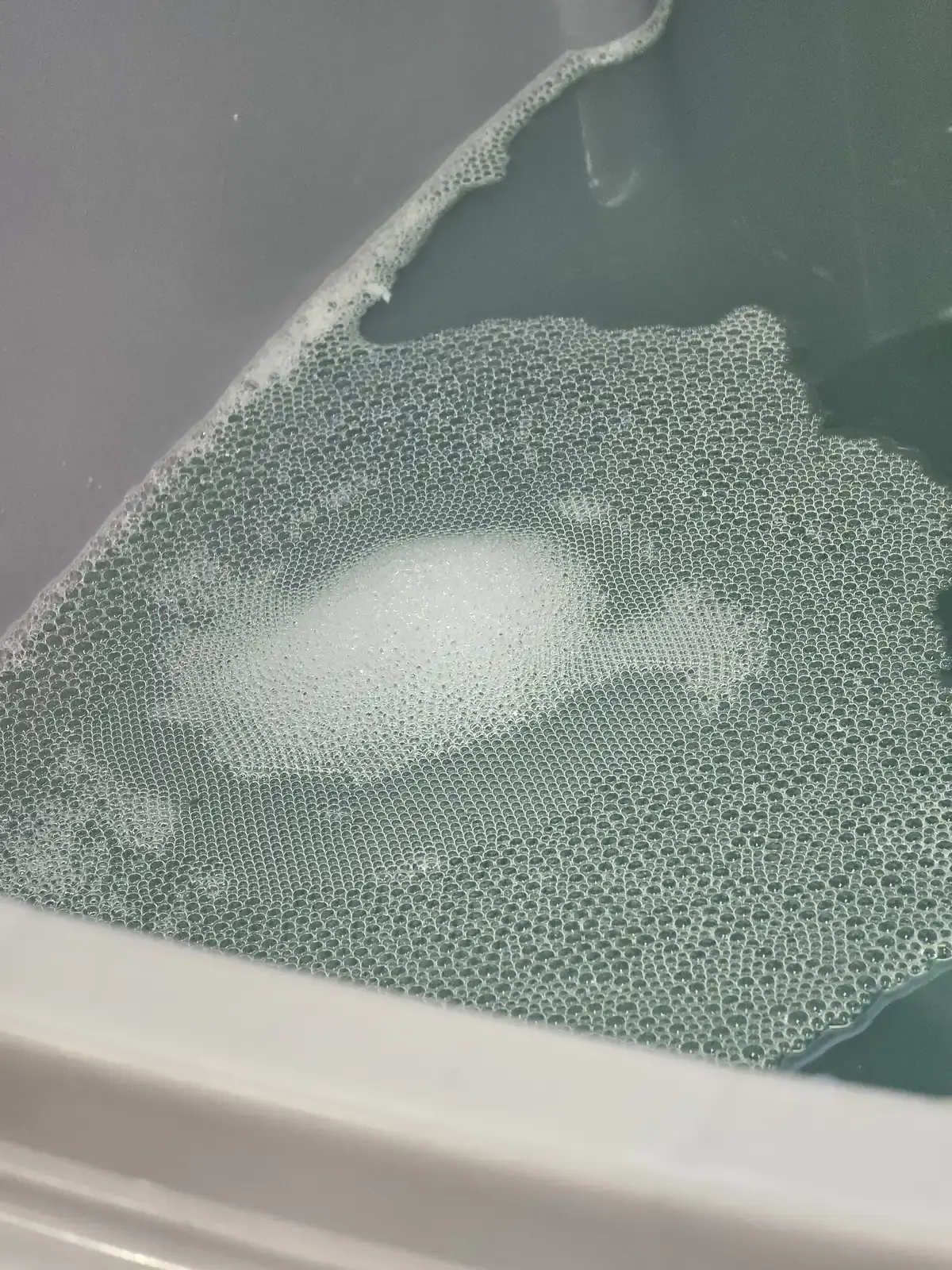
The authors also note that D'Arcy Thompson likened these cells to the shapes that surfaces settle into under tension, as in clusters of soap bubbles; how soap films meet is the subject of the soap film page.
Where else do Voronoi patterns show up?
A plane split into polygons does not make a Voronoi diagram by itself. The question for each case is whether there are seeds, and whether each wall really sits halfway between two of them. Examples on this site fall into different evidence levels.
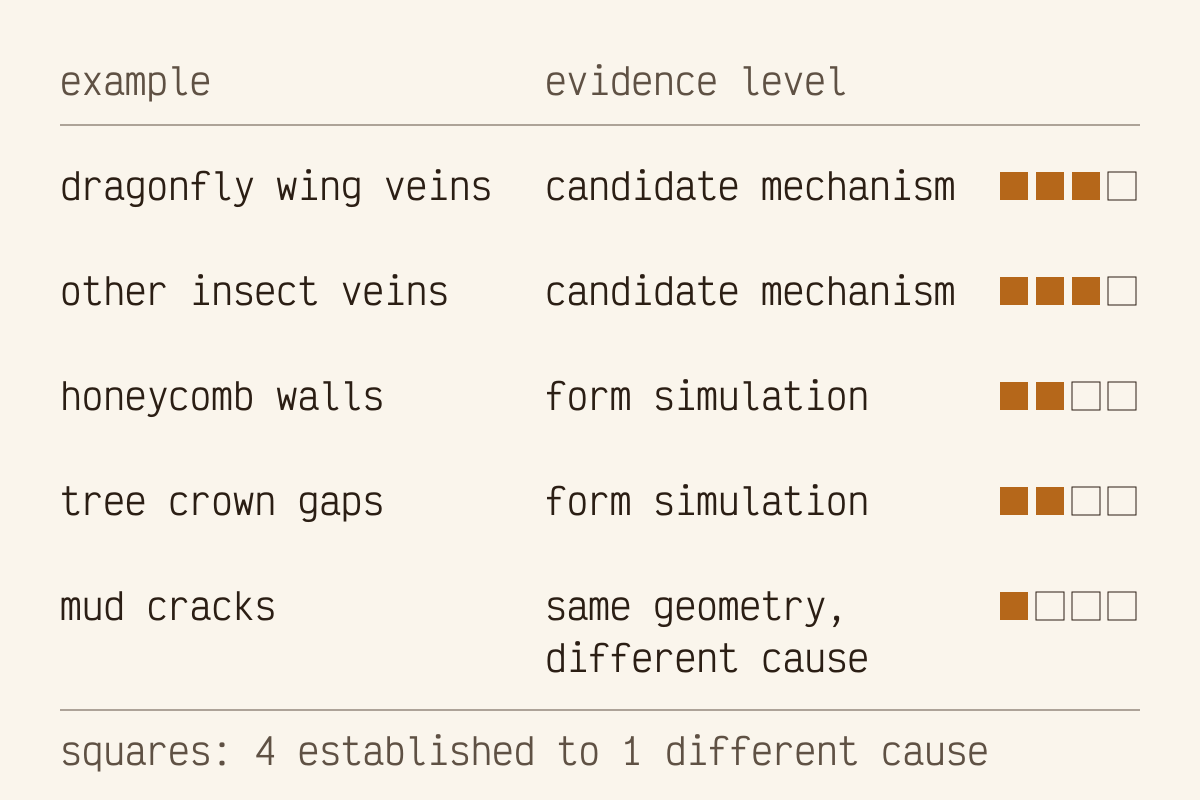
Five places where Voronoi-like cells appear, each graded by how much the evidence ties the shape to the nearest-seed rule. Filled squares run from 4 for an established mechanism to 1 for the same geometry from a different cause.
Recipe rows=5; squares filled: established mechanism=4, candidate mechanism=3, form simulation=2, same geometry, different cause=1; grades assigned by this site from Hoffmann et al. 2018, Goehring 2013 and this site's drawings
Read this figure as text
| Example | What the rule does | Evidence level | Source |
|---|---|---|---|
| Dragonfly and damselfly cross-veins | Evenly spaced centers, with veins forming between them, draw cell patterns like the real wings | Candidate mechanism | Hoffmann et al. 2018 full text |
| Lacewing and grasshopper cross-veins | The same model reproduces most regions and is less accurate in some | Candidate mechanism | Hoffmann et al. 2018 full text |
| Honeycomb walls | Seeds on a triangular grid give regular hexagons; this draws the comb, not how it is built | Form simulation | This page's computation |
| Gaps between tree crowns | A nearest-center drawing looks like the gap network; no study read here ties the gaps to the rule | Form simulation | This site's drawing |
| Mud cracks | A polygon network, but cracks form one after another, and later cracks tend to meet earlier ones at right angles | Same geometry, different cause | Goehring 2013 full text |
"Where Voronoi-like cells appear, by evidence level" by Spiral, Fern & Honeycomb, https://spiralfernandhoneycomb.com/tilings/voronoi-diagram/, licensed under CC BY 4.0 (https://creativecommons.org/licenses/by/4.0/).
Data: Hoffmann et al. 2018, PNAS 115(40):9905-9910 (wing veins); Goehring 2013, Phil. Trans. R. Soc. A 371, 20120353 (mud cracks)
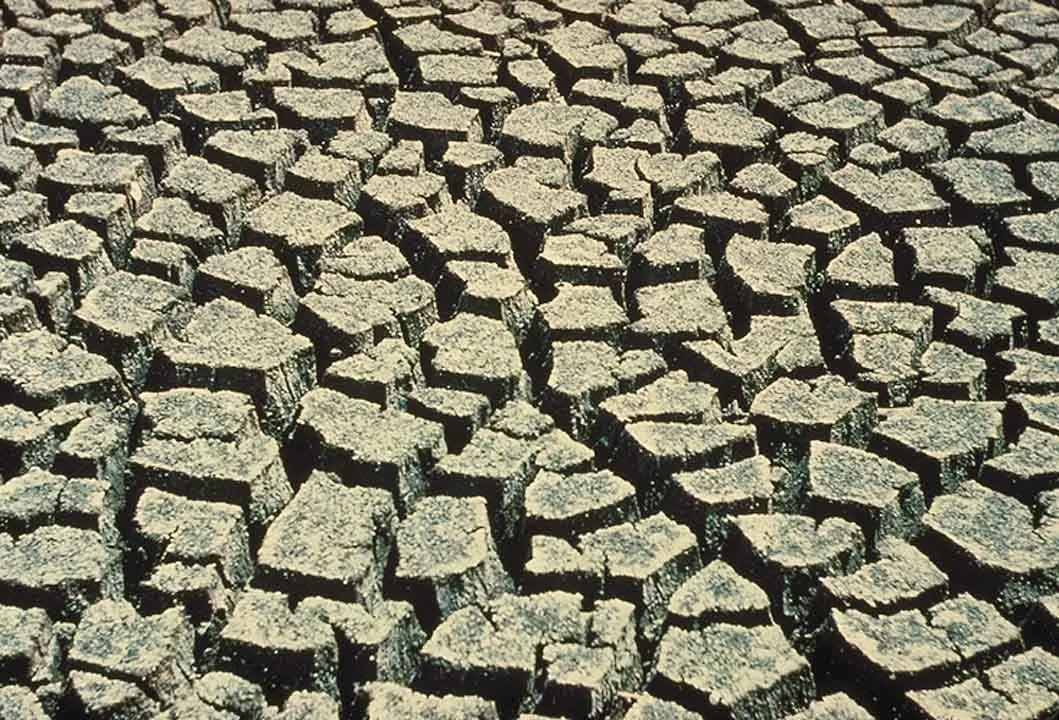
Mud cracks show why the grades matter. According to a 2013 review by Lucas Goehring full text, cracks in a thin drying layer break it into smaller and smaller pieces one crack at a time, and later cracks tend to meet earlier ones at right angles. In that account the pieces are cut out by cracks, not claimed by seed points, even where they look like Voronoi cells.
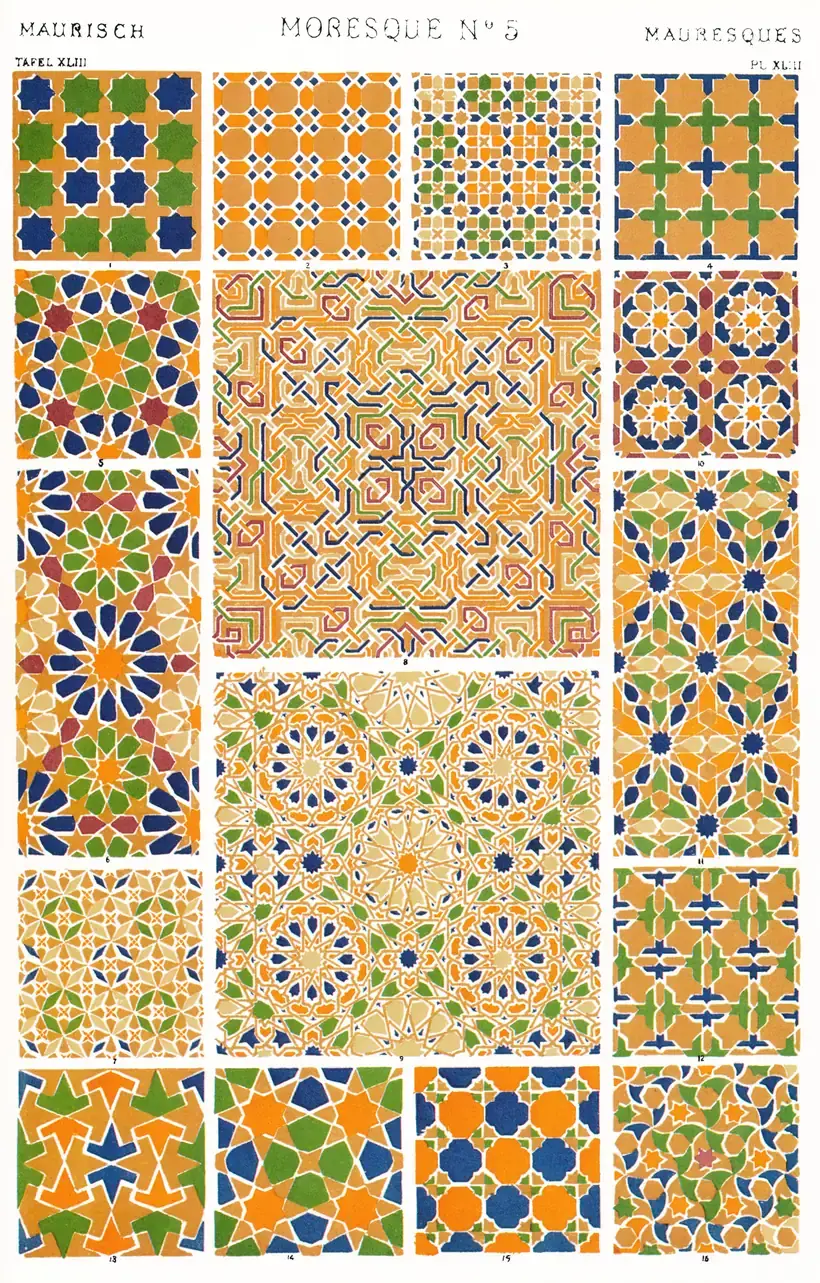
Tiles can split a plane too, by a designer's layout rather than by nearest seeds, as on the Alhambra symmetry page, where the dispute is over how to count the symmetries of tiled walls.
Sources
- Hoffmann J, Donoughe S, Li K, Salcedo MK, Rycroft CH (2018). A simple developmental model recapitulates complex insect wing venation patterns. Proceedings of the National Academy of Sciences of the USA 115(40):9905-9910. doi:10.1073/pnas.1721248115. PMCID PMC6176563. pmc.ncbi.nlm.nih.gov/articles/PMC6176563/Read: full text; Significance, Abstract, Results, Discussion and Methods (main text; the supplementary appendix not read)
- Goehring L (2013). Evolving fracture patterns: columnar joints, mud cracks, and polygonal terrain. Philosophical Transactions of the Royal Society A 371:20120353. doi:10.1098/rsta.2012.0353. arXiv 1211.6762. arxiv.org/abs/1211.6762Read: full text; arXiv v2 (13 June 2013), abstract, sections 1 to 4 and Figures 1 to 6
Cite this page
Spiral, Fern & Honeycomb. “Voronoi Diagram: Nothing in the Rule Asks for Hexagons.” Published November 23, 2026. https://spiralfernandhoneycomb.com/tilings/voronoi-diagram/ (accessed the day you read it).
- How each figure and source is checked
- Retunings: every correction, dated
- Report an error on this page (contact@spiralfernandhoneycomb.com)
More from Tiles, Cracks & Foams
Alhambra Patterns: The Symmetry Count Depends on the Rules
Picture credit
"Plate 43, The Grammar of Ornament (1868)" by Owen Jones — https://commons.wikimedia.org/wiki/File:Owen_Jones_-_Grammar_of_Ornament_-_1868_-_plate_043_-_300ppi.jpg — Public domain (EU: Owen Jones d. 1874 per library catalog record; US: published before 1931 (1868); scanned from a later reprint of the 1868 folio edition, according to the file page); modified: whole plate resized from 2433 x 3807 to 820 x 1283 pixels and saved as WebP
Mud Cracks: In Lab Clay Dried Again, T Joints Drift Toward Y
Picture credit
"Dry Mud, NPSPhoto" by Everglades NPS from Homestead, Florida, United States — https://commons.wikimedia.org/wiki/File:Dry_Mud,_NPSPhoto_(9257940252).jpg — Public domain (Work of a National Park Service employee made as part of official duties; public domain in the United States under 17 U.S.C. §105; outside the United States the Commons PD-USGov-NPS template is the only basis given; upstream not traced)
Soap Film: In Stable Dry Foam, Walls Meet in Threes at 120°
Picture credit
"Bubbles forming a geometric pattern" by TheresNothingOutThere — https://commons.wikimedia.org/wiki/File:Bubbles_forming_a_geometric_pattern.jpg — CC BY 4.0 (https://creativecommons.org/licenses/by/4.0/); modified: rotated upright by the camera's orientation tag, scaled down to 1200 x 1600 pixels and saved as WebP (quality 55, to keep the web copies under 250,000 bytes)