Soap Film: In Stable Dry Foam, Walls Meet in Threes at 120°
Mechanism deep dive Spiral, Fern & Honeycomb Published
In brief
In a stable dry foam, soap films meet three at a time along an edge, at equal angles of 120 degrees, and four of those edges meet at a point at about 109.47 degrees (Plateau 1873, §173 and §181). The soap does not pick these angles: each film pulls with the same tension, and three equal pulls balance only when they are spread evenly around their shared edge.
Pattern card
- Pattern
- In a stable dry foam, soap films meet three to an edge at 120 degrees, and edges meet four to a point at about 109.47 degrees
- Where
- Soap foams, clusters of touching bubbles, and films spanning wire frames
- Made by
- packing: established (Plateau 1873 full text)
- Working recipe
- 1 rule / 0 parameters: each film pulls along its surface with the same tension, and the films settle where the pulls balance
- Key source
- Plateau 1873, Statique expérimentale et théorique des liquides, t. I, ch. V, §173 and §181 full text
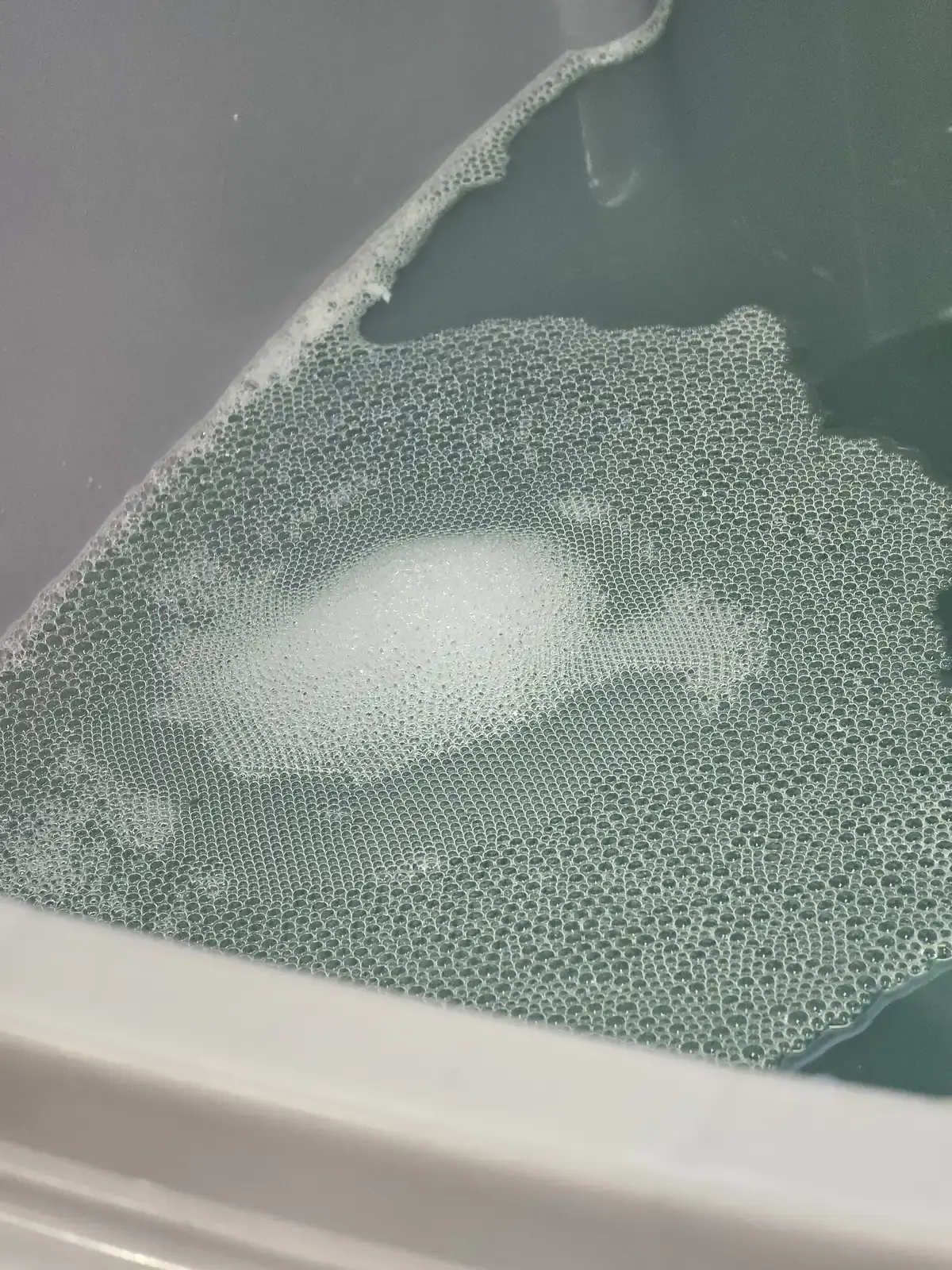
A raft of small soap bubbles on the water of a basin used to wash glassware, according to the file page.
"Bubbles forming a geometric pattern" by TheresNothingOutThere — https://commons.wikimedia.org/wiki/File:Bubbles_forming_a_geometric_pattern.jpg — CC BY 4.0 (https://creativecommons.org/licenses/by/4.0/); modified: rotated upright by the camera's orientation tag, scaled down to 1200 x 1600 pixels and saved as WebP (quality 55, to keep the web copies under 250,000 bytes)
Blow two soap bubbles so they touch, and look at the wall between them. If the two match in size, that wall is flat; if one is smaller, the wall bows into the bigger bubble. Either way, once the pair settles, the three films meet along one curved edge at equal angles.
A bowl of soapy water from the kitchen and a straw are enough. Blow the bubbles onto a wet plate, so they sit still long enough to look at.
What happens to the wall between two bubbles?
Joseph Plateau, a professor at the University of Ghent according to his title page, worked through this case in his 1873 treatise on liquid films, Statique expérimentale et théorique des liquides soumis aux seules forces moléculaires full text. In §173 an air bubble rising through a liquid lifts a dome of film at the surface. A second bubble rising partly under the first makes a second dome, and the two domes trap separate pockets of air.
The part of the second film that divides them, which Plateau calls the partition, is also a piece of a sphere. Its curve depends on the air on either side. A curved film presses on the air it encloses, and §116 shows that this pressure varies inversely with the bubble's diameter, so smaller bubbles push harder.
Two equal bubbles push equally, so the partition between them has no curve at all. Unequal bubbles push unequally, and the partition bulges toward the side with the lower pressure, which is the bigger bubble.
Plateau then gives the radius of the partition, r, from the radii of the two bubbles, written here as R for the larger and R' for the smaller: r = R × R' / (R − R'). For equal bubbles the formula gives an infinite radius, which is a flat wall. When the smaller bubble has half the radius of the larger, the formula gives r = R: the wall has the same curve as the big bubble.
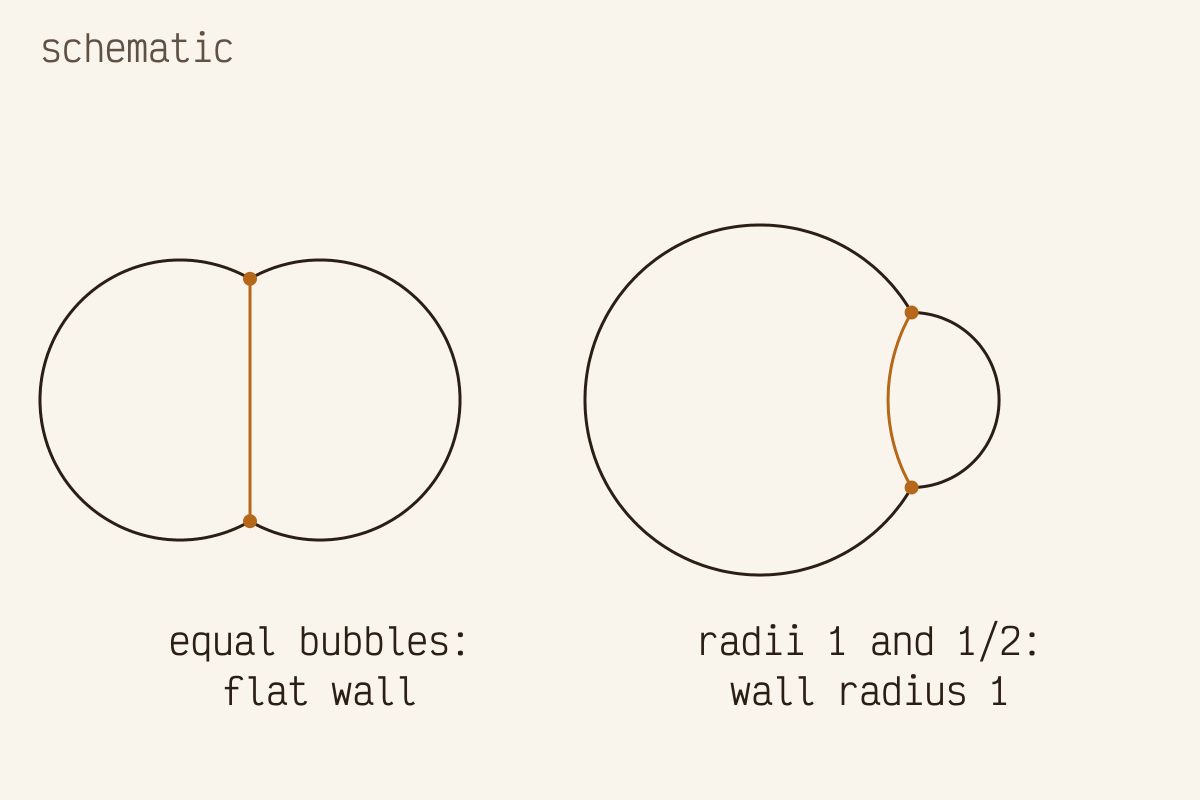
A schematic of two touching bubbles: equal bubbles share a flat wall, and bubbles of radius 1 and 1/2 share a wall of radius 1 that curves into the larger one. At both junctions the three films leave at 120.0000 degrees, recomputed on this page.
Recipe radii 1 and 1, then 1 and 0.5; center gap = sqrt(r1^2 + r2^2 - r1*r2); wall radius = r1*r2/(r1 - r2); junction angles 120.0000 deg
"Two touching soap bubbles and the wall between them" by Spiral, Fern & Honeycomb, https://spiralfernandhoneycomb.com/tilings/soap-film/, licensed under CC BY 4.0 (https://creativecommons.org/licenses/by/4.0/).
Data: Plateau 1873, Statique expérimentale et théorique des liquides, §173 (public domain)
The figure checks two of Plateau's results against each other. With the bubbles placed so their films meet at 120 degrees, as in a settled pair, the wall radius from his formula fits exactly, and the pressures balance: 1/0.5 − 1/1 = 1/1. The method behind each figure is set out on Each figure regrown.
Why do soap films meet three at a time?
Plateau's §173 ends with the angle at the junction. Here is the passage in his French, followed by this site's translation:
“or ces trois lames possédant des tensions identiques (§ 170), et tirant ainsi leur arête commune avec des forces égales, il est clair qu’elles doivent faire entre elles, à cette arête, des angles égaux, angles qui sont conséquemment de 120°.” (Plateau 1873, t. I, ch. V, §173, on films in equilibrium; p. 141 of the retypeset text)
In English (this site's translation of a passage about films in equilibrium): these three films have identical tensions, and so pull on their common edge with equal forces; it is clear that they must make equal angles with one another at that edge, angles which are therefore 120 degrees.
The tension he relies on is summed up a few pages earlier, in §170. A film's tension is the same over its whole surface and in all directions along it. It does not depend on how the film curves, nor on its thickness, as long as the film is not thinner than twice the reach of the attraction between molecules.
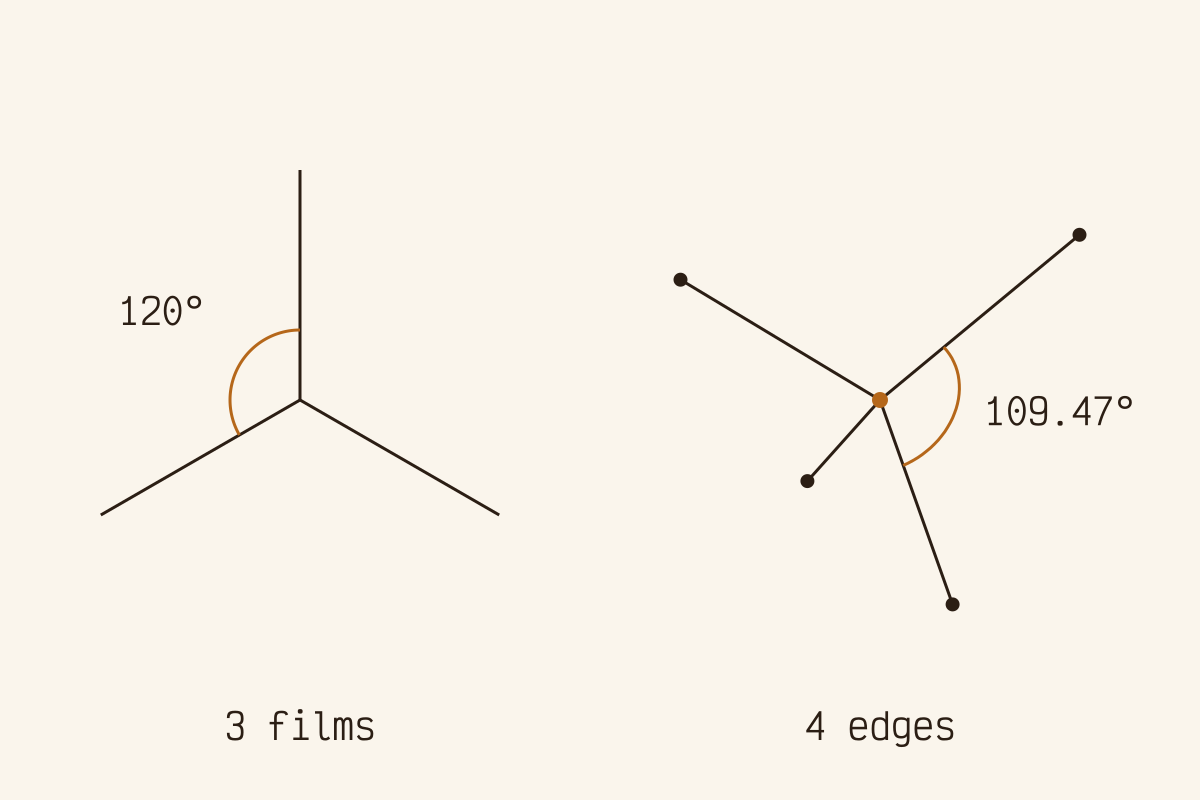
Plateau's two angles for a settled, dry foam: three films meet along an edge at 120 degrees, and four edges meet at a point at the angle whose cosine is −1/3 (drawn in projection; the true angle is 109.47°). That angle, arccos(−1/3), recomputed in double precision: 109.4712 degrees, 109° 28' 16.39".
Recipe 3 films: 120 deg; 4 edges: arccos(-1/3) = 109.4712 deg = 109 deg 28 min 16.39 sec
"Plateau's angles: 120 and 109.47 degrees" by Spiral, Fern & Honeycomb, https://spiralfernandhoneycomb.com/tilings/soap-film/, licensed under CC BY 4.0 (https://creativecommons.org/licenses/by/4.0/).
Data: Plateau 1873, Statique expérimentale et théorique des liquides, §173, §181 (public domain)
The arithmetic behind the 120 is short. Three equal pulls cancel only when each sits 120 degrees from the next, so in a stable foam the films have nowhere else to rest. Space them any other way and a net pull is left over, which would move the edge.
The score is a single line long: equal tension, played three ways around one edge.
What about the tiny bead of liquid at the edge?
Plateau is careful about one detail. In §173 he notes that liquid films cannot meet in a sharp line, so a small mass of liquid with strongly curved surfaces collects along the edge where they join. For the 120 degrees of a settled system, he sets that mass aside “because of its extreme smallness” (this site's translation).
That is where the qualifier comes from. The angle rule describes a dry foam, one with very little liquid between the bubbles, once it has stopped moving.
What rules did Plateau write down?
Plateau tested the three-film rule by adding bubbles. In §180 he imagines four equal bubbles on a glass plate. Set them out like the corners of a square, and four walls share one edge at right angles; set them out like a rhombus, and five walls appear, three to an edge, at 120 degrees, both layouts in equilibrium by their symmetry.
The square layout, he reports, cannot be made, or lasts only an instant before it passes to the rhombus. The rhombus forms directly and stays. He concludes that the square is unstable and that four walls on one edge probably cannot exist together.
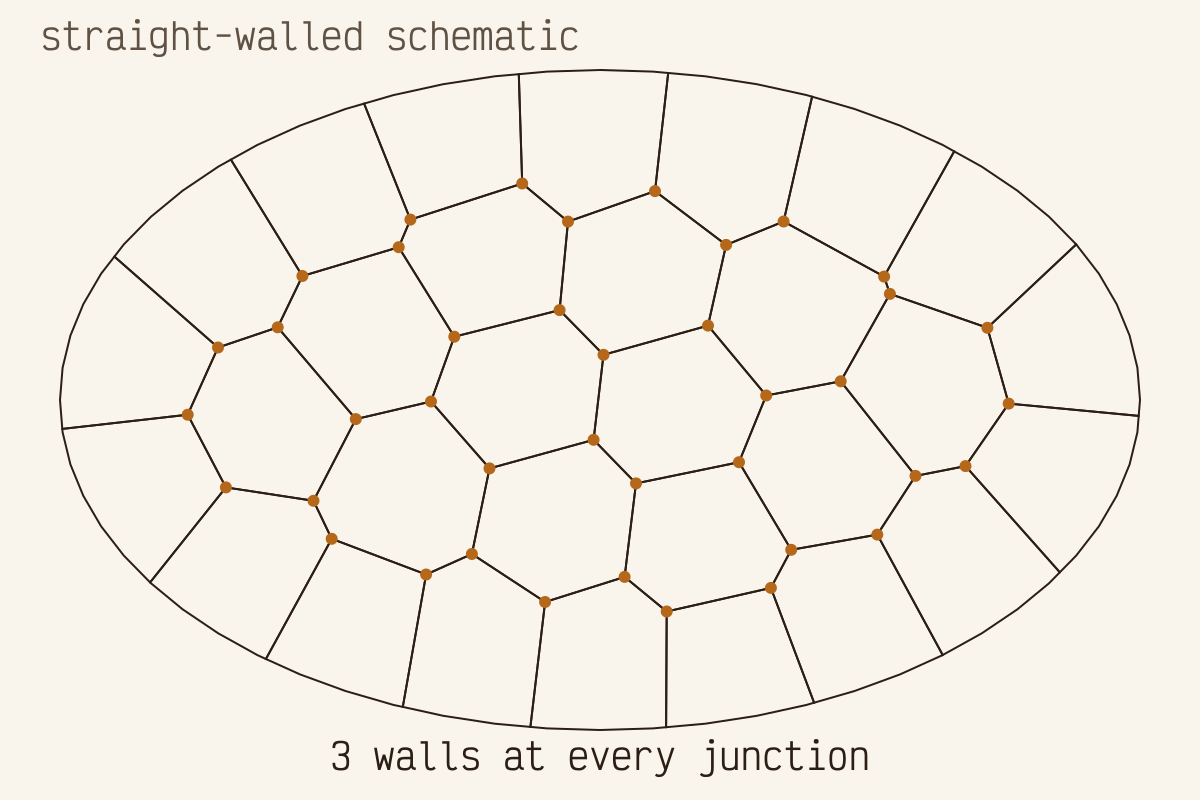
A straight-walled schematic of a two-dimensional foam, built from seed points and not a model of real foam: three walls at every junction. Real films curve, and the straight walls here only approximate their corners.
Recipe schematic; seeds=30, drawn uniformly in an 800 x 560 box; seed=12; Lloyd rounds=40 inside an oval 1080 x 660 (64-sided polygon); straight walls
"Two-dimensional foam, straight-walled schematic" by Spiral, Fern & Honeycomb, https://spiralfernandhoneycomb.com/tilings/soap-film/, licensed under CC BY 4.0 (https://creativecommons.org/licenses/by/4.0/).
Data: site computation
The second rule follows in §181. Where four edges meet at one point, Plateau shows that their angles must also be equal. He finds the value by placing a point at the center of a regular tetrahedron and drawing lines to its four corners:
“chacun de ces angles est celui qui a pour cosinus −1/3 ; on trouve, d’après cela, que cet angle est de 109° 28' 16", c’est-à-dire à fort peu près de 109 degrés et demi.” (Plateau 1873, t. I, ch. V, §181; pp. 152–153 of the retypeset text)
In English (this site's translation): each of these angles is the one whose cosine is −1/3; from this one finds that the angle is 109° 28' 16", that is, very nearly 109 and a half degrees. Recomputed in double precision, arccos(−1/3) comes to 109.4712 degrees, or 109° 28' 16.39", which matches his value to the second. Both angles, with the section and page each comes from, are in the data file below.
Plateau's angles and the flat Kelvin cell (CSV) (file notes: source and license) Data: Plateau 1873, Statique expérimentale et théorique des liquides, §173, §181 (public domain)
Plateau also built wire frames and dipped them. In §182 he reports that a cube frame, lifted from his glycerin soap liquid, invariably carries the same system: twelve films, one from each wire edge, all meeting a small four-sided film at the center.
Who took the rules further?
J. Taylor's 1976 paper in the Annals of Mathematics, The structure of singularities in soap-bubble-like and soap-film-like minimal surfaces, is known on this page only by its title and citation bibliographic. The Hales 2001 paper on the honeycomb lists it among the general results on the existence and regularity of solutions to problems of this kind.
The rules also have limits that Plateau's own liquids show. A plain soap bubble a decimeter across, made in the open air of a room, rarely lasts two minutes (§98). He mixed glycerin into his soap solution to get films that lasted long enough to study, and his frame experiments use that liquid.
A draining foam, or one so wet that the liquid along each edge is not tiny, falls outside the assumption Plateau states in §173. The two angles are rules for a stable dry foam.
Why are bubbles round?
A lone bubble follows the same tension rule, with no neighbors to pull against. In §95, Plateau shows that a thin film in air takes the same shapes of balance as a mass of liquid with no weight, once gravity is ignored. His §174 states that a mass of liquid that is finite, entirely free and shaped by rotation about an axis can take only one shape of balance: a single sphere.
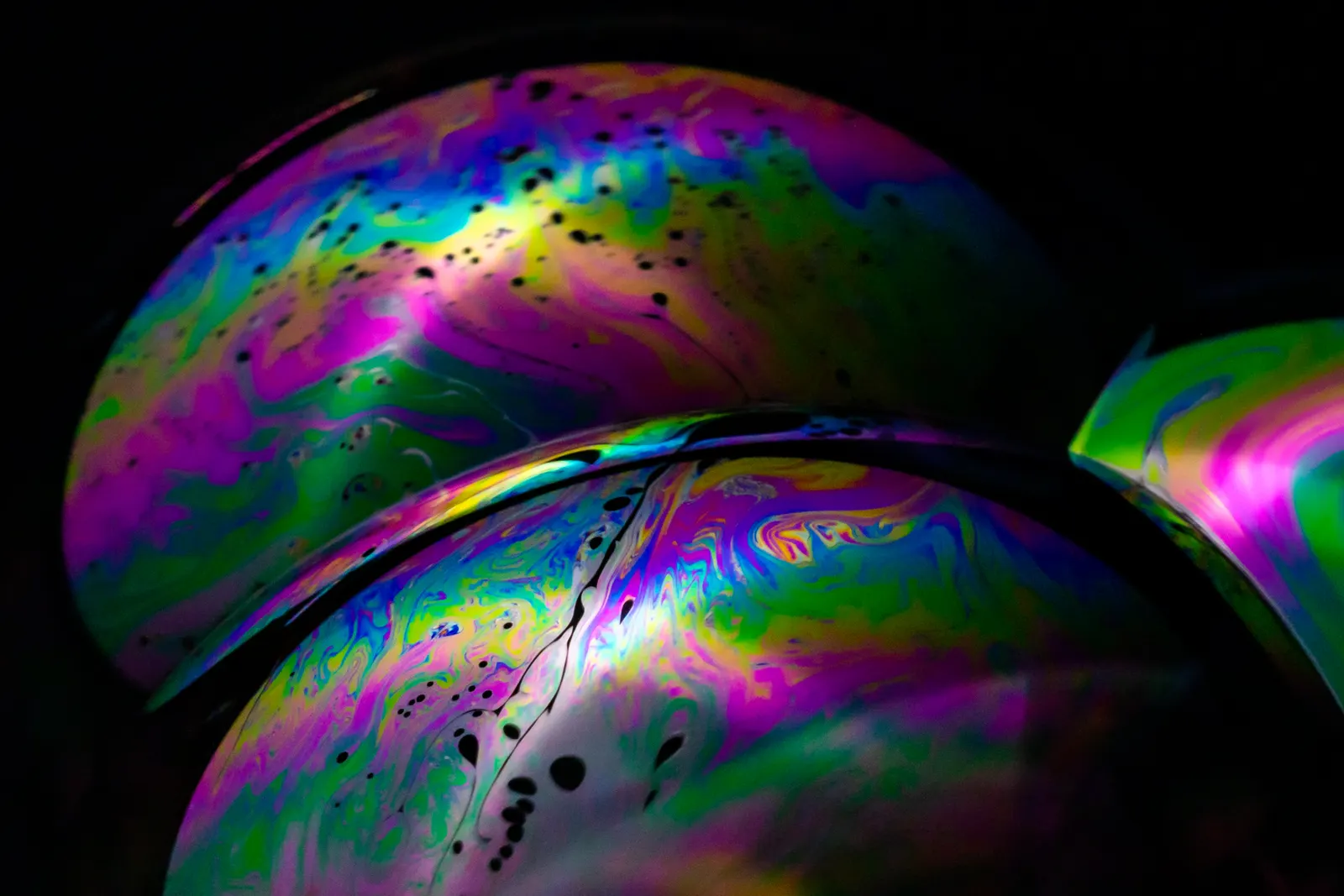
Touching soap bubbles against a black background: each outer film is a smooth curve, and the colored bands are interference in the thin film, according to the file page.
"Seifenblasen -- 2020 -- 0074" by Dietmar Rabich / Wikimedia Commons / “Seifenblasen -- 2020 -- 0074” / CC BY-SA 4.0 — https://commons.wikimedia.org/wiki/File:Seifenblasen_--_2020_--_0074.jpg — CC BY-SA 4.0 (https://creativecommons.org/licenses/by-sa/4.0/)
A sphere has all its radii of curvature equal, so in §116 Plateau can write the pressure of a spherical bubble on its air as one term that falls as the diameter grows. He then measured it. In §121 he lists ten bubbles from 7.55 mm to 48.10 mm across, and diameter times pressure stays near an average of 22.75 in his units, apart from the last two readings.
Read together, these sections give the answer. A free bubble is round because its film pulls the same way everywhere, and a closed film that pulls evenly rests as a sphere. Touching bubbles are not free all round, so they trade the sphere for flat or gently curved walls that meet by the three-film rule.
Why isn't foam made of hexagons?
Seen from above, a single layer of bubbles can look like a honeycomb, and the reason is the 120 degrees of a settled foam. A regular hexagon has corners of 120 degrees, so three hexagons fit around each corner with nothing left to pull. The honeycomb page follows that geometry to the proof about the shortest walls. The Voronoi diagram is the rule that splits a plane into cells around seed points, the same rule behind the flat foam figure above.
Plateau saw the same pull on his prism frames as he lifted them out of the liquid. In §190 he explains that when the base of a frame has fewer than six sides, its side faces meet at less than 120 degrees, the angle the films need for equilibrium. The films there tend to pull inward, away from the wires, to get their 120 back. On a regular hexagonal prism (§189), the side films stay flat, but only until the lower base leaves the liquid.
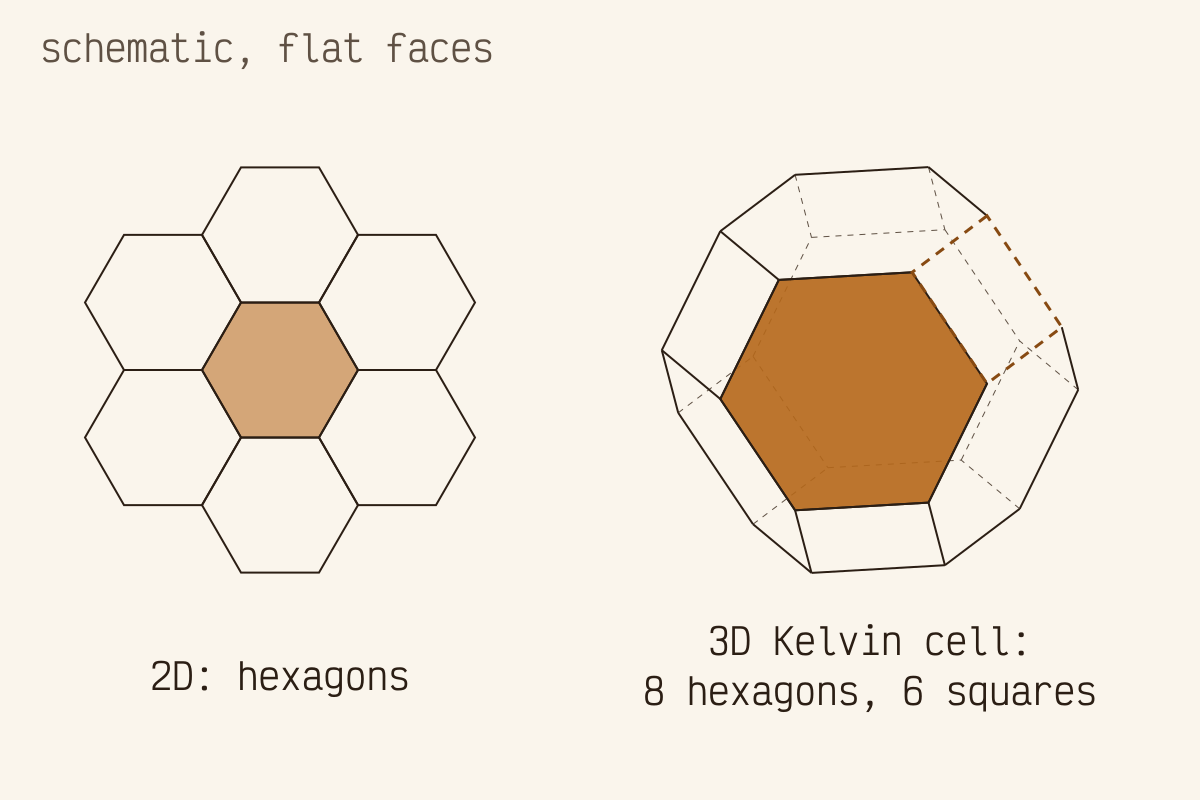
A schematic with flat faces: hexagons tile a plane, and the Kelvin cell, the cell of the body-centered cubic lattice, has 8 hexagonal and 6 square faces. Faces and angles recomputed on this page; the Weaire–Phelan cells are not drawn.
Recipe Kelvin cell = cell of the body-centered cubic lattice; vertices = permutations of (0, +-1/2, +-1); flat faces; 14 faces, 36 edges
"Hexagons in two dimensions, the Kelvin cell in three" by Spiral, Fern & Honeycomb, https://spiralfernandhoneycomb.com/tilings/soap-film/, licensed under CC BY 4.0 (https://creativecommons.org/licenses/by/4.0/).
What shape are the cells in three dimensions?
Real foam fills space, though, and its cells are solids, not hexagons. Hales 2001 full text calls the search for the least wall area that divides space into equal-volume cells the Kelvin problem. Kelvin's answer starts from truncated octahedra, the cells of the body-centered cubic lattice. In Hales's words, “A small deformation of the faces produces a minimal surface.”
The arithmetic on this page shows why the faces have to bend. Where three flat Kelvin cells meet along an edge, their walls sit at 109.47, 125.26 and 125.26 degrees, not three 120s. Three equal pulls at that spacing leave a net pull of about 0.15 of one film's tension, so in a settled foam each edge has to come back to 120 degrees, and the flat faces have to curve.
Kelvin's cell was not the last word. Hales reports that D. Weaire and R. Phelan found a counterexample to Kelvin's proposal, and cites Frank Morgan's remark that in 1994 they improved on Kelvin's candidate for dividing space into equal volumes with the least area. Their own paper was not read for this page, so no comparison figures are given.
Flat tilings on walls follow other rules again, as on the Alhambra's tiled walls, where even the count of symmetry groups depends on the rules used to count.
Sources
- Plateau J (1873). Statique expérimentale et théorique des liquides soumis aux seules forces moléculaires, t. I. Paris: Gauthier-Villars; ch. III, §95, §98, §116, §121; ch. V, §170, §173, §174, §180, §181, §182, §189, §190. Public domain (published 1873). kenbrakke.com/PlateauBook/Plateau-Fr.pdfRead: full text; French original in a modern retypeset edition; §173 on p. 141 and §181 on pp. 152–153 of the retypeset text (1873 page numbers not given)
- Hales TC (2001). The Honeycomb Conjecture. Discrete & Computational Geometry 25:1–22. arXiv math/9906042. arxiv.org/abs/math/9906042Read: full text; arXiv preprint, introduction and references
Cite this page
Spiral, Fern & Honeycomb. “Soap Film: In Stable Dry Foam, Walls Meet in Threes at 120°.” Published November 23, 2026. https://spiralfernandhoneycomb.com/tilings/soap-film/ (accessed the day you read it).
- How each figure and source is checked
- Retunings: every correction, dated
- Report an error on this page (contact@spiralfernandhoneycomb.com)
More from Tiles, Cracks & Foams
Alhambra Patterns: The Symmetry Count Depends on the Rules
Picture credit
"Plate 43, The Grammar of Ornament (1868)" by Owen Jones — https://commons.wikimedia.org/wiki/File:Owen_Jones_-_Grammar_of_Ornament_-_1868_-_plate_043_-_300ppi.jpg — Public domain (EU: Owen Jones d. 1874 per library catalog record; US: published before 1931 (1868); scanned from a later reprint of the 1868 folio edition, according to the file page); modified: whole plate resized from 2433 x 3807 to 820 x 1283 pixels and saved as WebP
Mud Cracks: In Lab Clay Dried Again, T Joints Drift Toward Y
Picture credit
"Dry Mud, NPSPhoto" by Everglades NPS from Homestead, Florida, United States — https://commons.wikimedia.org/wiki/File:Dry_Mud,_NPSPhoto_(9257940252).jpg — Public domain (Work of a National Park Service employee made as part of official duties; public domain in the United States under 17 U.S.C. §105; outside the United States the Commons PD-USGov-NPS template is the only basis given; upstream not traced)

Voronoi Diagram: Nothing in the Rule Asks for Hexagons
Picture credit
"Dragonfly close up macro photo" by U.S. Fish and Wildlife Service — https://commons.wikimedia.org/wiki/File:Dragonfly_close_up_macro_photo.jpg — Public domain (Work of a U.S. Fish and Wildlife Service employee made as part of official duties; public domain in the United States under 17 U.S.C. §105; outside the United States the Commons PD-USGov-FWS template is the only basis given; upstream not traced (the file page cites a stock-image site as its source)); modified: cropped to remove the inset thumbnail at top left (the top 160 px strip of the 2,048 x 1,312 original), scaled to 1600 x 900 and saved as WebP; no color change