Paper Wasp Nest: One Study Found Order Only Over Short Range
Pattern entry Spiral, Fern & Honeycomb Published
In brief
A paper wasp nest is usually a single, uncovered layer of six-sided cells built from plant fibers and hung from one or more stalks. A 2022 study of 25 Polistes wattii nests found that the six-sided order holds only over short distances, with no long-range order, which the authors liken to amorphous materials. Where the order breaks, the same study found five-sided and seven-sided cells side by side, the pairs that mark dislocations in crystals.
Pattern card
- Pattern
- Six-sided paper cells with paired five- and seven-sided cells
- Where
- Single-layer, uncovered combs of Polistes paper wasps hung from one or more stalks; measured in Polistes wattii (2022)
- Made by
- behavior: candidate (Nazzi 2016 full text) · packing: candidate (Krishna et al. 2022 full text)
- Working recipe
- 2 rules / 1 parameter: start a new cell in the groove between two cells; raise its walls once the floor reaches cell size (parameter: cell size). Honeybee rule from Nazzi 2016, reported similar in Polistes fuscatus; not compared with other recipes
- Key source
- Krishna, Gopinath & Bhattacharjee 2022, Scientific Reports 12:12901 full text
This card as CSV file notes: source and license
Data: Krishna, Gopinath & Bhattacharjee 2022, Scientific Reports 12:12901, CC BY 4.0; Nazzi 2016, Scientific Reports 6:28341, CC BY 4.0
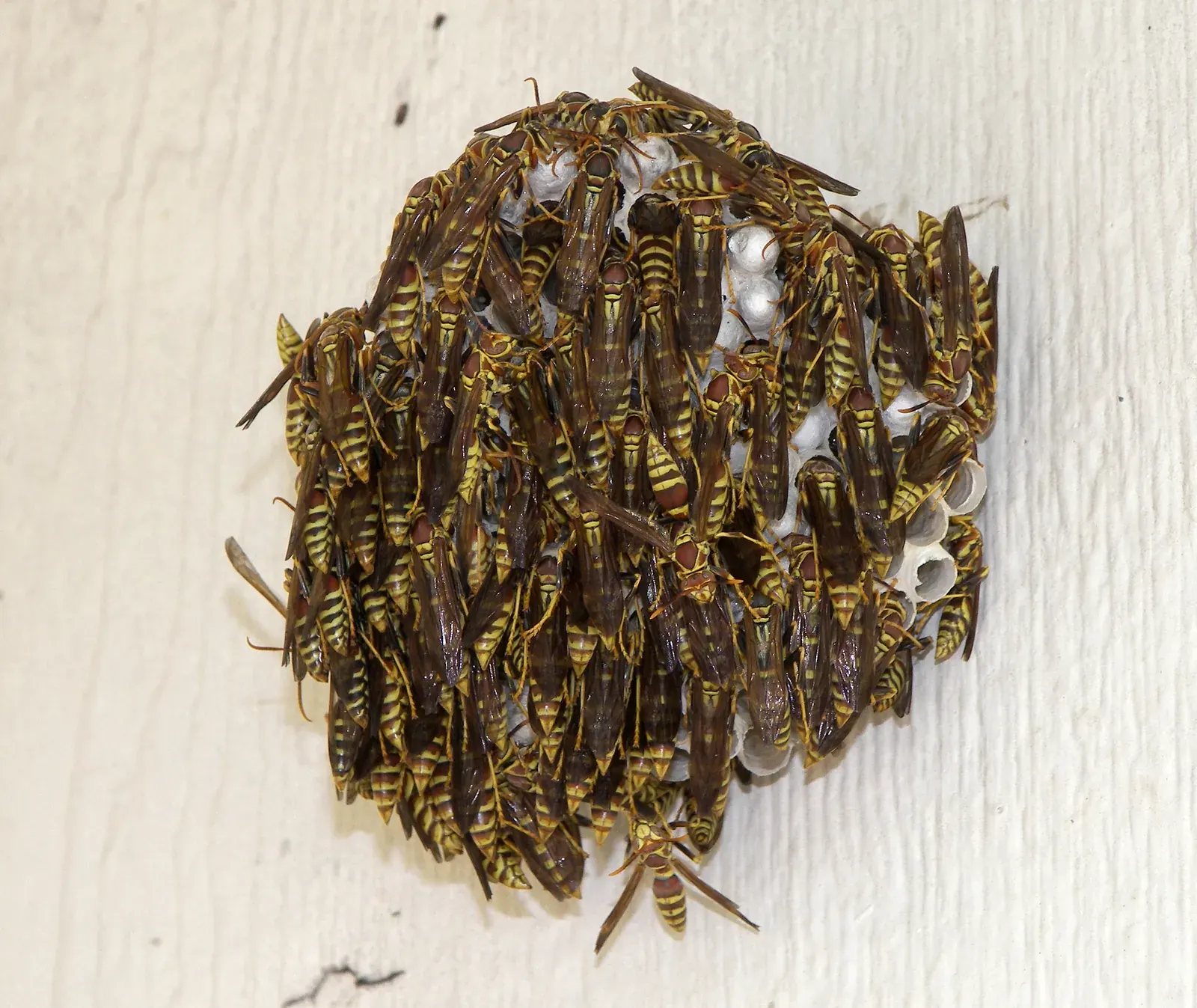
A Polistes exclamans nest in Bastrop County, Texas, in 2008, according to the file page; adult wasps cover most of the open cells.
"Polistes exclamans nest" by Larry D. Moore — https://commons.wikimedia.org/wiki/File:Polistes_exclamans_nest.jpg — CC BY 4.0 (https://creativecommons.org/licenses/by/4.0/); modified: resized to 1600 px wide and saved as WebP
Tear a strip of newspaper and look at the fuzzy edge where the fibers pulled apart. A paper wasp's comb is also made of plant fibers, chewed into a paste. The authors of a 2022 study argue that plant fibers are less plastic than wax, so building errors are harder to smooth away, and their photographs of wasp combs show the errors that stay: five-sided and seven-sided cells, locked together in pairs. Keep the tearing to paper: for the comb itself, the photographs on this page are enough.
What is a paper wasp nest made of?
In On Growth and Form (1917), D'Arcy Thompson described the material and the shape in one sentence full text: “The social wasps and many bees build, usually out of vegetable matter chewed into a paste with saliva, very beautiful nests of ‘combs’; and the close-set papery cells which constitute these combs are just as regularly hexagonal as are the waxen cells of the hive-bee” (p. 332).
Thompson added that in nearly all of these combs the cells sit “in a single row,” one layer deep. A honeybee comb, by contrast, has two layers of cells back to back, as Francesco Nazzi's 2016 paper in Scientific Reports describes full text.
The 2022 study, by Shivani Krishna, Apoorva Gopinath and Somendra Bhattacharjee in Scientific Reports full text, uses similar words for the material. Most wasp species, they write, build with “either mud or fibrous materials of plant origin.” Wasps of the genus Polistes hang their nests “from one or more stalks,” and the nest is a sheet of open six-sided cells. Other insect builders work in other materials: see the mud dauber nest, built by a wasp that uses mud instead of paper, or the caddisfly case, which an insect larva builds and carries.
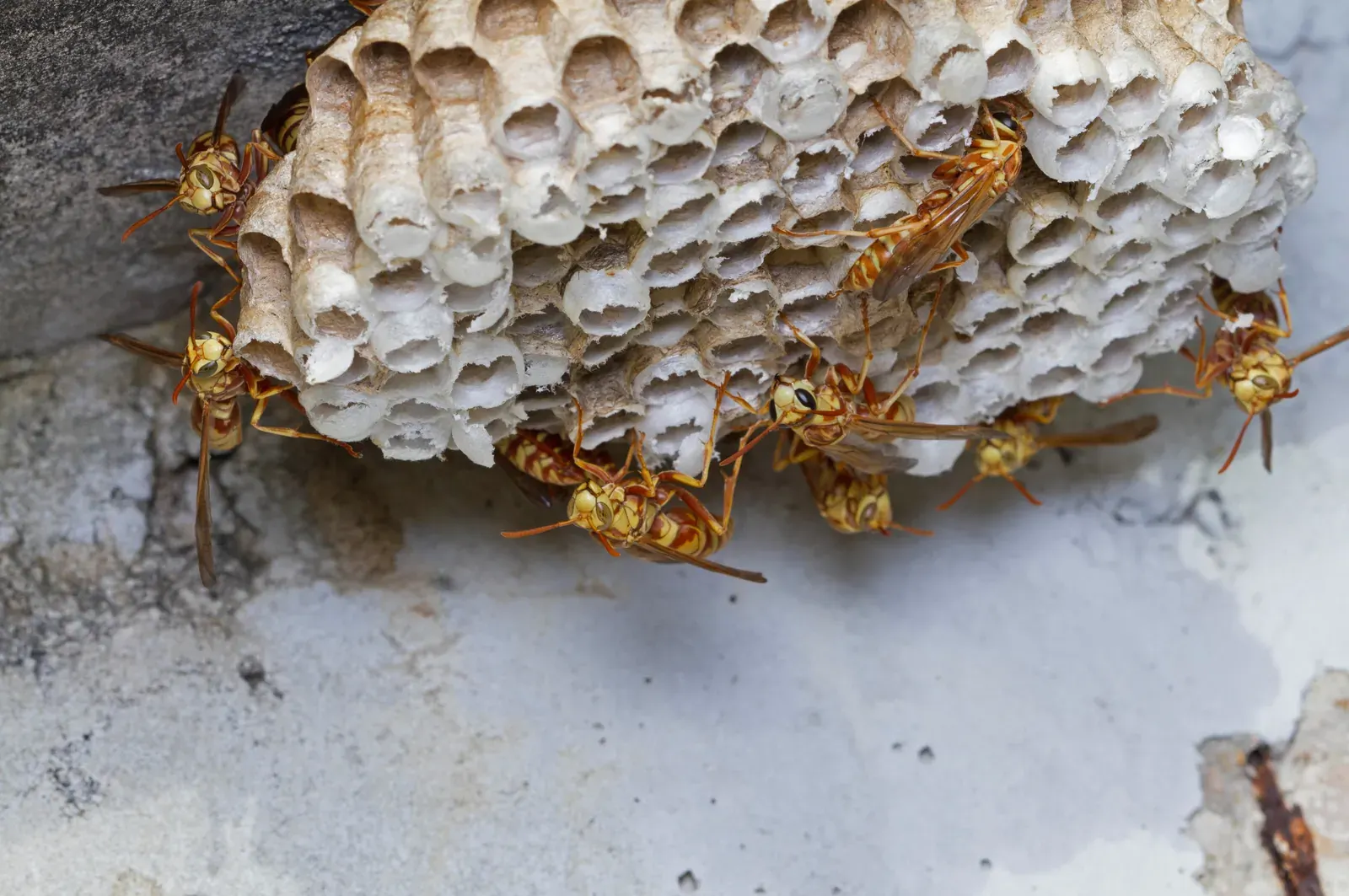
A Polistes apachus nest at Palmetto State Park in Gonzales County, Texas, in October 2016, according to the file page; adult wasps cling to the edge of a sheet of open six-sided paper cells.
“Paper wasp nest (Vespidae, Polistes apachus)”, Alejandro Santillana, Insects Unlocked project, The University of Texas at Austin; CC0.
Full credit
"Paper wasp nest (Vespidae, Polistes apachus)" by Alejandro Santillana, Insects Unlocked project, The University of Texas at Austin — https://commons.wikimedia.org/wiki/File:Paper_wasp_nest_(Vespidae,_Polistes_apachus)_(30960058872).jpg — CC0 1.0 (https://creativecommons.org/publicdomain/zero/1.0/); modified: cropped off the black caption strip at the bottom (box 0, 0, 4965, 3300 of 4965 x 3672); the strip's credit text is kept in this credit line, resized to 1600 px wide and saved as WebP
How does the nest grow cell by cell?
Francesco Nazzi's 2016 study of honeybee combs proposed a two-step building rule. A new cell starts in the groove between two existing cells, and its walls go up once the floor reaches a certain size. In a simple simulation, the rule gave an alternating pattern of similar-sized cells, while letting a floor start anywhere gave cells lined up in straight rows.
In the same paper, Nazzi 2016 wrote that his rule closely resembles one reported for the paper wasp Polistes fuscatus, despite the different building material. The schematic below draws the rule in plan view.
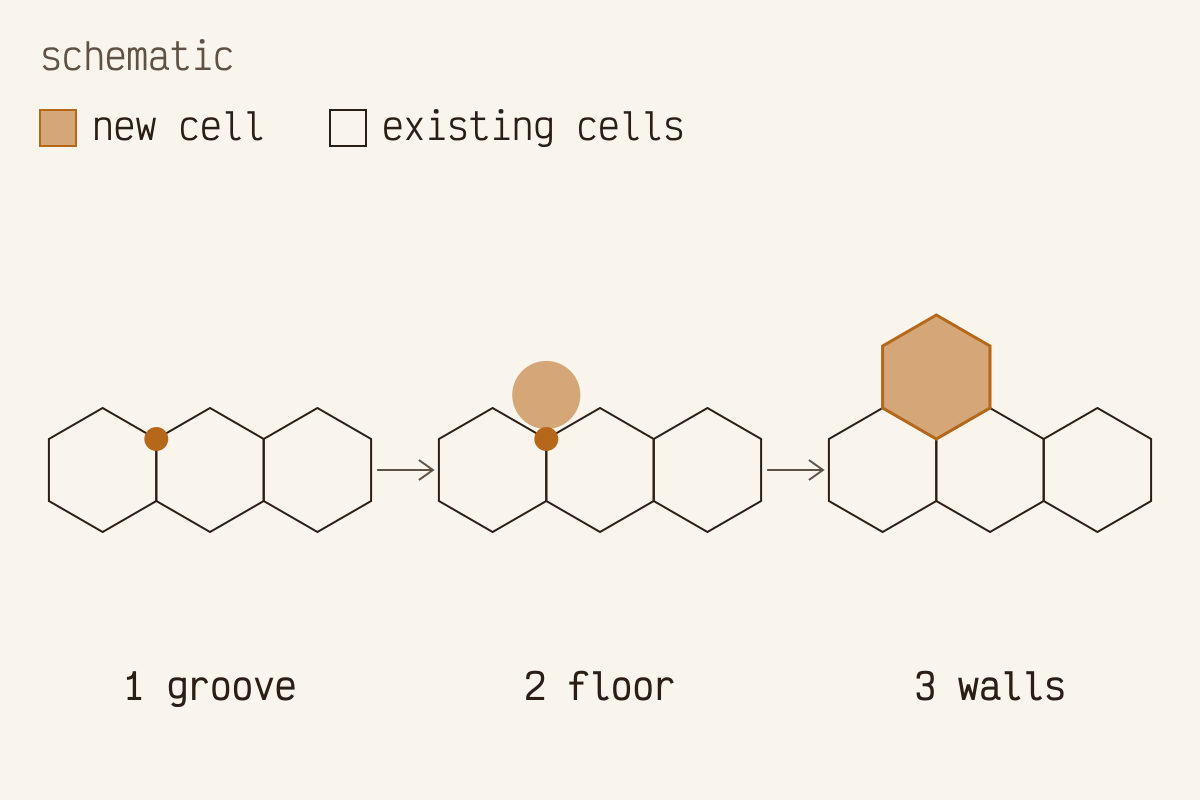
A schematic of the groove-start rule: the new cell (filled) begins where two existing cells meet and ends up sharing one wall with each of them. The rule as worded by Nazzi 2016 for honeybees, drawn in plan view and not traced from any paper's figure.
Recipe pointy-top hexagons, circumradius R=62; row of 3 existing cells; new cell center at the groove, offset (sqrt(3)*R/2, -1.5*R) from the left cell of the pair; shares 2 walls with the cells below
"Groove-start rule for a new comb cell, schematic" by Spiral, Fern & Honeycomb, https://spiralfernandhoneycomb.com/combs-and-cases/paper-wasp-nest/, licensed under CC BY 4.0 (https://creativecommons.org/licenses/by/4.0/).
Data: Nazzi 2016, Scientific Reports 6:28341, CC BY 4.0 (rule wording)
A cell started in a groove leans on two neighbors at once, so two of its walls are already shared. The 2022 Polistes wattii paper credits earlier models by Karsai and Pénzes bibliographic with explaining varied nest shapes from a simple set of rules, but points out that by construction those models describe regular hexagons only.
That leaves a gap. The groove rule for wasps rests on Nazzi's comparison, so this site lists a shared building behavior in wasps and bees as a candidate, not an established cause.
Are the cells regular hexagons?
No. The 2022 study photographed fully built Polistes wattii nests on a university campus in Sonepat, India, in the summers of 2020 and 2021. The team marked the cell corners on the images and measured how regularly the corners repeat with distance.
In 25 nests with 50 to 740 cells each, the corners showed short-range hexagonal order but no long-range order. Near any corner, the next few corners sit about where a hexagonal grid would put them; beyond about the third ring of corners, positions approach a random spread. Orientation held up better than spacing: the median orientational order was 0.85, on a scale where 1 means all the cells are turned the same way as in an ideal hexagonal grid.
Size varied more than orientation. Wall lengths ran from 0.1 to 0.9 cm (median 0.3 cm). Within single nests, the coefficient of variation, the spread expressed as a share of the average, was 44 to 58% for wall length and 13 to 28% for cell area.
The study also checked 35 nests cell by cell for topological defects: breaks in the six-sided order that cannot be repaired by changing one cell alone. These turned up “at low frequency (20% of the nests),” a share the paper gives without naming its base. The basic defect is a dislocation, a five-sided cell next to a seven-sided cell, which slips an extra row of hexagons into the comb.
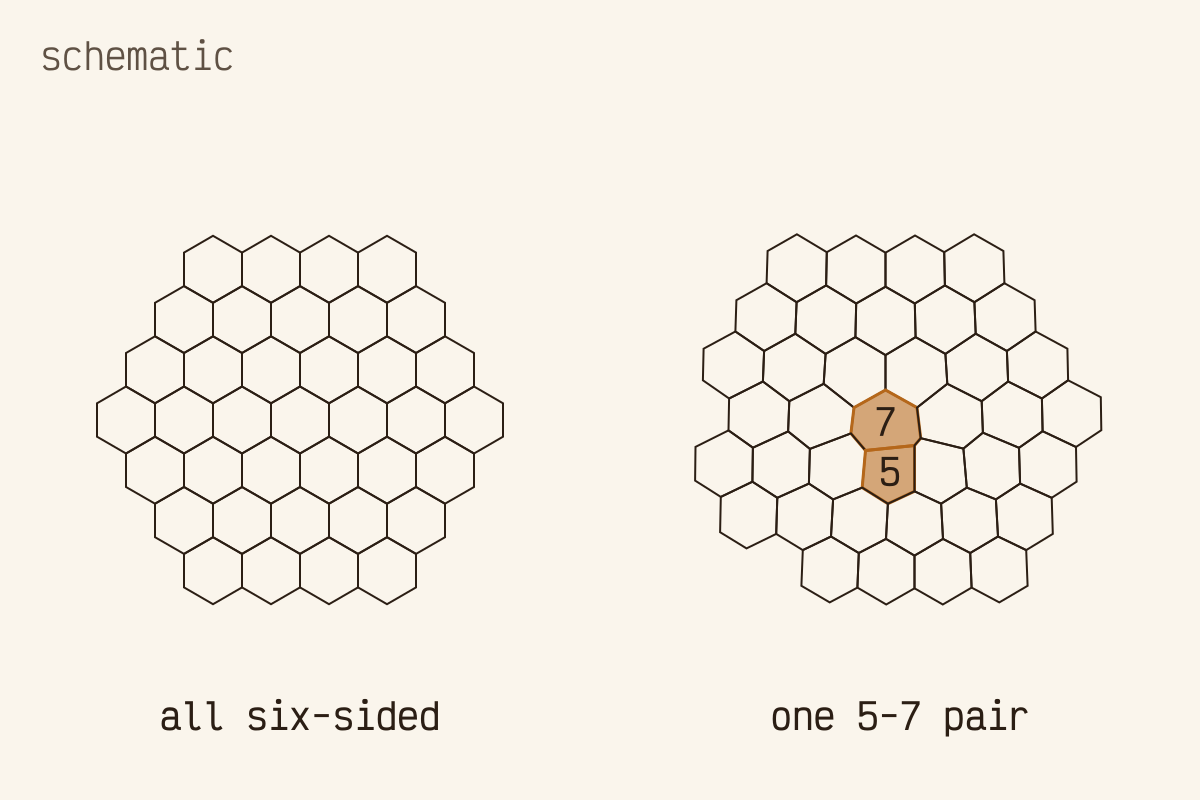
A schematic of a dislocation: shifting the same seed points by one extra half-row puts one five-sided and one seven-sided cell side by side among the six-sided ones. Side counts recounted on the drawn cells: 37 six-sided at left; 36 six-sided, 1 five-sided and 1 seven-sided at right. Drawn from the principle in the 2022 paper, not from its figures.
Recipe triangular lattice, spacing=58; 15 rows of 19 seeds; one edge dislocation, Burgers vector = 1 spacing along x, Poisson ratio 0.3, core offset (0, 0.43) spacings; Lloyd rounds=0; walls = Voronoi bisectors; cells shown within radius 225
"A five- and seven-sided cell pair in a six-sided comb, schematic" by Spiral, Fern & Honeycomb, https://spiralfernandhoneycomb.com/combs-and-cases/paper-wasp-nest/, licensed under CC BY 4.0 (https://creativecommons.org/licenses/by/4.0/).
Data: Krishna, Gopinath & Bhattacharjee 2022, Scientific Reports 12:12901, CC BY 4.0 (principle only)
The paper also records Stone-Wales defects, two pentagons and two heptagons together, and eight-sided cells flanked by pentagons. In its data, a pentagon and a heptagon were never separated by hexagons; they came as neighbors. Six-sided cells next to a pentagon-heptagon pair had corner angles from 99 to 151 degrees, against 90 to 140 degrees in sampled cells of a nest without defects. A regular hexagon has 120.
| Measure (Polistes wattii, 2022 study full text) | Value |
|---|---|
| Nests analyzed for order | 25 |
| Cells per nest | 50 to 740 |
| Wall length, range across nests | 0.1 to 0.9 cm (median 0.3 cm) |
| Cell area, range across nests | 0.07 to 0.85 sq cm (median 0.25) |
| Median orientational order (1 = ideal) | 0.85 |
| Nests with topological defects | 20% (the paper's “low frequency”; base not given) |
This table as CSV (paper-wasp-nest-order.csv) (file notes: source and license) Data: Krishna, Gopinath & Bhattacharjee 2022, Ordering and topological defects in social wasps' nests, Scientific Reports 12:12901, CC BY 4.0, https://pmc.ncbi.nlm.nih.gov/articles/PMC9334299/
How each schematic on this site is built is explained under Each figure regrown.
Why do wasp combs and honeycombs look alike?
Thompson's 1917 answer was physical. He suggested the walls take their final shape by surface tension “while the papery pulp is still liquid, or while the wax is warm” (p. 333), so the same pull of thin films would set the angles in both kinds of comb.
The 2022 authors read the materials the other way. Wax stays workable, so disruptions in a honeycomb's tiling can be corrected. Plant fibers are less plastic, which, they write, makes paper combs “prone to topological defects.” In that reading, the wasp comb keeps a record of its wrong notes that a honeycomb tends to erase.
The 2022 paper leaves open how the wasps produce the pairs. The authors give two alternatives that, in their words, “require further investigations”: a seven-sided cell appears first and is fixed by adding a pentagon, or a five-sided cell made with too little material is fixed by adding a heptagon. They postulate that the wasps inspect and repair cells locally, but it is unknown whether such checks count corners or sense angles.
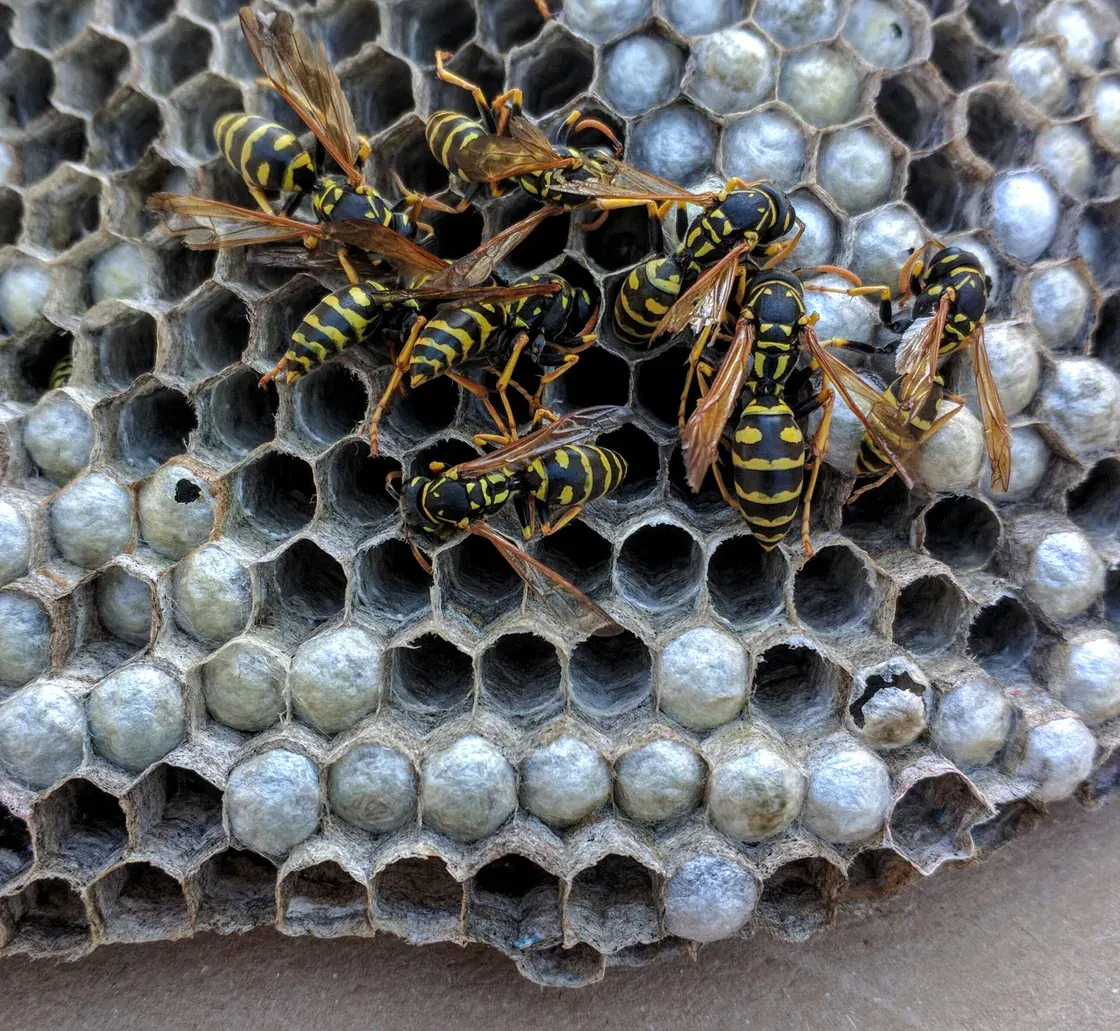
Polistes dominula paper wasps on part of a large nest in Santa Clara County, California, in 2016, according to the file page; open and capped cells sit in offset rows.
"Polistes dominula nest - paper wasps" by Dicklyon — https://commons.wikimedia.org/wiki/File:Polistes_dominula_nest_-_paper_wasps.jpg — CC BY-SA 4.0 (https://creativecommons.org/licenses/by-sa/4.0/); modified: resized to 1120 px wide and saved as WebP
What the two combs share for certain is geometry: six-sided cells packed edge to edge, with three walls at each corner. A behavior they may share, such as starting cells in grooves, remains a candidate. The score is the same tiling; whether wasps and bees perform it the same way is not settled.
Sources
- Krishna S, Gopinath A, Bhattacharjee SM (2022). Ordering and topological defects in social wasps' nests. Scientific Reports 12:12901. doi:10.1038/s41598-022-16836-6. pmc.ncbi.nlm.nih.gov/articles/PMC9334299/Read: full text; Introduction, Methods, Results and ConclusionText license: CC BY 4.0 (terms)
- Thompson DW (1917). On Growth and Form. Cambridge: at the University Press. Author d. 1948 per Project Gutenberg catalog record; public domain in the US (published 1917) www.gutenberg.org/ebooks/55264Read: full text; pp. 332–333
- Nazzi F (2016). The hexagonal shape of the honeycomb cells depends on the construction behavior of bees. Scientific Reports 6:28341. doi:10.1038/srep28341 pmc.ncbi.nlm.nih.gov/articles/PMC4913256/Read: full text; PMC version, CC BY 4.0Text license: CC BY 4.0 (terms)
Cite this page
Spiral, Fern & Honeycomb. “Paper Wasp Nest: One Study Found Order Only Over Short Range.” Published November 23, 2026. https://spiralfernandhoneycomb.com/combs-and-cases/paper-wasp-nest/ (accessed the day you read it).
- How each figure and source is checked
- Retunings: every correction, dated
- Report an error on this page (contact@spiralfernandhoneycomb.com)
More from Combs & Cases
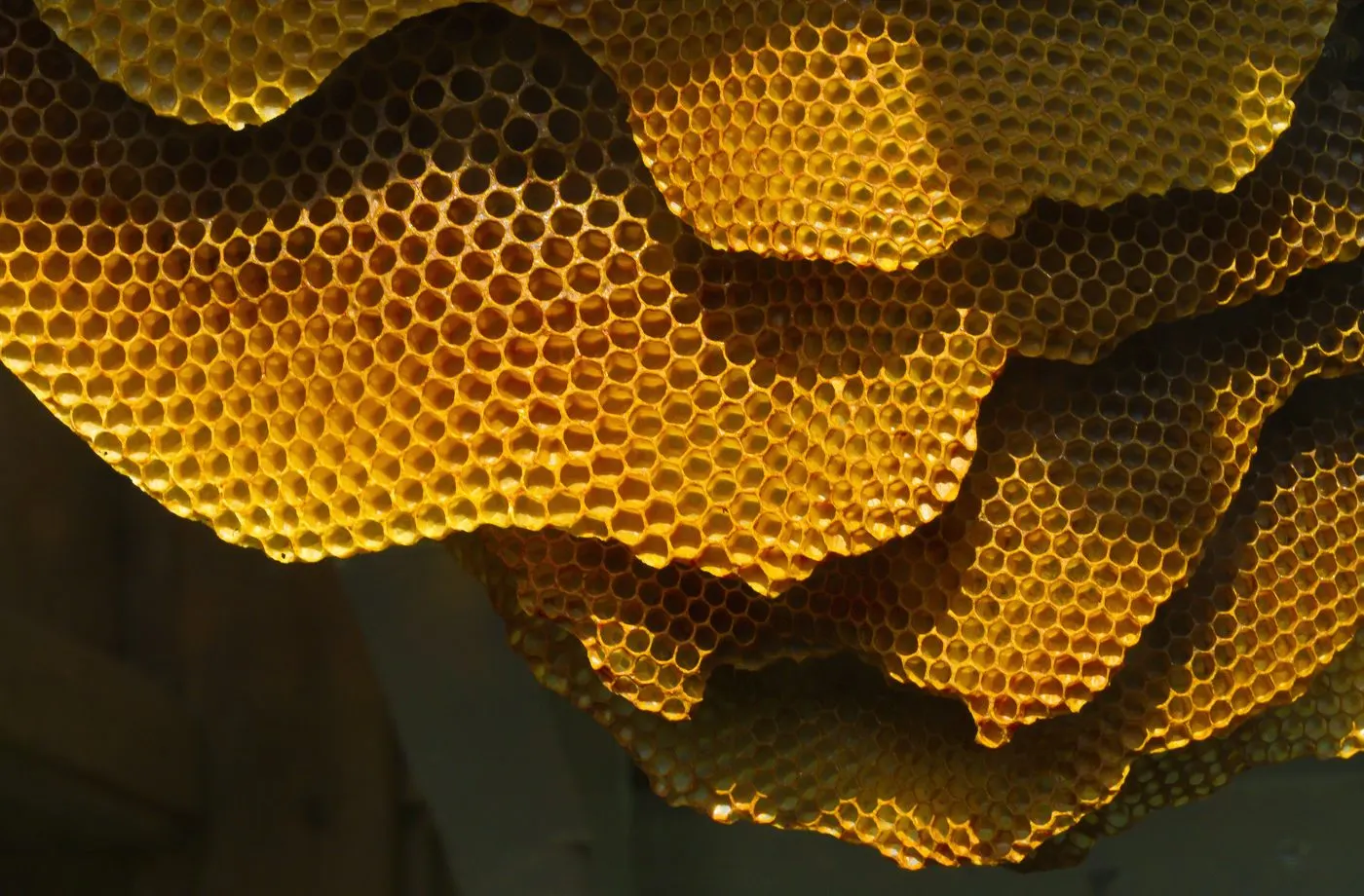
Why Are Honeycombs Hexagonal? Likely Six Equal Neighbors
Picture credit
"Honey Comb Structure" by Gavin Mackintosh from South Molton, United Kingdom — https://commons.wikimedia.org/wiki/File:Honeycomb_structure_(6248780733).jpg — CC BY 2.0 (https://creativecommons.org/licenses/by/2.0/); modified: downscaled from 5066 x 3330 to 1400 x 920 pixels
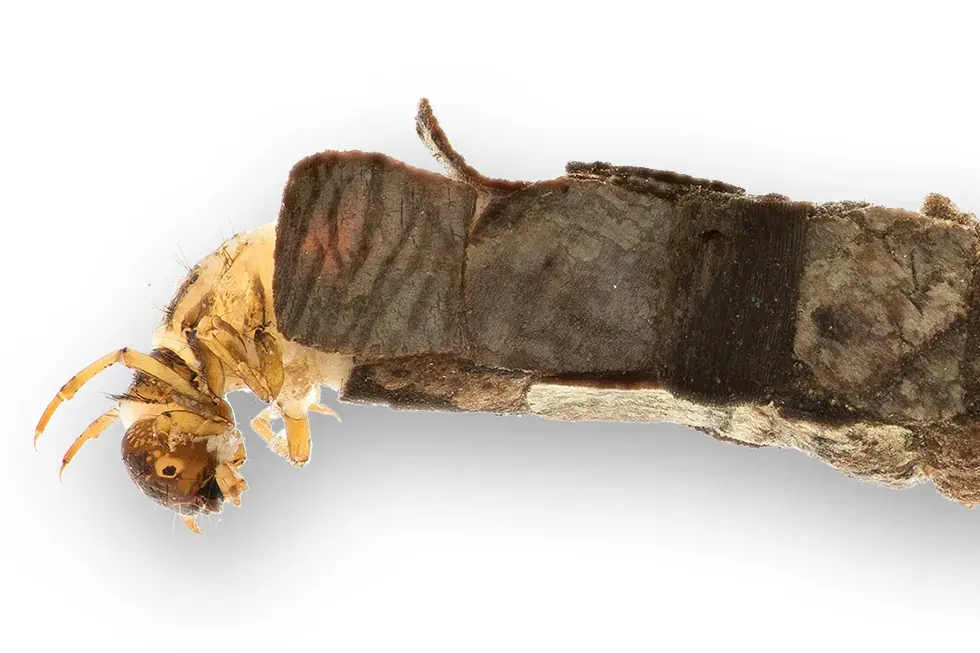
Caddisfly Case: Three Separate Origins in a 2024 Family Tree
Picture credit
"Lepidostoma hirtum larva" by Hallvard Elven, Naturhistorisk museum, Universitetet i Oslo — https://commons.wikimedia.org/wiki/File:Lepidostoma_hirtum_larva.jpg — CC BY 4.0 (https://creativecommons.org/licenses/by/4.0/); modified: cropped to a 3:2 frame around the larva and the front of its case (box 110, 40, 1090, 693 of 2000 x 808, from the original orig-Lepidostoma_hirtum_larva.jpg): the whole larva and about three complete case sections, with the rear of the case left out at the right; original not altered, saved as WebP at the crop's own size, 980 x 653, not enlarged
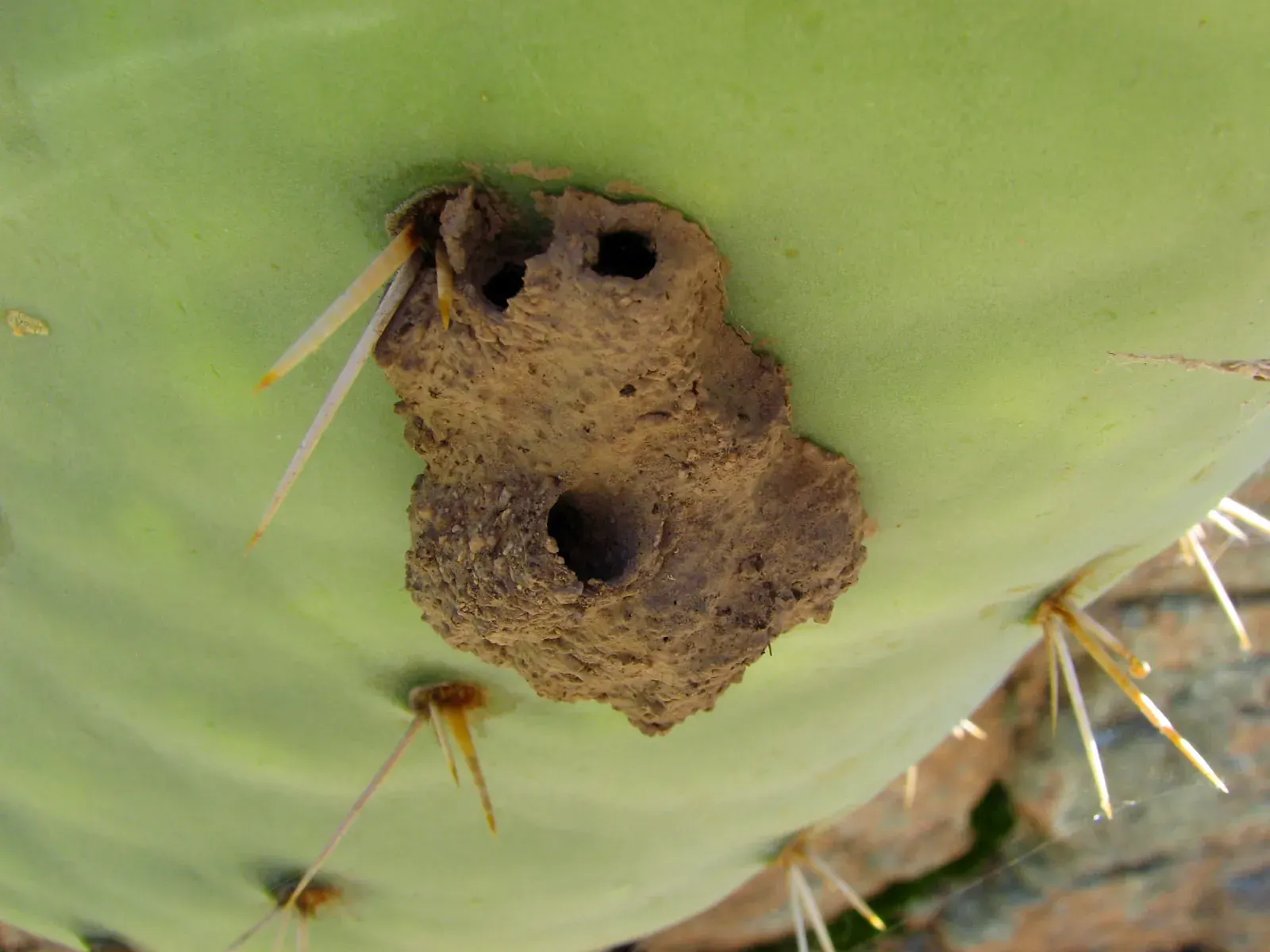
Mud Dauber Nest: Tapping May Pack the Mud Walls Hard
Picture credit
"Mud Dauber Nest" by Katja Schulz — https://commons.wikimedia.org/wiki/File:Mud_Dauber_Nest_-_Flickr_-_treegrow.jpg — CC BY 2.0 (https://creativecommons.org/licenses/by/2.0/); modified: saved as WebP at the original 1600 px width