Alhambra Patterns: The Symmetry Count Depends on the Rules
Same rule, two bodies Spiral, Fern & Honeycomb Published
In brief
The claim that all 17 possible symmetry groups appear on the Alhambra's walls is not settled by the published counts. As summarized by Bodner (2013), a 1944 thesis counted 11, a 1986 study found at most 13 and named four groups missing, and a 1987 study reported finding those four. Bodner's own survey, which treated the patterns as uncolored and counted over-under crossings, found 14 of the 17, so the answer depends on the counting rules.
Pattern card
- Pattern
- Repeating tile, plaster and brick patterns, sorted by the symmetry moves that leave them unchanged
- Where
- Walls, floors and ceilings of the Alhambra, Granada; drawn panels in Owen Jones's The Grammar of Ornament
- Made by
- design: established (Bodner 2013 full text)
- Working recipe
- 1 rule / 1 parameter: with color ignored, repeat one star's square by the moves of p4m; star spacing a, about 137 px on the plate scan (plate 43, panel 1)
- Key source
- Bodner 2013, Proceedings of Bridges 2013, pp. 225-232 full text
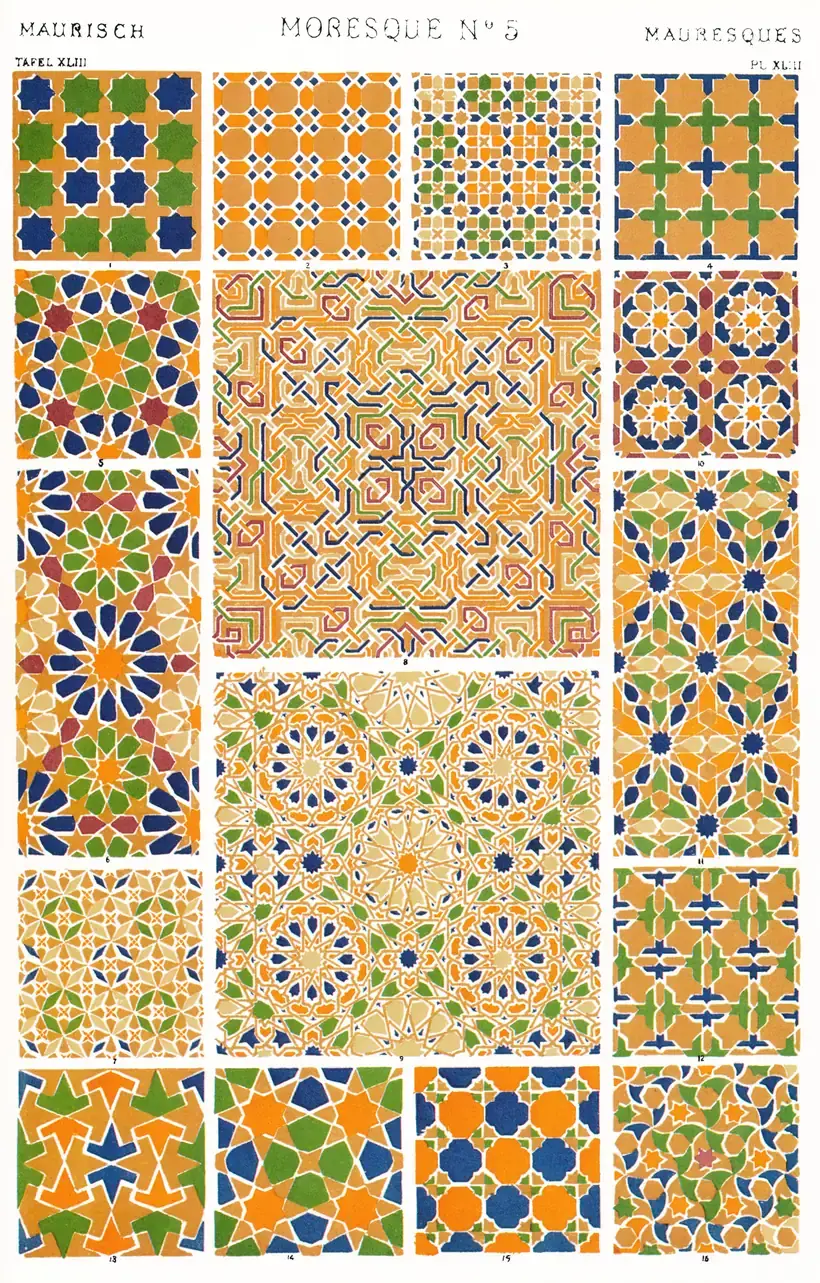
Plate 43, “Moresque No. 5”, from Owen Jones's The Grammar of Ornament, scanned from a later reprint according to the file page: sixteen numbered pattern panels, with star and cross panels and one panel of crossing bands.
“Plate 43, The Grammar of Ornament (1868)”, Owen Jones; Public Domain Mark.
Full credit
"Plate 43, The Grammar of Ornament (1868)" by Owen Jones — https://commons.wikimedia.org/wiki/File:Owen_Jones_-_Grammar_of_Ornament_-_1868_-_plate_043_-_300ppi.jpg — Public domain (EU: Owen Jones d. 1874 per library catalog record; US: published before 1931 (1868); scanned from a later reprint of the 1868 folio edition, according to the file page); modified: whole plate resized from 2433 x 3807 to 820 x 1283 pixels and saved as WebP
Pick one panel on this plate and find the smallest piece that repeats. In the top-left panel, the answer turns on one choice: whether blue and green count as different. Count the colors and the repeating piece holds eight stars; ignore them and it holds one, yet both readings land on the same symmetry group.
Published counts run from 11 groups to a claim of all 17, and choices like that one are part of the reason. Bodner's 2013 paper puts it plainly: the count has varied “sometimes due to inconsistencies in the ways in which the patterns were chosen and analyzed” full text.
How do you count the symmetry groups in a tiled wall?
A symmetry of a pattern is a move that leaves it looking unchanged: a slide, a turn, a mirror flip, or a glide, which is a flip followed by a slide along the mirror line. When a flat pattern repeats in two directions, the full set of such moves is called a wallpaper group. Bodner's paper notes that there are only 17 of them.
Counting means naming the group of each pattern, then listing how many different groups turn up. Three rules have to be fixed first:
- Color: keep it, so a blue star may only land on a blue star, or ignore it, so any star may land on any star.
- Interlacing: count which band passes over which, which can break a mirror, or flatten the bands.
- Idealization: decide how much wear, uneven cutting and missing area to forgive, and how large a patch must be before it counts.
The top-left panel of Owen Jones's plate 43 scanned page has no crossing bands, so only color matters there. This page sorted each pixel of the scanned panel into orange, white, blue or green, then tried each candidate move. A move holds when at least 80 percent of the compared pixels land on their own class, a score of 0.80, and fails below 70 percent. Only pixels clear of the panel's edges are compared.
What did the panel reading find?
With color ignored, a one-star shift, a quarter turn about a star, and mirrors through the stars and along the diagonals all held, at 0.83 to 0.88. That set of moves is the group p4m: quarter turns, with all the turning points on mirror lines.
Once color was kept, the one-star shift failed (0.51), and so did the quarter turn about a star (0.51). A two-star diagonal shift held (0.81), as did a quarter turn about the panel's center and the mirrors between star rows. The group is again p4m, but the smallest repeating piece now holds 8 stars instead of 1.
A reading must also rule out extra symmetry, or a pattern lands in too small a group. Here a half-star shift (0.19) and an eighth turn about a star (0.46) both failed with color ignored. The stars have eight points, but the panel as a whole does not turn by eighths.
The scores depend on where the star centers are placed. A separate recomputation, which located the centers its own way, moved the scores by up to 0.06 without changing any move that decides the group.
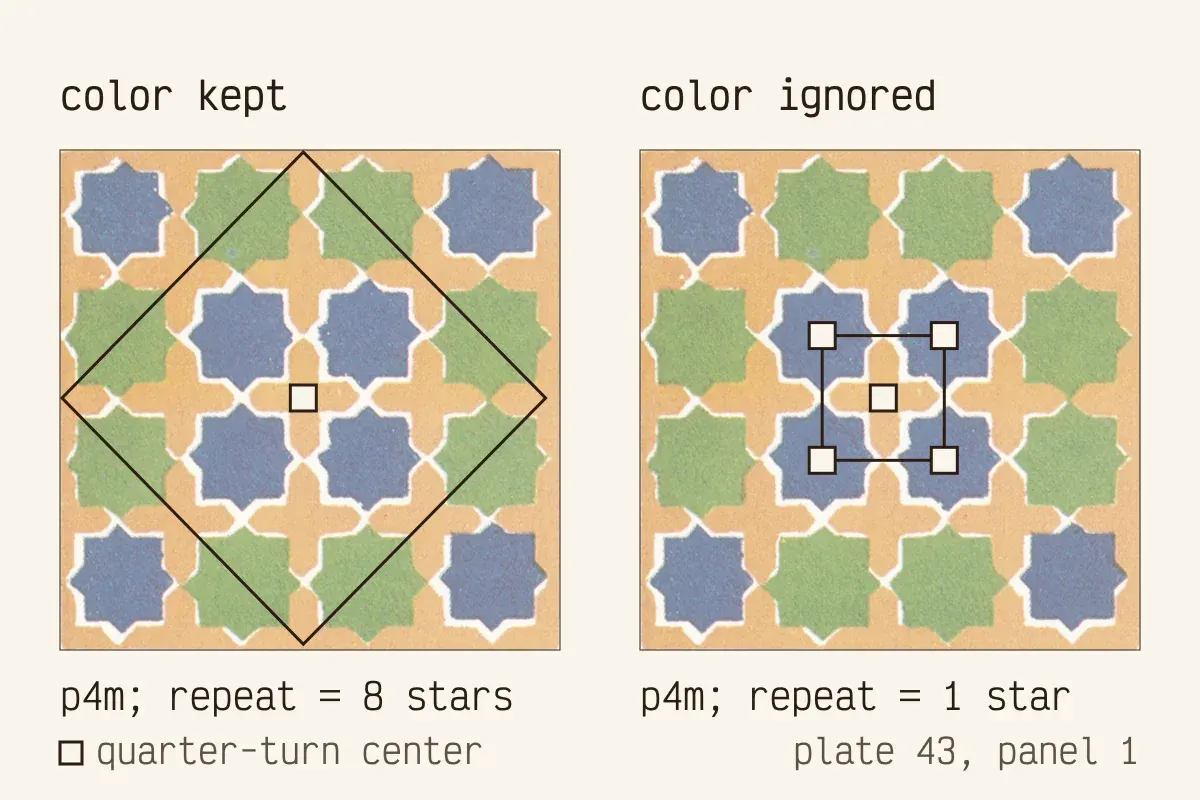
Panel 1 of plate 43, lightened, with the smallest repeating piece outlined: a tilted square holding 8 stars when blue and green count as different, a single star's square when they do not; both readings give p4m.
Recipe crop 559 x 564 px from the 2433 x 3807 scan; star spacing 135.5 px across and 138.9 px down (a, about 137 px), from the centers of the star blobs; classes blue (B > R + 40 and B > G + 10), green (G > R and G > B + 20), white (saturation < 0.25, brightest channel > 170), orange for the rest (blue = green when color is ignored); a move holds when >= 0.80 of compared pixels keep their class and fails below 0.70; pixels within 14 px of the crop edge, before or after the move, are not compared
Read this figure as text
- Color ignored: one-star shifts 0.83 and 0.85, quarter turn about a star 0.84, mirror through a star column 0.84, diagonal mirror 0.88; group p4m, repeat of 1 star.
- Color kept: one-star shifts 0.51 and 0.52 and the quarter turn about a star 0.51 fail; two-star diagonal shift 0.81, quarter turn about the panel center 0.86, mirror between star rows 0.87, diagonal mirror 0.88 hold; group p4m, repeat of 8 stars.
- Extra symmetry: half-star shift 0.19 and 0.13, eighth turn 0.46 and 0.33 (color ignored, then kept); all fail.
- Controls: an arbitrary shift and a 30-degree turn score 0.35 to 0.46.
- Not decisive: a two-star sideways shift with color ignored scored 0.79, between the two cut-offs; the one-star shift it repeats held.
“Plate 43, panel 1: the repeat unit with color kept and with color ignored”, Spiral, Fern & Honeycomb; CC BY 4.0.
Full credit
"Plate 43, panel 1: the repeat unit with color kept and with color ignored" by Spiral, Fern & Honeycomb, https://spiralfernandhoneycomb.com/tilings/alhambra-symmetry/, licensed under CC BY 4.0 (https://creativecommons.org/licenses/by/4.0/). Base layer: "Plate 43, The Grammar of Ornament (1868)" by Owen Jones — https://commons.wikimedia.org/wiki/File:Owen_Jones_-_Grammar_of_Ornament_-_1868_-_plate_043_-_300ppi.jpg — Public domain (EU: Owen Jones d. 1874 per library catalog record; US: published before 1931 (1868); scanned from a later reprint of the 1868 folio edition, according to the file page); modified: whole plate resized from 2433 x 3807 to 820 x 1283 pixels and saved as WebP, panel 1 cropped from the plate scan, shown twice, mixed 45 percent toward the page color, with repeat units and quarter-turn centers drawn over it.
Data: Owen Jones, The Grammar of Ornament, plate XLIII (Moresque No. 5), public domain; symmetry moves tested on the scan by Spiral, Fern & Honeycomb
Symmetry reading (CSV) (file notes: source and license)
Which groups did each count find?
Bodner's 2013 paper opens with the history, and the earlier counts reach this page only through that summary full text. E. Müller's 1944 doctoral thesis reported 11 of the 17 groups, as summarized by Bodner. In 1986, by Bodner's account, Grünbaum, Grünbaum and Shephard reported at most 13 and named four groups they had not found: p2, pg, pgg and p3m1.
A year later, Bodner writes, R. Pérez-Gómez and J. M. Montesinos reported finding those four, which made a claim of all 17. Grünbaum came back to the question in the Notices of the American Mathematical Society in 2006. According to Bodner, he challenged these findings and asked for classification by explicit, stated criteria. That article itself could not be read for this page bibliographic.
Bodner's own survey, made over several days in 2003, set its rules out first. All patterns were treated as uncolored; interlacing and Arabic inscriptions were taken into account, even where they broke a mirror or a turn; small imperfections were ignored. A pattern had to cover about one square meter and repeat at least twice in each of two directions.
Under those rules Bodner reported 14 of the 17 groups, with p2, pmg and p3m1 still missing.
| Study | Groups found | Groups named as missing | Rules stated | Reading level |
|---|---|---|---|---|
| E. Müller, thesis, 1944 | 11 | not given in the summary | not given in the summary | bibliographic, as summarized by Bodner |
| Grünbaum, Grünbaum and Shephard, 1986 | at most 13 | p2, pg, pgg, p3m1 | not given in the summary | bibliographic, as summarized by Bodner |
| Pérez-Gómez and Montesinos, 1987 | 17, claimed | none | not given in the summary | bibliographic, as summarized by Bodner |
| Grünbaum, 2006 | none given in the summary | none | asked for explicit criteria | bibliographic, as summarized by Bodner |
| Bodner, 2013 | 14 | p2, pmg, p3m1 | uncolored; interlacing counted; about 1 square meter; two repeats each way | full text |
Published counts (CSV) (file notes: source and license) Data: Bodner BL (2013). The Planar Crystallographic Groups Represented at the Alhambra. Proceedings of Bridges 2013, pp. 225–232, https://archive.bridgesmathart.org/2013/bridges2013-225.html (facts and counts only)
A photograph of a wall can give only a candidate group, because perspective, wear and the edge of the frame all hide part of the pattern. The wall below, read by eye with color ignored, has curved pieces that turn the same way around each star, so it has three-way turns and no mirrors: a candidate p3. With color kept, that reading cannot be decided: the colors of the curved pieces fit no repeat visible in the frame.
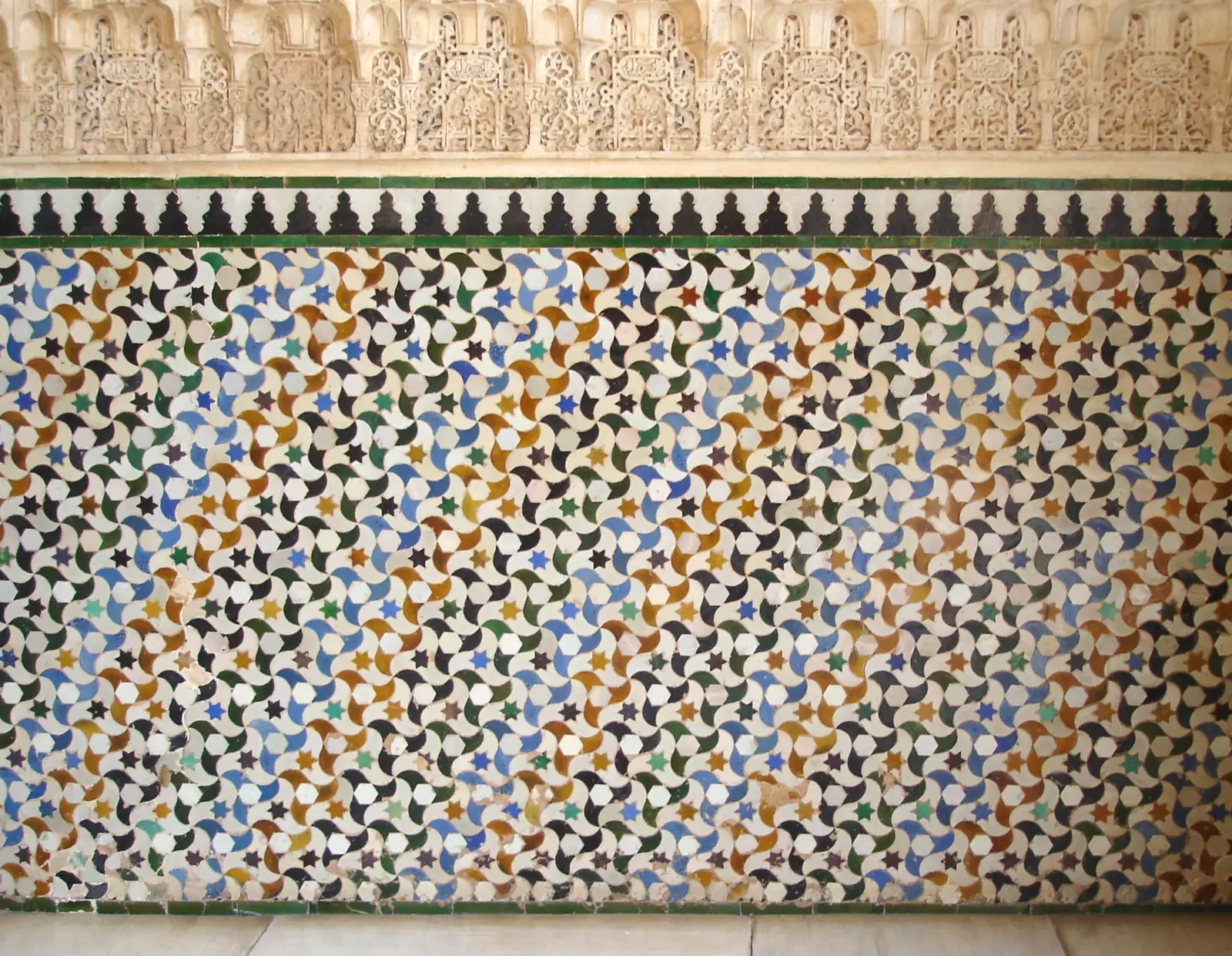
A wall tiling at the Alhambra, digitally enhanced by the photographer and labeled p3 on the file page; ignoring color, the curved pieces turn the same way around each star, a candidate p3, while their colors fit no repeat visible in the frame.
"Alhambra-p3-wall" by Dmharvey — https://commons.wikimedia.org/wiki/File:Alhambra-p3-wall.jpg — CC BY-SA 2.5 (https://creativecommons.org/licenses/by-sa/2.5/); modified: resized to 1600 px on the long edge and saved as WebP
Bodner's own p3 example is a mosaic in a recess of the Court of the Myrtles. The file page places this wall in the same court, which is the file page's statement, not a match this page could check.
Why do the counts disagree?
The claim is that all 17 groups are at the Alhambra. Its basis, as Bodner summarizes it, is the 1987 report of the four groups the 1986 count lacked. Bodner's working explanation for the spread is the one quoted at the top of this page: patterns were chosen and analyzed in different ways.
Bodner's own result shows how far the rules move the number. Two of the groups missing in 1986, pg and pgg, turn up in the 2003 survey: pgg in a brick floor, and pg only by counting which bands pass over and under in a painted fragment whose continuation had to be inferred. The group pmg, which was not on the 1986 list of missing groups as Bodner summarizes it, is one of the survey's three gaps.
What else changes the number?
Single objects are another fork. Bodner describes a 14th-century hexagonal tile shown in the Alhambra Museum whose design, repeated, gives p3m1, but left it out because it is one tile, not a tiled surface.
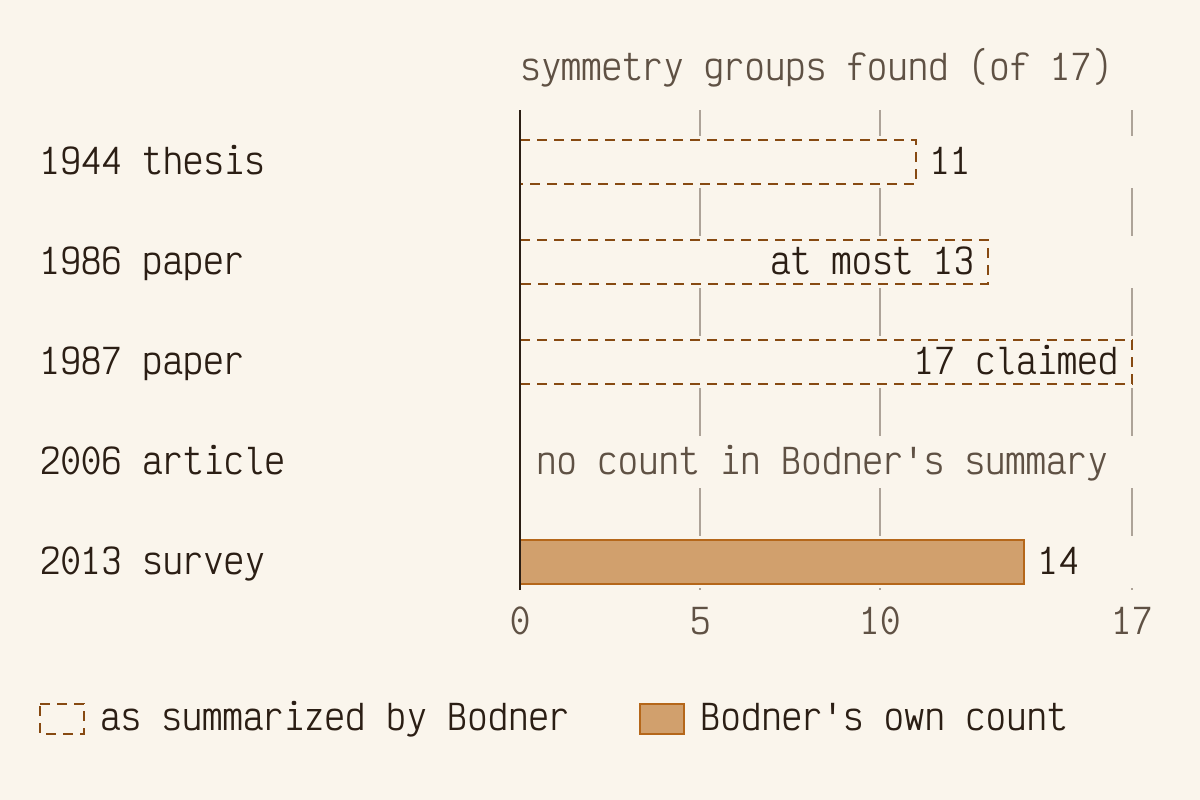
Group counts reported for the Alhambra, the first four as summarized by Bodner (2013), whose own 2013 count is the solid bar; the 1986 bar is an upper bound, the 1987 bar a claim, and the summary gives no count for the 2006 article.
Recipe bars = groups reported, scale 0-17; dashed = count as summarized by Bodner 2013, solid = Bodner's own count; 1986 = upper bound, 1987 = claim, 2006 = no count in the summary
Read this figure as text
- 1944, E. Müller's thesis: 11 groups (as summarized by Bodner; bibliographic).
- 1986, Grünbaum, Grünbaum and Shephard: at most 13 groups; p2, pg, pgg, p3m1 missing (as summarized by Bodner; bibliographic).
- 1987, Pérez-Gómez and Montesinos: reported finding the four missing groups, a claim of 17 (as summarized by Bodner; bibliographic).
- 2006, Grünbaum: no count given in the summary; challenged the findings and asked for explicit criteria (as summarized by Bodner; bibliographic).
- 2013, Bodner: 14 groups; p2, pmg, p3m1 missing (full text).
"Published counts of symmetry groups at the Alhambra" by Spiral, Fern & Honeycomb, https://spiralfernandhoneycomb.com/tilings/alhambra-symmetry/, licensed under CC BY 4.0 (https://creativecommons.org/licenses/by/4.0/).
Data: Bodner BL (2013). The Planar Crystallographic Groups Represented at the Alhambra. Proceedings of Bridges 2013, pp. 225–232, https://archive.bridgesmathart.org/2013/bridges2013-225.html (counts only; earlier counts as summarized there)
On the drawn panel above, color changed the size of the repeat but not the group. Nothing read for this page says how often color changes the group itself on the Alhambra's walls, and Bodner set the question aside by treating all patterns as uncolored.
This page's reading: the claim of all 17 rests on one report that reaches this page only through Bodner's summary, while the one survey read in full, with its rules stated, found 14. That is a count under one set of rules, not a ceiling. Bodner allows that the missing three may have been missed or may sit in rooms the survey could not enter.
What would settle the count?
A settled count needs three things the record read here lacks: one stated set of rules, a list of all patterns with their locations, and access to all rooms. Grünbaum's 2006 request, as Bodner reports it, was for the first of these.
Photographs alone are unlikely to do it. In this second view of a wall of curved pieces and stars, a pinkish flat patch near the upper left stands where several pieces should be, and the glaze colors drift from piece to piece.
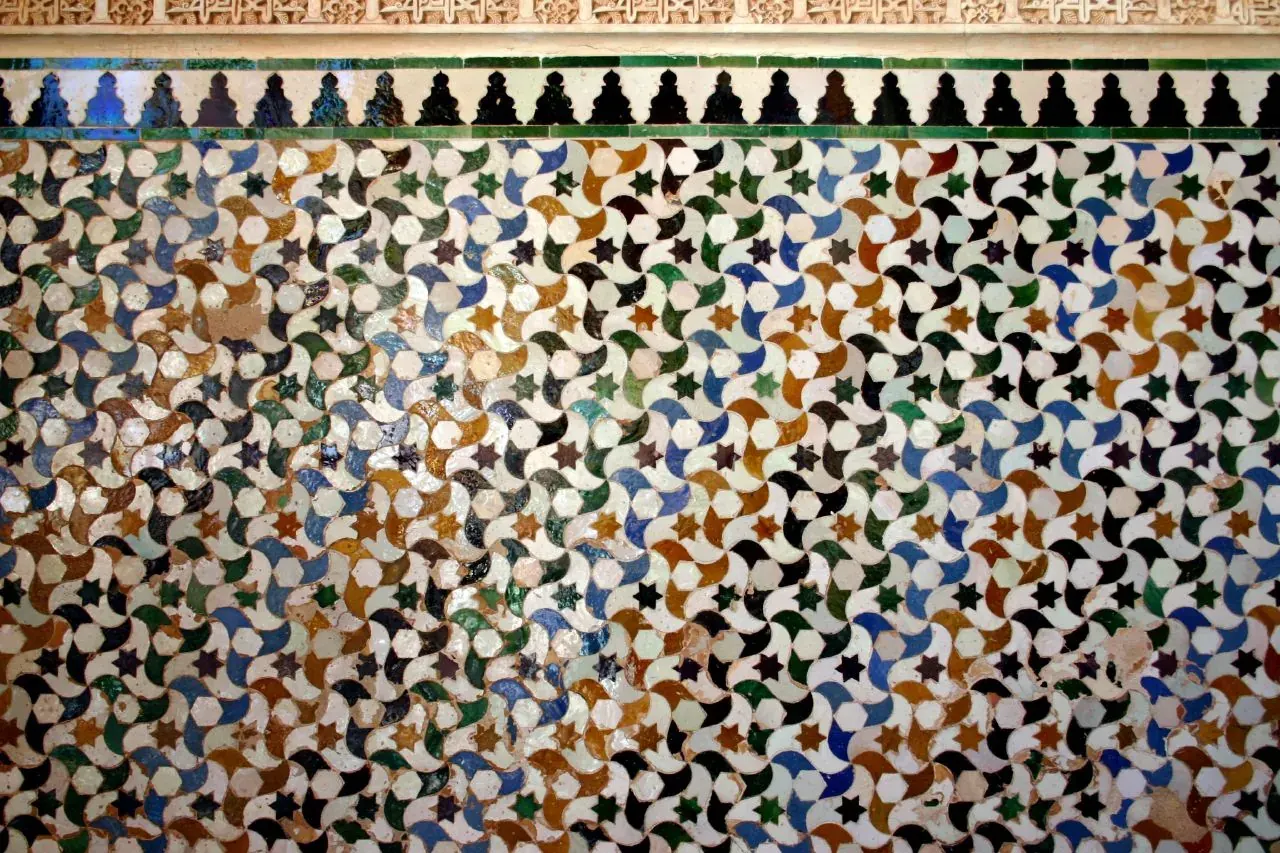
A tile mosaic described on the file page as a tessellation in the Alhambra; a flat patch near the upper left and the uneven glaze colors show how much a color-kept reading would first have to decide what is design and what is repair.
"Tassellatura alhambra" by gruban — https://commons.wikimedia.org/wiki/File:Tassellatura_alhambra.jpg — CC BY-SA 2.0 (https://creativecommons.org/licenses/by-sa/2.0/); modified: saved as WebP at the original 1280 x 853 pixels
Any color-kept reading of a wall like this one must first decide which pieces belong to the design and which are later repair. This page gives a firm group only for the plate, and only a candidate for the photographs, because a drawn plate skips that step: it shows the pattern with no wear left to forgive.
Other pages in this category have physical causes behind their cells: soap film walls meet three at a time in a stable dry foam, and in drying experiments mud cracks shift their joints with each wet-dry cycle. A tiled wall was laid out to a design, so the open question here is not what made it but how to count it.
Sources
- Bodner BL (2013). The Planar Crystallographic Groups Represented at the Alhambra. In Proceedings of Bridges 2013: Mathematics, Music, Art, Architecture, Culture, pp. 225–232. archive.bridgesmathart.org/2013/bridges2013-225.htmlRead: full text; pp. 225–232
- Jones O (1868). The Grammar of Ornament, folio edition, plate XLIII, “Moresque No. 5”. London: Bernard Quaritch. Public domain (Owen Jones d. 1874 per library catalog record). commons.wikimedia.org/wiki/File:Owen_Jones_-_Grammar_of_O…Read: scanned page; plate XLIII only, as scanned from a later reprint

Cite this page
Spiral, Fern & Honeycomb. “Alhambra Patterns: The Symmetry Count Depends on the Rules.” Published November 23, 2026. https://spiralfernandhoneycomb.com/tilings/alhambra-symmetry/ (accessed the day you read it).
- How each figure and source is checked
- Retunings: every correction, dated
- Report an error on this page (contact@spiralfernandhoneycomb.com)
More from Tiles, Cracks & Foams
Mud Cracks: In Lab Clay Dried Again, T Joints Drift Toward Y
Picture credit
"Dry Mud, NPSPhoto" by Everglades NPS from Homestead, Florida, United States — https://commons.wikimedia.org/wiki/File:Dry_Mud,_NPSPhoto_(9257940252).jpg — Public domain (Work of a National Park Service employee made as part of official duties; public domain in the United States under 17 U.S.C. §105; outside the United States the Commons PD-USGov-NPS template is the only basis given; upstream not traced)
Soap Film: In Stable Dry Foam, Walls Meet in Threes at 120°
Picture credit
"Bubbles forming a geometric pattern" by TheresNothingOutThere — https://commons.wikimedia.org/wiki/File:Bubbles_forming_a_geometric_pattern.jpg — CC BY 4.0 (https://creativecommons.org/licenses/by/4.0/); modified: rotated upright by the camera's orientation tag, scaled down to 1200 x 1600 pixels and saved as WebP (quality 55, to keep the web copies under 250,000 bytes)
Voronoi Diagram: Nothing in the Rule Asks for Hexagons
Picture credit
"Dragonfly close up macro photo" by U.S. Fish and Wildlife Service — https://commons.wikimedia.org/wiki/File:Dragonfly_close_up_macro_photo.jpg — Public domain (Work of a U.S. Fish and Wildlife Service employee made as part of official duties; public domain in the United States under 17 U.S.C. §105; outside the United States the Commons PD-USGov-FWS template is the only basis given; upstream not traced (the file page cites a stock-image site as its source)); modified: cropped to remove the inset thumbnail at top left (the top 160 px strip of the 2,048 x 1,312 original), scaled to 1600 x 900 and saved as WebP; no color change