Tree Branching Pattern: Wind May Explain Leonardo’s Rule
Mechanism deep dive Spiral, Fern & Honeycomb Published
In brief
Leonardo da Vinci wrote that all the branches of a tree at any height, put together, equal the trunk below them in thickness (§394 in J. P. Richter's 1883 translation), and later writers read that thickness as cross-section area, which sets the branching exponent delta at 2. When Ryoko Minamino and Masaki Tateno measured 26 branches on beech and fir trees for a 2014 PLOS ONE paper, the forks strayed from that area rule only slightly. A 2011 model by Christophe Eloy proposes that wind may be the reason, but the letter itself reports no field test of the model.
Pattern card
- Pattern
- Branches whose combined thickness matches the trunk below them (Leonardo's rule)
- Where
- Trees, from trunk to twigs; field tests on Fagus crenata and Abies homolepis branches
- Made by
- branching: candidate (wind-load model, Eloy 2011 full text)
- Working recipe
- 1 rule / 1 parameter: at each fork, d^delta = d1^delta + d2^delta, with delta = 2
- Cutoff pair
- observed: 3 to 4 branch levels above the trunk (counted on the cited CC BY 2.0 photograph Winter Tree, 1000 by 621 pixels) · physical: unverified
- Key source
- Richter 1883, The Notebooks of Leonardo da Vinci, par. 394 full text
This card as CSV file notes: source and license
Data: Richter 1883, The Notebooks of Leonardo da Vinci, par. 394 (public domain)
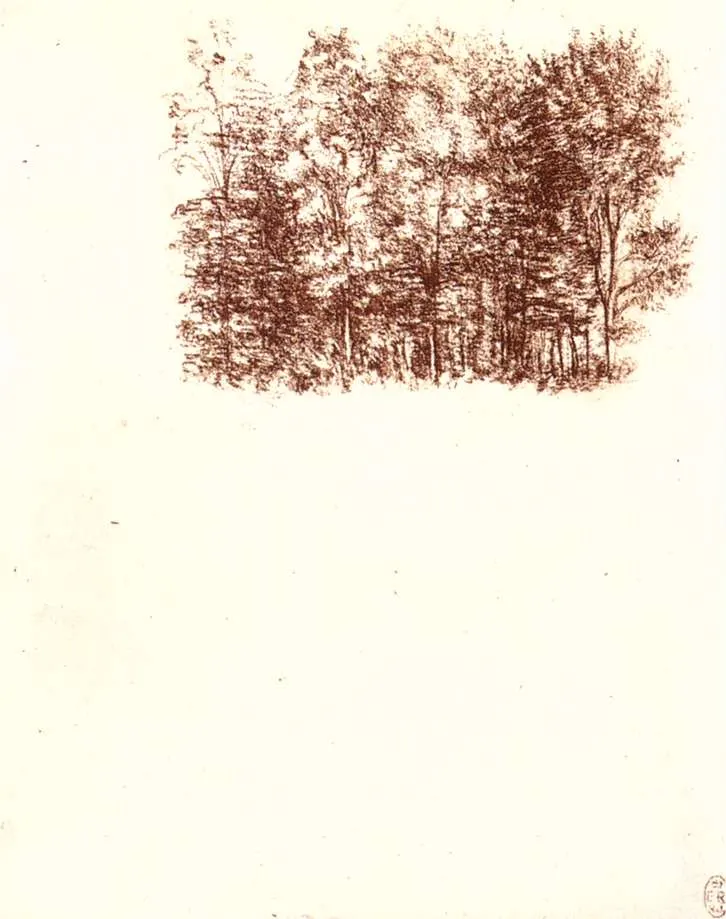
A copse of birches in red chalk, which the file page attributes to Leonardo and dates to about 1500.
"Birch copse (red chalk drawing, about 1500)" by Leonardo da Vinci — https://commons.wikimedia.org/wiki/File:Leonardo_da_vinci,_Birch_copse.jpg — Public domain (EU: Leonardo da Vinci d. 1519 per PG catalog record; US: published before 1931 (PD-old-100 and PD-Art on the file page); faithful reproduction via the Web Gallery of Art, upstream not traced)
Card and share picture, cropped from this figure: "Birch copse (red chalk drawing, about 1500), upper part of the sheet" by Leonardo da Vinci — https://commons.wikimedia.org/wiki/File:Leonardo_da_vinci,_Birch_copse.jpg — Public domain (EU: Leonardo da Vinci d. 1519 per PG catalog record; US: published before 1931 (PD-old-100 and PD-Art on the file page); faithful reproduction via the Web Gallery of Art, upstream not traced); modified: cropped to the upper part of the sheet showing the copse (box 120, 0, 726, 404 of 726 x 919, about the top 44 %, with a little paper margin); original not altered, saved as WebP, not enlarged
Pick up a fallen branch and pinch it just below a fork, then just above it. Each arm above the split feels thinner than the stem below. Leonardo's notebook rule says that if you could add the two arms together, they would match the stem.
That is a claim about adding up, not about any single branch. Two thin arms can hold as much wood across their cut faces as one thick stem. Read as area, the rule says a tree keeps that balance at each fork, from the trunk to the twigs. Use a twig that is already on the ground for this; there is no need to climb a tree or snap a living branch.
What did Leonardo write about tree branches?
The rule sits in a short group of notes headed “The relative thickness of the branches to the trunk,” numbered 393 to 396 in Richter's 1883 English edition full text. The core passage is §394.
“All the branches of a tree at every stage of its height when put together are equal in thickness to the trunk [below them]. All the branches of a water [course] at every stage of its course, if they are of equal rapidity, are equal to the body of the main stream.” (§394)
The next note, §395, repeats the rule for each year's growth and names an exception. It says the measurements at every stage “will always be equal to each other; unless the tree is pollard--if so the rule does not hold good.” A pollard is a tree cut back hard to its trunk.
The word in all of these notes is thickness. They give no unit or measurement, and area is not mentioned. Reading thickness as cross-section area is a later interpretation: the 2014 PLOS ONE paper states the rule as a sum of cross-sectional areas and calls it “Leonardo da Vinci's rule, or the area-preserving rule.”
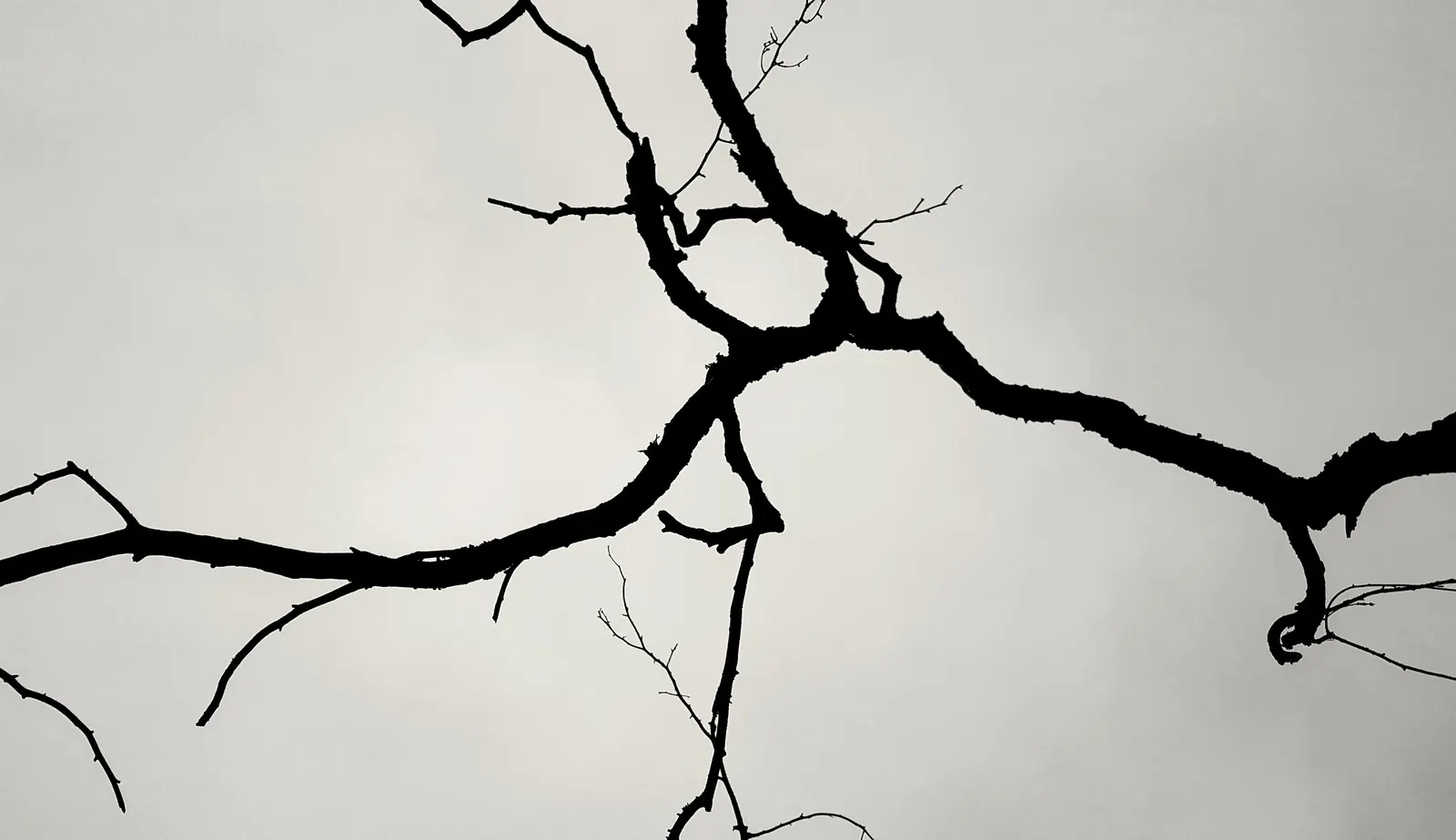
A bare limb seen from below; each thick stem divides into thinner ones, the situation Leonardo's note describes.
"Lonely tree branches (explored)" by Henrik Sandklef from Gothenburg, Sweden — https://commons.wikimedia.org/wiki/File:Lonely_tree_branches_(explored)_-_Flickr_-_sandklef.jpg — CC BY-SA 2.0 (https://creativecommons.org/licenses/by-sa/2.0/)
What does it mean for branches to add up to the trunk?
A round stem's cross-section area grows with the square of its diameter. If a trunk splits into two equal branches and the areas have to add up, each branch needs a diameter of the trunk's diameter divided by the square root of 2, about 0.707 of it. That makes each branch a little over two thirds as wide as the trunk. Together, the two still carry the same area.
Eloy's 2011 letter writes the rule as a model equation. A mother branch of diameter d splits into daughters of diameters d1, d2 and so on, and d raised to a power delta equals the sum of the daughters' diameters raised to the same power. Read as area, Leonardo's rule is the case delta = 2.
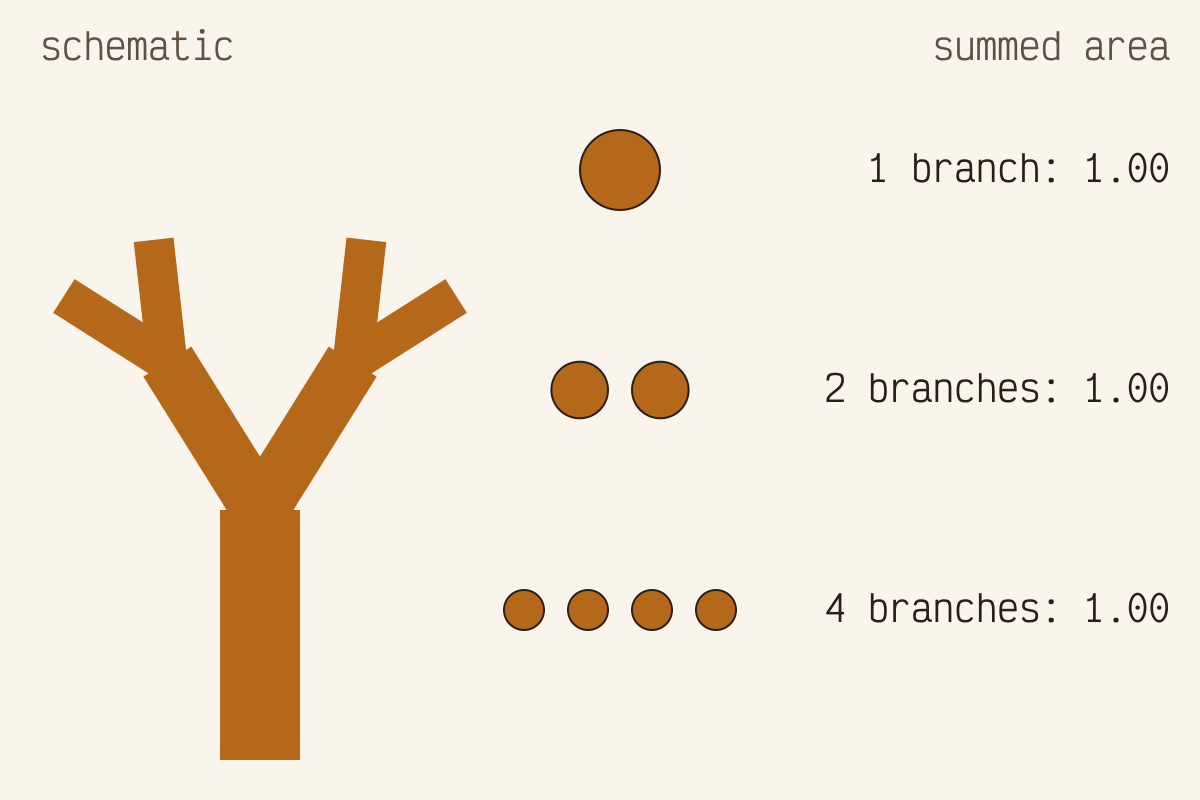
A schematic of the area reading of Leonardo's rule: one trunk, two branches and four branches, each level with the same summed cross-section area of 1.00.
Recipe schematic; trunk d=80, length 250; each fork: two branches of d/sqrt(2), length x0.70; forks=2; spread 32 deg, spread x0.8 per fork
"Leonardo's rule read as area, schematic" by Spiral, Fern & Honeycomb, https://spiralfernandhoneycomb.com/branching/leonardo-tree-rule/, licensed under CC BY 4.0 (https://creativecommons.org/licenses/by/4.0/).
Data: Richter 1883, The Notebooks of Leonardo da Vinci, par. 394 (public domain)
The pinch test from the opening is a rough version of this check. The arms above a fork feel thinner, as the rule predicts: about 0.707 of the stem's width for two equal arms.
Do real trees follow the rule?
Ryoko Minamino and Masaki Tateno put the rule to a field test for a 2014 paper in PLOS ONE full text. They measured 13 branches from six beech trees (Fagus crenata) and 13 branches from seven fir trees (Abies homolepis), and compared the forks with two models of how branches carry their own weight.
The measurements were simple in kind. On each low, roughly horizontal branch, the team took diameters at several forks, from 1 to 14 per branch, in both the horizontal and the vertical direction. They then worked out each cross-section twice, once as an ellipse and once as a circle, and compared the daughters' total area with the mother branch's area.
The forks differed between the two trees. Each beech fork split into 2 daughters, while fir forks split into 2 to 5. The beech branches gave 34 measured forks; the fir branches gave 39 forks with 2 daughters, 37 with 3 and 3 with 4 or 5.
The two weight models set different targets. In the uniform-stress model, the stress on a branch stays the same all along it; in the elastic-similarity model, each branch tip sags by the same fraction of that branch's length.
In their calculations, both weight models matched Leonardo's rule when the side branches left at small angles and were light, and both drifted away from it as the angles and weights grew. The measured forks followed the same trend, but the drift was small. The paper concludes that “Leonardo da Vinci's rule does not rule out compliance with biomechanical models in realistic circumstances.”
The two species did not behave the same way. The beech forks fit the uniform-stress model best, while the fir branches were often in agreement with Leonardo's rule. Eloy's 2011 letter, which proposes its own model, summarizes earlier measurements as placing the exponent between 1.8 and 2.3 for a large number of species.
What changes if the exponent is not 2?
The exponent matters more than it looks. With two equal daughter branches, changing delta changes how much wood the daughters carry compared with their mother.
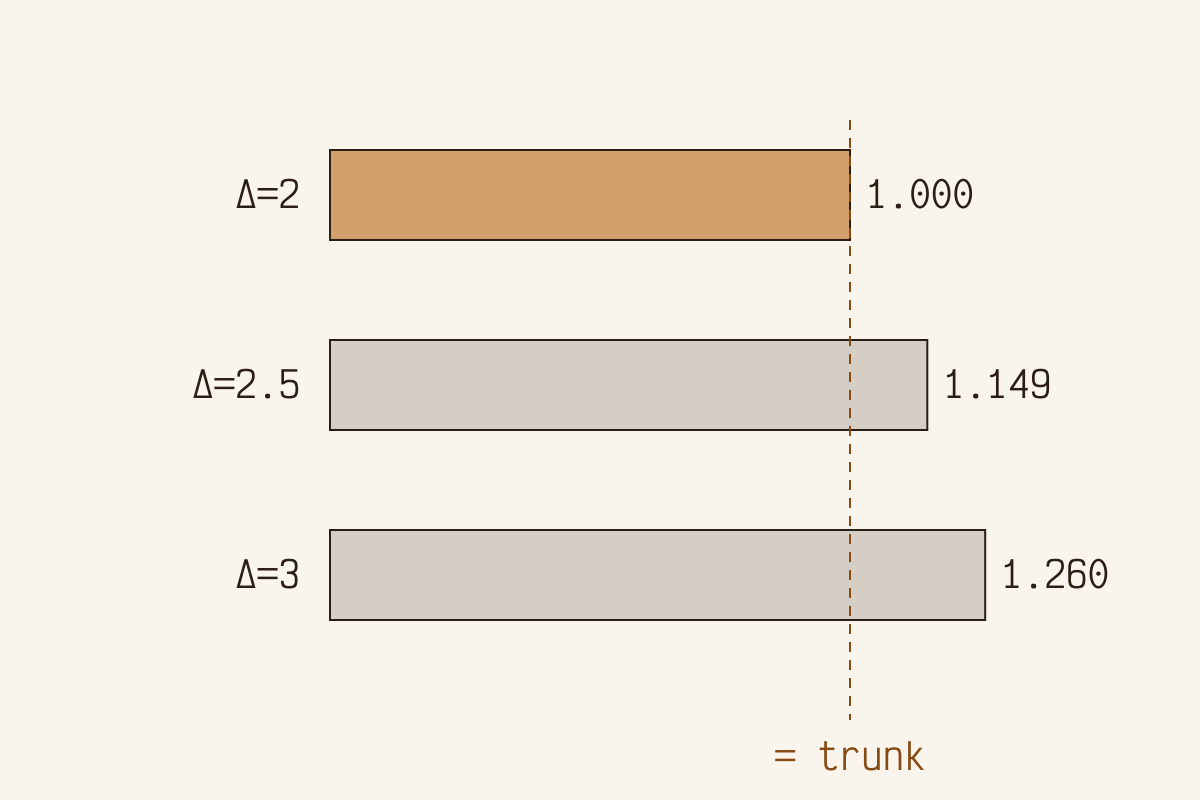
Summed cross-section area of two equal daughter branches compared with the mother branch, for three values of delta; the dashed line marks an area equal to the trunk's.
Recipe two equal daughters; d^delta = d1^delta + d2^delta; delta=2, 2.5, 3; area ratio = 2*2^(-2/delta)
Read this figure as text
- delta = 2: each daughter is 0.707107 of the mother's diameter; the daughters' summed area is 1.000 times the mother's.
- delta = 2.5: each daughter is 0.757858 of the mother's diameter; the summed area is 1.149 times the mother's.
- delta = 3: each daughter is 0.793701 of the mother's diameter; the summed area is 1.260 times the mother's.
"Branching exponent and summed daughter area" by Spiral, Fern & Honeycomb, https://spiralfernandhoneycomb.com/branching/leonardo-tree-rule/, licensed under CC BY 4.0 (https://creativecommons.org/licenses/by/4.0/).
Data: Richter 1883, The Notebooks of Leonardo da Vinci, par. 394 (public domain); ratios computed from d^delta = d1^delta + d2^delta
This table as CSV (leonardo-tree-rule-exponents.csv) (file notes: source and license) Data: Richter 1883, The Notebooks of Leonardo da Vinci, par. 394 (public domain)
At delta = 3, the cube law, the two daughters carry 26 percent more area than the branch they grow from. Cecil D. Murray's 1926 paper on the vascular system and the cost of blood volume is cited here at the bibliographic level only bibliographic. This page uses the cube law only as geometry.
Why might wind produce the rule?
Eloy's 2011 letter, published in Physical Review Letters and read here in its arXiv version full text, proposes that wind may be the reason trees keep to the rule. The letter first sets aside two older explanations. One treats a tree as a bundle of identical pipes running from leaves to roots; the other assumes that each branch bends under its own weight by an amount in proportion to its length.
Against the pipe idea, the letter notes that the wood carrying water may be as little as 5 percent of a branch's cross-section in mature trees. As for the bending idea, Eloy argues that the assumption behind that model is artificial and hard to tie to any advantage for the tree.
How does the wind model work?
The model in its place has two parts. Wind pushes on the leaves at the branch tips, and that push builds into a bending load that grows toward the trunk. Eloy's model then sizes each rank of branches so that all ranks have the same chance of breaking in the wind, on a tree whose branching repeats itself from rank to rank.
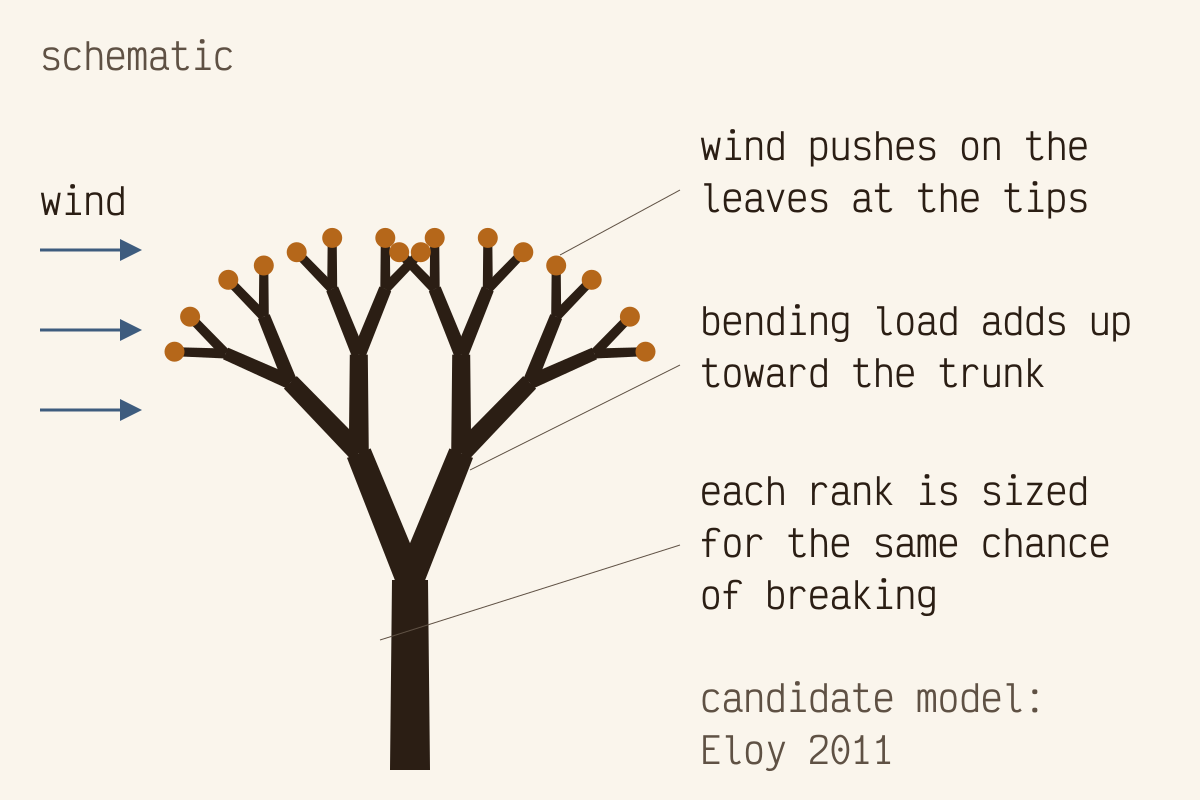
A schematic of the idea Eloy's 2011 model proposes: wind pushes on the leaves at the tips, the load adds up toward the trunk, and each rank of branches is sized for the same chance of breaking, which may give Leonardo's rule.
Recipe schematic; trunk length 190, width 40; ranks=4; forks of 2; spread 22 deg; length x0.72 and width x2^(-1/2) per rank; each segment tapers to 0.9 of its base width; leaves at 16 tips; wind from the left
"Wind load and Leonardo's rule, schematic" by Spiral, Fern & Honeycomb, https://spiralfernandhoneycomb.com/branching/leonardo-tree-rule/, licensed under CC BY 4.0 (https://creativecommons.org/licenses/by/4.0/).
Data: Principle from Eloy 2011, Physical Review Letters 107:258101 (arXiv:1105.2591); drawn independently, no published figure redrawn
Under those assumptions, for a tree that branches without end, a branching skeleton with a fractal dimension between 2 and 3, and one set value (10) for how widely the strength of wood varies, the model gives an exponent between 1.93 and 2.21, close to Leonardo's 2.
In Eloy's summary, the model suggests that “the best design to resist wind-induced fracture in self-similar trees naturally yields Leonardo's rule.” The letter adds that steady loads from fruit, snow or ice would give similar results, so in this model wind is one load among several.
The 2011 letter contains no field test. Eloy proposes one: measure how branch diameters change with the peak wind speeds a tree has to stand. The 2014 study does not settle the question either way. Its branches grew inside a forest, where the authors expected wind effects to be relatively small, and the beech forks fit a weight-based model best.
The rule holds up fairly well as a description, and wind remains a candidate cause rather than an established one. The score is short, and the 2011 letter leaves its performance in a real gale still to be tested.
How far down does the branching repeat?
A mathematical branching pattern can split forever, but a tree stops at its twigs. This site records that limit as the cutoff pair: the range of levels actually counted, kept apart from any physical stopping point that a source has measured.
This page counted branch levels on one CC BY 2.0 photograph, Winter Tree by Tee Cee, 1,000 by 621 pixels, taken in Barking Park, London, according to the file page. The counting rule: start at the trunk and add one level each time a side branch separates as its own line when the photograph is enlarged four times. The count reached 3 to 4 levels above the trunk; the finest twigs blur together at this resolution, so the fourth level is uncertain.

A young bare tree at sunset; counted on the cited photograph, its branching reaches 3 to 4 levels above the trunk before the twigs blur.
"Winter Tree" by Tee Cee from Cheshire, UK — https://commons.wikimedia.org/wiki/File:Winter_Tree_(23537419312).jpg — CC BY 2.0 (https://creativecommons.org/licenses/by/2.0/)
The physical layer stays unverified. None of the sources read for this page measured where a tree's twig branching stops. The 2014 study tested forks on mother branches from 56.0 down to 8.3 millimeters across in beech and from 49.1 down to 6.0 millimeters in fir, a range that marks where the rule was tested and not where branching ends.
Eloy's model assumes a branching skeleton that repeats itself, and the letter notes that the skeleton's fractal dimension had never been measured directly on real trees. Without a measured physical layer, this page makes no numerical fractal claim about trees. The method is set out in Each figure regrown.
Other bodies stop at different depths. Romanesco is a vegetable whose branches repeat a few levels down, and an L-system is a rewrite rule that draws branches on paper for as many steps as anyone cares to run.
Sources
- Richter JP, ed. and trans. (1883). The Notebooks of Leonardo da Vinci, §393–§396 (relative thickness of branches to the trunk). Project Gutenberg eBook 5000. Public domain (Leonardo d. 1519 per Project Gutenberg catalog record; English edition 1883, translator J. P. Richter d. 1937 per Project Gutenberg catalog record). www.gutenberg.org/ebooks/5000Read: full text; §394 and §395 of the English edition
- Minamino R, Tateno M (2014). Tree branching: Leonardo da Vinci's rule versus biomechanical models. PLOS ONE 9(4):e93535. doi:10.1371/journal.pone.0093535 pmc.ncbi.nlm.nih.gov/articles/PMC3979699/Read: full text; open-access article under the Creative Commons Attribution License
- Eloy C (2011). Leonardo's rule, self-similarity and wind-induced stresses in trees. Physical Review Letters 107:258101. doi:10.1103/PhysRevLett.107.258101; preprint arXiv:1105.2591 arxiv.org/abs/1105.2591Read: full text; arXiv version 2 (2011-11-15)
- Murray CD (1926). The physiological principle of minimum work: I. The vascular system and the cost of blood volume. Proceedings of the National Academy of Sciences 12(3):207–214. doi:10.1073/pnas.12.3.207 doi.org/10.1073/pnas.12.3.207Read: bibliographic
Cite this page
Spiral, Fern & Honeycomb. “Tree Branching Pattern: Wind May Explain Leonardo’s Rule.” Published November 23, 2026. https://spiralfernandhoneycomb.com/branching/leonardo-tree-rule/ (accessed the day you read it).
- How each figure and source is checked
- Retunings: every correction, dated
- Report an error on this page (contact@spiralfernandhoneycomb.com)
More from Branching
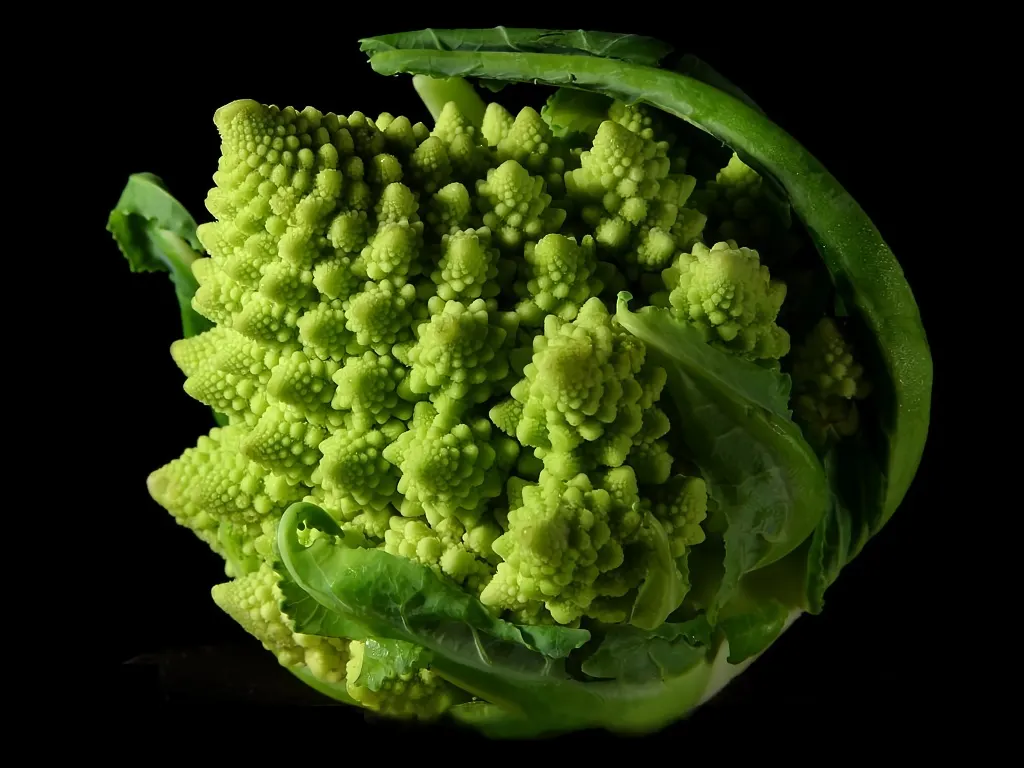
Romanesco Broccoli: Three Levels of Cones on Two Photos
Picture credit
"Fractal Broccoli" by Jon Sullivan (PD Photo.org) — https://commons.wikimedia.org/wiki/File:Fractal_Broccoli.jpg — Public domain (author's own public domain release (PD-author tag on the file page): in the US, released into the public domain by the author and copyright holder Jon Sullivan; in the EU and other countries, the same release applies worldwide, and where that is not legally possible the author grants anyone the right to use the work for any purpose without conditions; the quoted source page adds a CC0 designation for non-US use); modified: background behind the table replaced to remove a basket by Commons user David.Monniaux (retouched upstream, according to the file page); not altered here
Crown Shyness: Swaying Branches May Wear the Gaps Open
Picture credit
"Dryobalanops aromatica canopy" by Patrice78500 — https://commons.wikimedia.org/wiki/File:Dryobalanops_Aromatica_canopy.jpg — Public domain (released into the public domain worldwide, including the US and the EU, by the copyright holder, Patrice78500 (PD-self on the file page); no term of protection relied on); modified: saved as WebP at the original 1,020 x 765 pixels
L-System Plants: One Rewrite Rule Draws a Branching Weed
Picture credit
"Starr 070308-5329 Capsella bursa-pastoris" by Forest & Kim Starr — https://commons.wikimedia.org/wiki/File:Starr_070308-5329_Capsella_bursa-pastoris.jpg — CC BY 3.0 (https://creativecommons.org/licenses/by/3.0/); modified: resized from 2,112 x 2,816 to 900 x 1,200 pixels and saved as WebP