L-System Plants: One Rewrite Rule Draws a Branching Weed
Pattern entry Spiral, Fern & Honeycomb Published
In brief
An L-system is a set of rewrite rules, introduced in 1968 by Lindenmayer according to the preface of The Algorithmic Beauty of Plants full text, that replaces all the letters of a string at once; here the string is then read as drawing steps. The branching weed of that book's Fig. 1.24(a), p. 25, needs a single rule, F becomes F[+F]F[-F]F, with a turning angle of 25.7 degrees; after four rewrites the string holds 1,561 symbols and draws 625 line segments. The rule draws a weed-like outline; it does not show how a real plant grows.
Pattern card
- Pattern
- A branching weed drawn from one rewrite rule: each line becomes five lines with one side branch to the left and one to the right, step after step
- Where
- Drawn plant models in The Algorithmic Beauty of Plants; on this page set beside photographs of real branching weeds
- Made by
- branching: simulation-only (the rule draws a weed-like shape; a real plant is not shown to grow from a string)
- Shortest recipe
- 1 rule / 1 parameter: F -> F[+F]F[-F]F; delta=25.7 deg; shortest of 5 candidates in this page's comparison record; steps and step length are display settings
- Key source
- Prusinkiewicz & Lindenmayer 1990, The Algorithmic Beauty of Plants, Fig. 1.24(a), p. 25 full text
This card as CSV file notes: source and license
Data: Prusinkiewicz & Lindenmayer 1990, The Algorithmic Beauty of Plants, Fig. 1.24(a), p. 25
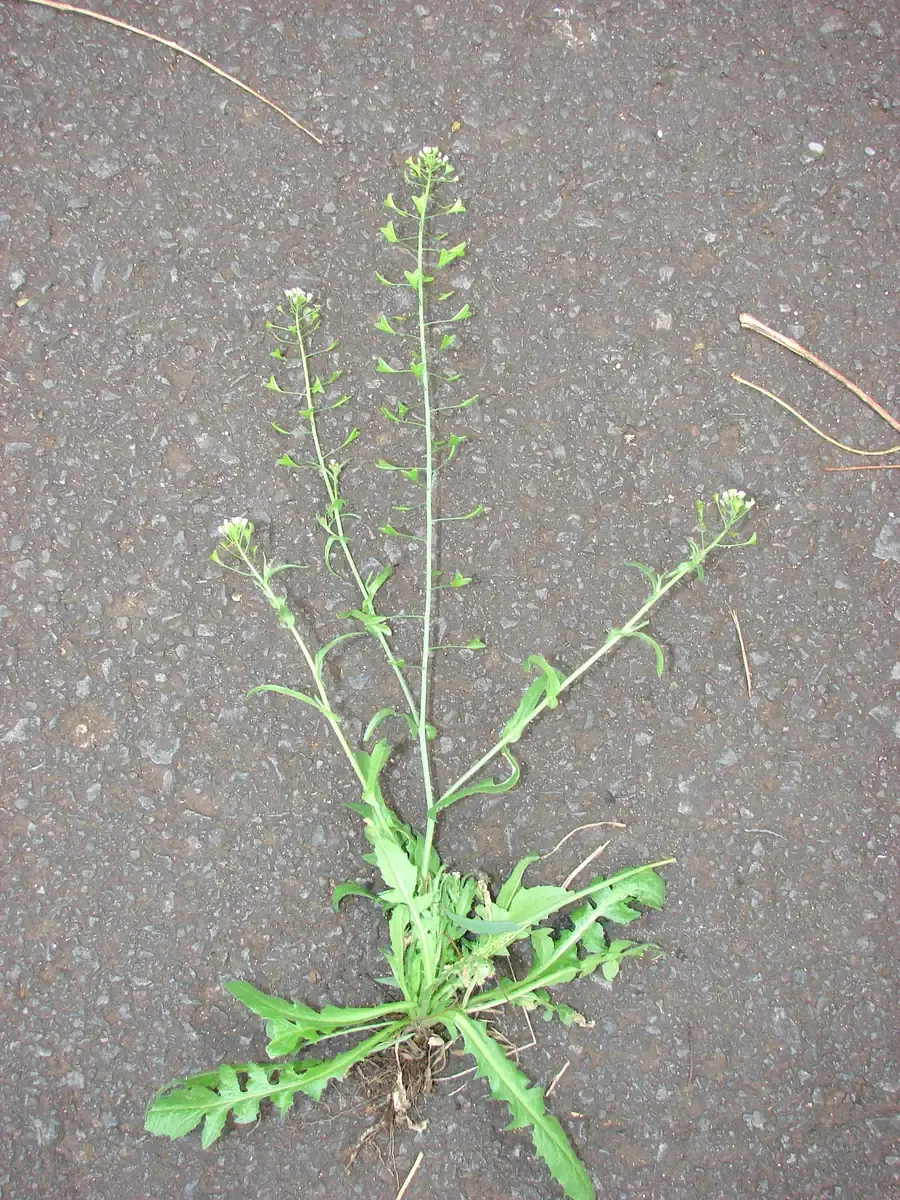
A whole weed laid on asphalt with its roots showing, named Capsella bursa-pastoris on its file page; its flowering stems fork off near the base and branch again higher up.
"Starr 070308-5329 Capsella bursa-pastoris" by Forest & Kim Starr — https://commons.wikimedia.org/wiki/File:Starr_070308-5329_Capsella_bursa-pastoris.jpg — CC BY 3.0 (https://creativecommons.org/licenses/by/3.0/); modified: resized from 2,112 x 2,816 to 900 x 1,200 pixels and saved as WebP
Write F on a sheet of paper, then replace it with F[+F]F[-F]F and repeat. Each round swaps all the F's at once, so a single F becomes 5, then 25, then 125. Read as instructions for a pen, the lengthening string draws a weed whose branches carry smaller branches of their own.
What is an L-system?
An L-system is a procedure for growing a string of symbols by repeated substitution. A rule, called a production, says what each letter turns into, and all the letters are replaced in the same step. The Algorithmic Beauty of Plants, by Przemyslaw Prusinkiewicz and Aristid Lindenmayer (1990), puts the difference from Chomsky grammars, which apply rules one after another, this way: in L-systems the rules “are applied in parallel and simultaneously replace all letters in a given word” (p. 3).
The string becomes a picture when a pen, called a turtle in the book, follows it one symbol at a time:
- F: draw one step forward.
- +: turn left by the angle delta.
- -: turn right by delta.
- [: remember the pen's position and heading.
- ]: jump back to the last remembered position and heading.
The brackets make the branches. The book describes [ as pushing the turtle's state onto a stack and ] as retrieving it (p. 24), so everything between a pair of brackets becomes a side branch, and the drawing then continues from the position where that branch began.
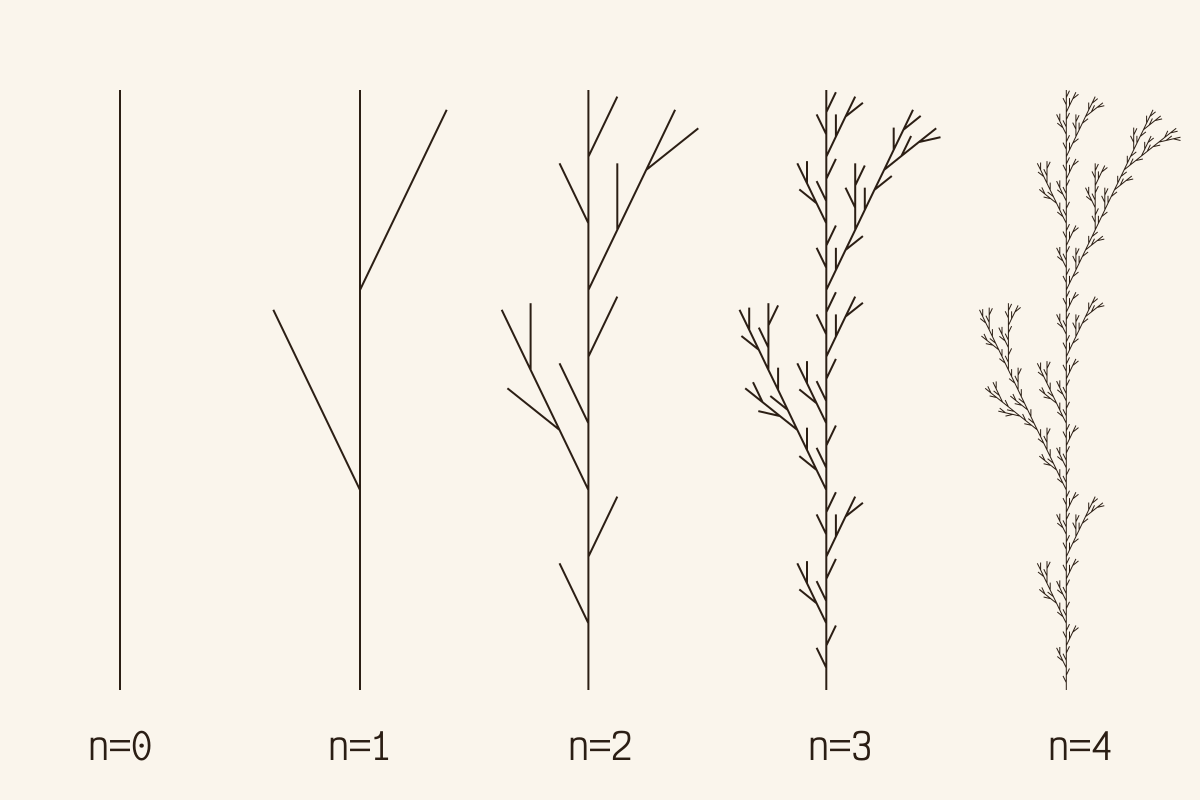
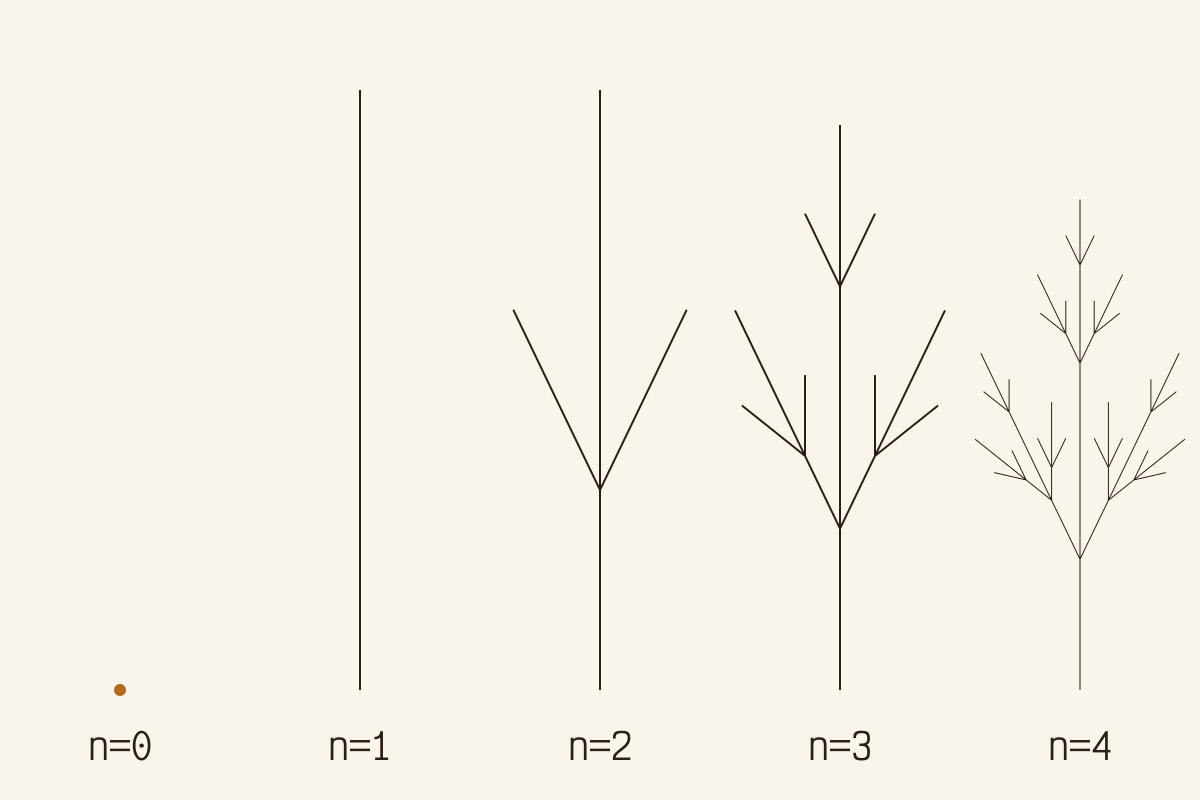
The rule of Fig. 1.24(a), drawn here from the printed rule for 0 to 4 rewrites, each panel scaled to the same height; the book's own figure goes one step further, to 5.
Recipe F -> F[+F]F[-F]F; delta=25.7; n=0-4 (ABOP Fig. 1.24(a), p. 25)
"L-system weed, Fig. 1.24(a) rule, 0 to 4 rewrites" by Spiral, Fern & Honeycomb, https://spiralfernandhoneycomb.com/branching/l-system/, licensed under CC BY 4.0 (https://creativecommons.org/licenses/by/4.0/).
Data: Rule F -> F[+F]F[-F]F and angle 25.7 degrees from Prusinkiewicz & Lindenmayer 1990, The Algorithmic Beauty of Plants, Fig. 1.24(a), p. 25
Each rewrite multiplies the number of F's by five, because each F is replaced by a string containing five of them. Counted on this page's strings:
| Rewrites (n) | Symbols in the string | F's (line segments) | Branches opened |
|---|---|---|---|
| 0 | 1 | 1 | 0 |
| 1 | 11 | 5 | 2 |
| 2 | 61 | 25 | 12 |
| 3 | 311 | 125 | 62 |
| 4 | 1,561 | 625 | 312 |
This table as CSV (l-system-generations.csv) (file notes: source and license) Data: Rules from Prusinkiewicz & Lindenmayer 1990, The Algorithmic Beauty of Plants, Fig. 1.24, p. 25; counts computed on this site
The rule stays one line long, while the string it generates grows more than five times longer at each step. Each figure regrown sets out how the counts were checked.
How do a few rewrites grow a plant?
One small edit to the rule alters the whole plant. Fig. 1.24(b) on the same page puts the last F of the rule in brackets, F[+F]F[-F][F], and uses a smaller angle of 20 degrees.
Because the pen jumps back after that bracketed F, the rest of the plant grows from the point below it rather than from its tip, so from the second rewrite on, several shoots can leave one point. After four rewrites the string has 1,873 symbols and still 625 F's, but it opens 468 branches instead of 312, so the plant looks denser and bushier.
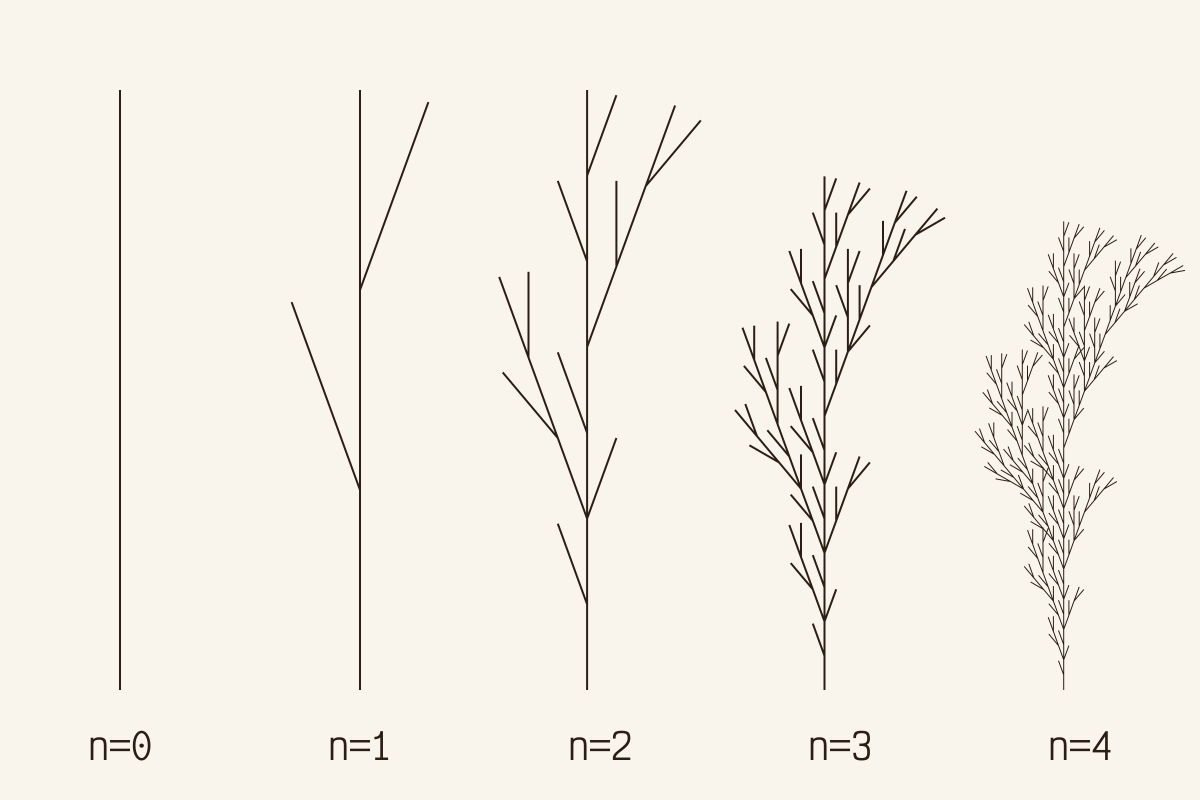
The rule of Fig. 1.24(b), drawn here from the printed rule for 0 to 4 rewrites; with the last F in brackets, later growth starts below each segment's tip, so shoots crowd at shared points.
Recipe F -> F[+F]F[-F][F]; delta=20; n=0-4 (ABOP Fig. 1.24(b), p. 25)
"L-system weed, Fig. 1.24(b) rule, 0 to 4 rewrites" by Spiral, Fern & Honeycomb, https://spiralfernandhoneycomb.com/branching/l-system/, licensed under CC BY 4.0 (https://creativecommons.org/licenses/by/4.0/).
Data: Rule F -> F[+F]F[-F][F] and angle 20 degrees from Prusinkiewicz & Lindenmayer 1990, The Algorithmic Beauty of Plants, Fig. 1.24(b), p. 25
Both weeds grow the same way on paper: at each step, each segment, whether old or new, is replaced by five segments, some of them on new side branches. That is a procedure for drawing, and the drawing order says nothing about the sequence in which a real plant's stems appear.
Can two different rules draw a similar plant?
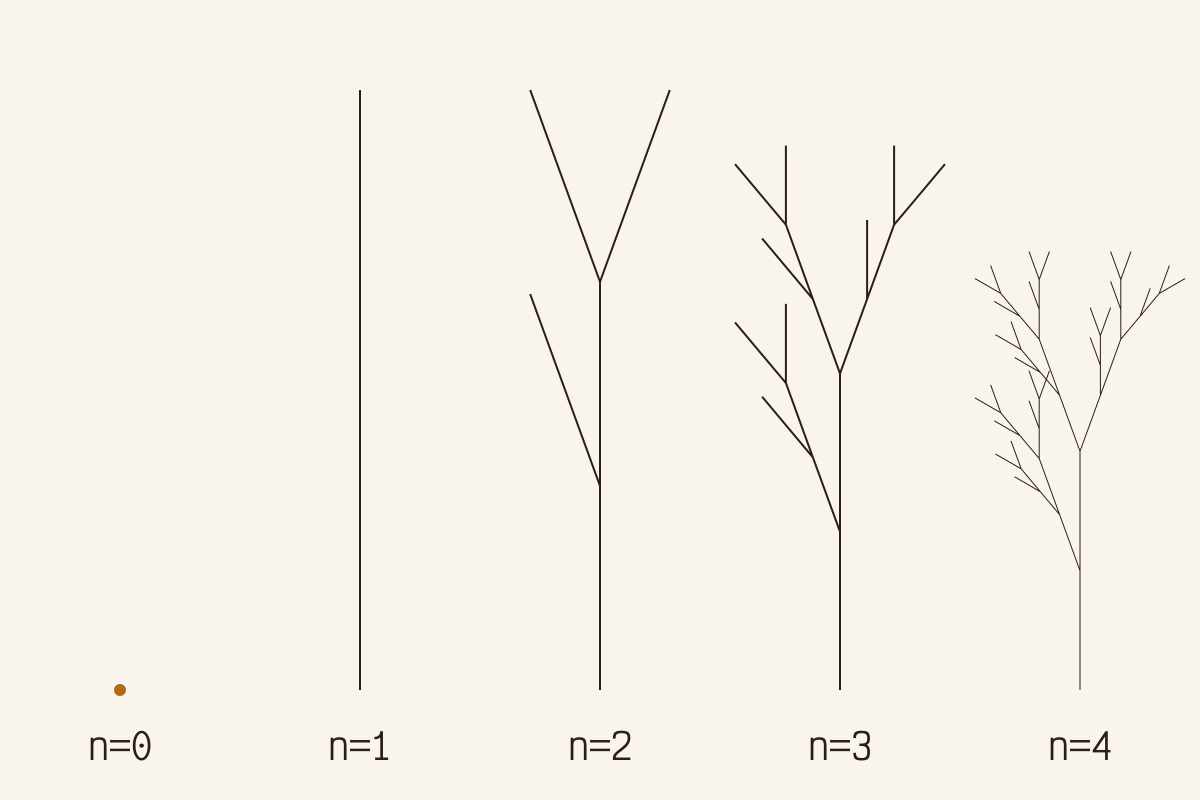
Yes, and the same page of the book shows two of them. Figs. 1.24(d) and (e) introduce a second letter, X, that the pen ignores: it marks a position where new branches will appear. Their rules are X becomes F[+X]F[-X]+X for (d) and X becomes F[+X][-X]FX for (e), and both add F becomes FF, so each existing segment doubles in length at each step.
"L-system plant, Fig. 1.24(d) rule, 0 to 4 rewrites" by Spiral, Fern & Honeycomb, https://spiralfernandhoneycomb.com/branching/l-system/, licensed under CC BY 4.0 (https://creativecommons.org/licenses/by/4.0/).
Data: Rules X -> F[+X]F[-X]+X, F -> FF and angle 20 degrees from Prusinkiewicz & Lindenmayer 1990, The Algorithmic Beauty of Plants, Fig. 1.24(d), p. 25
"L-system plant, Fig. 1.24(e) rule, 0 to 4 rewrites" by Spiral, Fern & Honeycomb, https://spiralfernandhoneycomb.com/branching/l-system/, licensed under CC BY 4.0 (https://creativecommons.org/licenses/by/4.0/).
Data: Rules X -> F[+X][-X]FX, F -> FF and angle 25.7 degrees from Prusinkiewicz & Lindenmayer 1990, The Algorithmic Beauty of Plants, Fig. 1.24(e), p. 25
The rules of Fig. 1.24(d), first, and (e), second, drawn here from the printed rules for 0 to 4 rewrites; the dot at n=0 is the undrawn letter X. The book's figures go to 7 rewrites.
Recipe (d) X -> F[+X]F[-X]+X, F -> FF, delta=20; (e) X -> F[+X][-X]FX, F -> FF, delta=25.7; n=0-4 (ABOP Fig. 1.24, p. 25)
After four rewrites the two plants have the same counts on this page's strings: 130 segments and 27 tips each. The branching differs. Plant (d) has 26 points where the stem splits in two; plant (e) has 13 points where three shoots leave together.
Which rule is the shortest recipe?
The shortest recipe is this site's name for the rule that ranks shortest among the candidates in a page's comparison record while still passing a stated check. Rules and parameters are counted, and fewer of both together ranks first; on a tie, fewer parameters wins.
Here the check asks which candidates rebuild the branching of the Fig. 1.24(a) weed after 5 rewrites, the step count of the book's figure. It compares four features: 1,563 tips, 1,562 branch points, at most 2 shoots at one point and a deepest branch level of 5. Each candidate was rewritten from step 1 until all four features matched, or up to step 9 if none did, and the angle does not enter the check.
| Candidate rule | Rules / parameters | Rebuilds Fig. 1.24(a)? | Where it comes from |
|---|---|---|---|
| F -> F[+F]F[-F]F; delta | 1 / 1 | yes, at step 5 | Fig. 1.24(a) |
| F -> F[+F]F[-F][F]; delta | 1 / 1 | no | Fig. 1.24(b) |
| F -> F[+F]F[-F]F; left and right angles | 1 / 2 | yes, at step 5 | a variant set up on this site |
| X -> F[+X]F[-X]+X; F -> FF; delta | 2 / 1 | no | Fig. 1.24(d) |
| X -> F[+X][-X]FX; F -> FF; delta | 2 / 1 | no | Fig. 1.24(e) |
This table as CSV (l-system-recipes.csv) (file notes: source and license) Data: Candidate rules (a), (b), (d) and (e) from Prusinkiewicz & Lindenmayer 1990, The Algorithmic Beauty of Plants, Fig. 1.24, p. 25; checks computed on this site
The book's own rule passes, as it must, since the target is the branching that rule produces. The record shows which neighbors also pass and at what cost: the two-angle version passes with one more parameter, and the other three fail.
The shortest recipe in this record is the Fig. 1.24(a) rule, 1 rule and 1 parameter. It is the shortest of these five, not the shortest rule that could ever draw this weed.
Do real plants grow like this?
Not by this page's reading. The book's caption for Fig. 1.24 presents the drawings as examples of structures that look like plants (p. 25). Its opening chapter explains the parallel rewriting by a different picture: the rules are meant to capture cell divisions in organisms made of many cells, where many divisions may happen at the same time (p. 3).
A drawing that resembles a weed demonstrates that a short rule can produce that outline. It does not demonstrate that a weed constructs itself by rewriting a string, so the Pattern card classifies the rule as a simulation only.
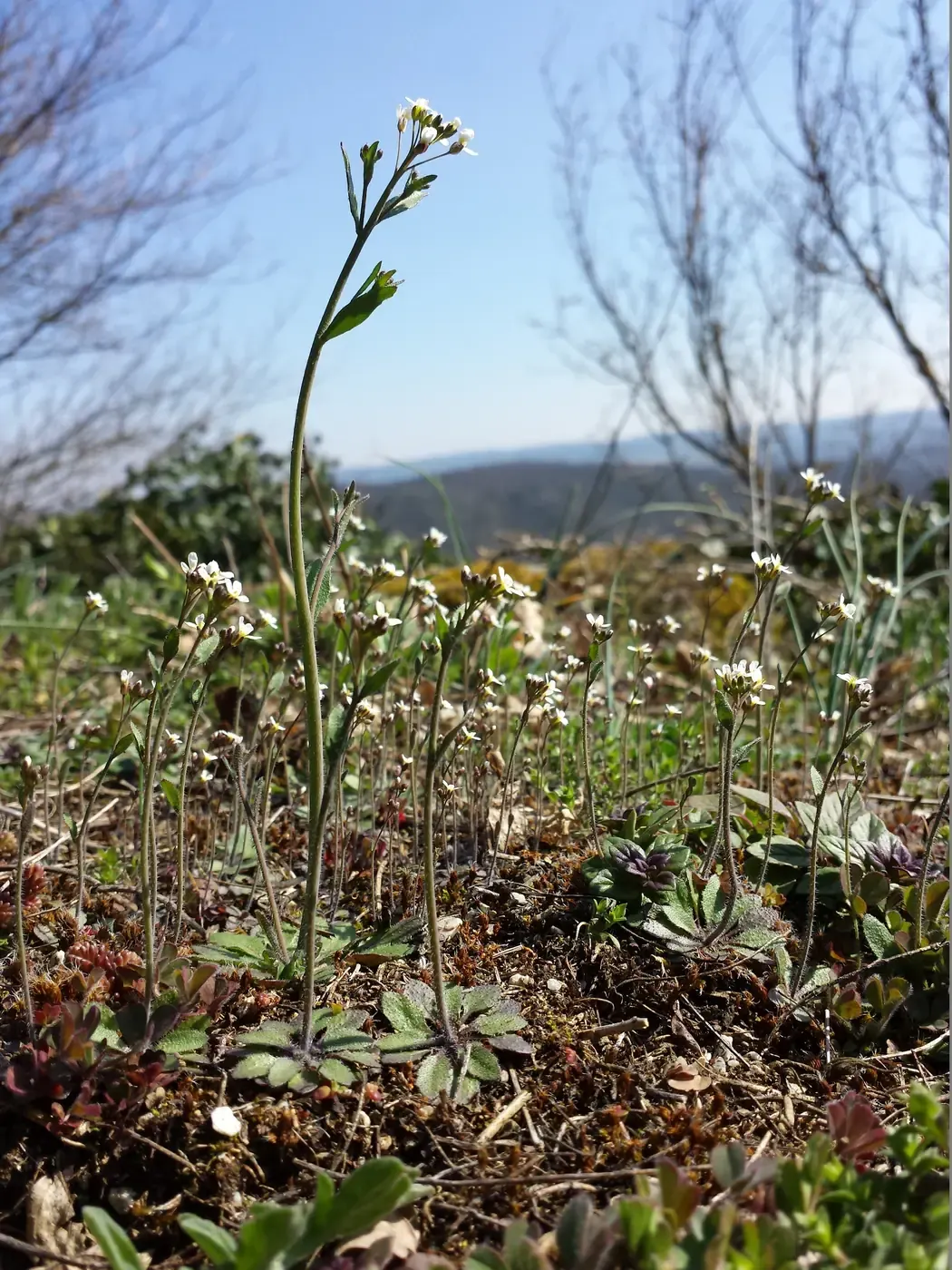
Small flowering weeds on a stone wall at a castle ruin in Lower Austria, named Arabidopsis thaliana on the file page; on this photograph the stems rise at uneven heights and lengths, unlike the strict repeat of the drawings above.
"Arabidopsis thaliana sl10" by Stefan.lefnaer — https://commons.wikimedia.org/wiki/File:Arabidopsis_thaliana_sl10.jpg — CC BY-SA 4.0 (https://creativecommons.org/licenses/by-sa/4.0/); modified: resized from 3,096 x 4,128 to 1,050 x 1,400 pixels and saved as WebP
The two photographs on this page show the difference. On the weed at the top, stems leave the base at irregular angles and fork again only a few times, while the drawn weed branches on each segment at each step.
To try the rule yourself, a pencil and a sheet of paper are enough. Rewrite F twice by hand, draw the 25 segments with a fixed angle, and compare the result with the two photographs on this page.
Other pages follow branching in real bodies. Crown shyness is about treetops that leave gaps between them, and Leonardo's tree rule is a rule for how thick real branches are.
Sources
- Prusinkiewicz P, Lindenmayer A (1990). The Algorithmic Beauty of Plants. New York: Springer-Verlag; authors' electronic edition 2004, chapter 1 (Graphical modeling using L-systems) and preface. Fig. 1.24, p. 25. algorithmicbotany.org/papers/abop/abop-ch1.pdfRead: full text; preface p. vi, chapter 1 pp. 3, 24 and 25 (Fig. 1.24 checked on the page image)
Cite this page
Spiral, Fern & Honeycomb. “L-System Plants: One Rewrite Rule Draws a Branching Weed.” Published November 23, 2026. https://spiralfernandhoneycomb.com/branching/l-system/ (accessed the day you read it).
- How each figure and source is checked
- Retunings: every correction, dated
- Report an error on this page (contact@spiralfernandhoneycomb.com)
More from Branching
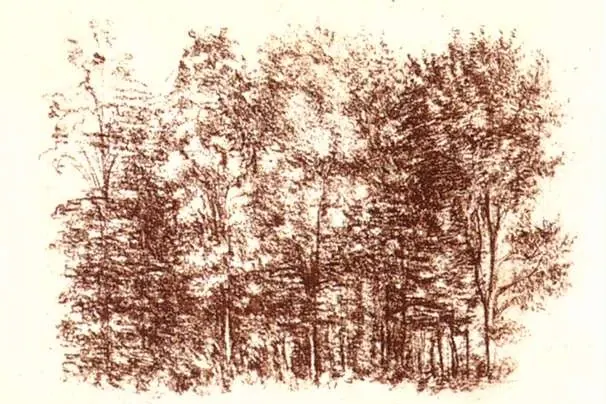
Tree Branching Pattern: Wind May Explain Leonardo’s Rule
Picture credit
"Birch copse (red chalk drawing, about 1500), upper part of the sheet" by Leonardo da Vinci — https://commons.wikimedia.org/wiki/File:Leonardo_da_vinci,_Birch_copse.jpg — Public domain (EU: Leonardo da Vinci d. 1519 per PG catalog record; US: published before 1931 (PD-old-100 and PD-Art on the file page); faithful reproduction via the Web Gallery of Art, upstream not traced); modified: cropped to the upper part of the sheet showing the copse (box 120, 0, 726, 404 of 726 x 919, about the top 44 %, with a little paper margin); original not altered, saved as WebP, not enlarged
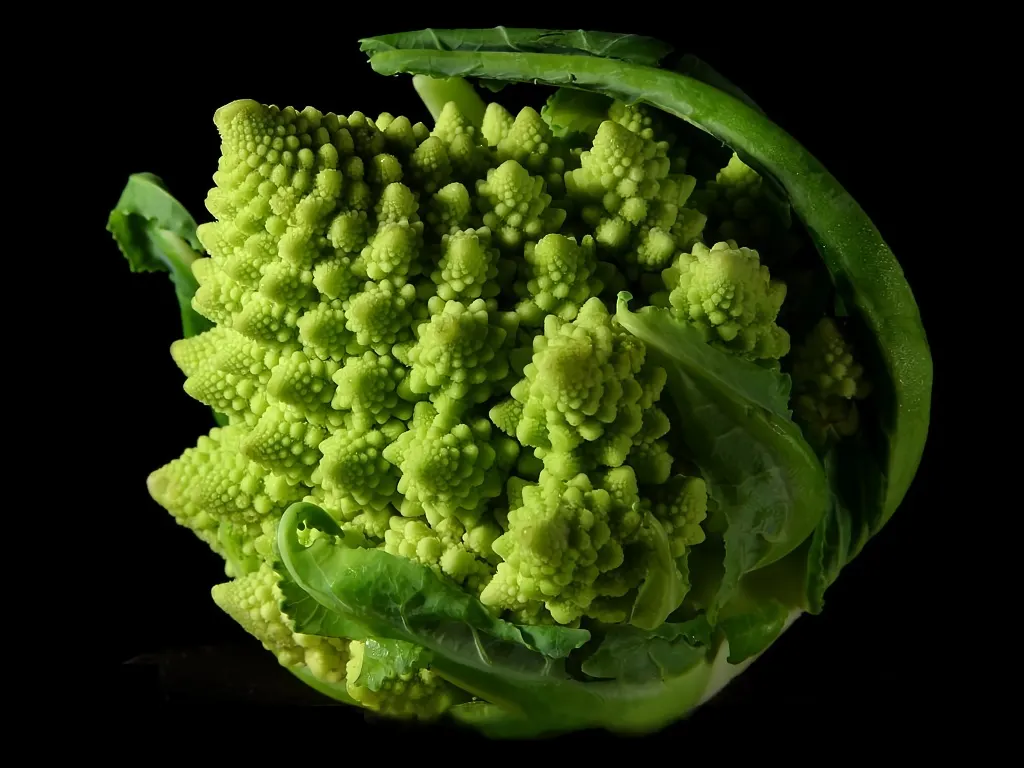
Romanesco Broccoli: Three Levels of Cones on Two Photos
Picture credit
"Fractal Broccoli" by Jon Sullivan (PD Photo.org) — https://commons.wikimedia.org/wiki/File:Fractal_Broccoli.jpg — Public domain (author's own public domain release (PD-author tag on the file page): in the US, released into the public domain by the author and copyright holder Jon Sullivan; in the EU and other countries, the same release applies worldwide, and where that is not legally possible the author grants anyone the right to use the work for any purpose without conditions; the quoted source page adds a CC0 designation for non-US use); modified: background behind the table replaced to remove a basket by Commons user David.Monniaux (retouched upstream, according to the file page); not altered here

Crown Shyness: Swaying Branches May Wear the Gaps Open
Picture credit
"Dryobalanops aromatica canopy" by Patrice78500 — https://commons.wikimedia.org/wiki/File:Dryobalanops_Aromatica_canopy.jpg — Public domain (released into the public domain worldwide, including the US and the EU, by the copyright holder, Patrice78500 (PD-self on the file page); no term of protection relied on); modified: saved as WebP at the original 1,020 x 765 pixels