Romanesco Broccoli: Three Levels of Cones on Two Photos
Pattern entry Spiral, Fern & Honeycomb Published
In brief
On a Romanesco head, each cone carries smaller cones and those carry buds, and on two openly licensed photographs the repeat could be followed for 3 levels on both a whole head and a close-up before the detail ran out. That count is the observed half of the cutoff pair, the site's two-part record that keeps the levels actually counted apart from any measured point where the repetition stops. No source read for this page measured that stopping point, so the physical half stays unverified.
Pattern card
- Pattern
- Self-similar cones: each cone on a Romanesco head carries smaller cones, which carry buds
- Where
- Romanesco heads, a cultivated form of Brassica oleracea
- Made by
- growth: unresolved
- Working recipe
- 1 rule / 1 parameter: give each cone smaller copies of itself on its surface; width ratio per level about 4 to 11 on the counted photographs; number of levels is a display setting
- Cutoff pair
- observed: 3 levels (counted on the cited photographs: a close-up, CC BY 4.0, and a whole head, public domain) · physical: unverified
- Key source
- Romanesco Broccoli Close Up, photograph by Mds08011, CC BY 4.0, Wikimedia Commons file page abstract or record
This card as CSV file notes: source and license
Data: Level count by this site on two Commons photographs; ITIS TSN 23062
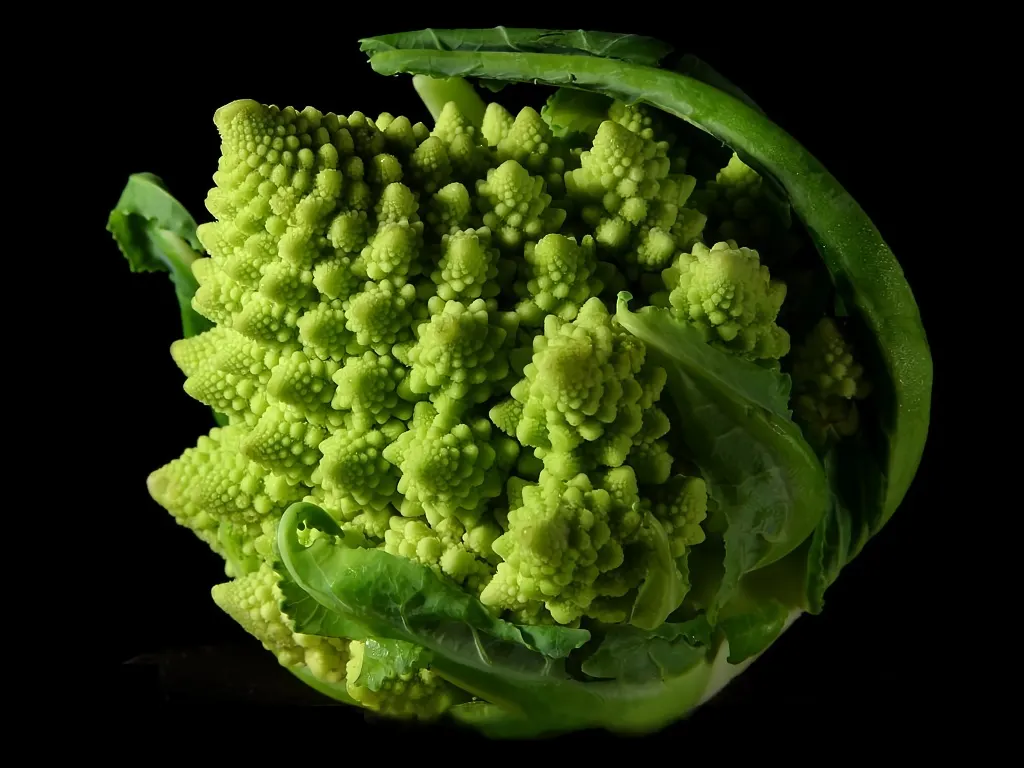
A whole Romanesco head; counted on the cited photograph, the repetition runs 3 levels, from the head to its cones to the buds on them.
“Fractal Broccoli”, Jon Sullivan (PD Photo.org); public domain.
Full credit
"Fractal Broccoli" by Jon Sullivan (PD Photo.org) — https://commons.wikimedia.org/wiki/File:Fractal_Broccoli.jpg — Public domain (author's own public domain release (PD-author tag on the file page): in the US, released into the public domain by the author and copyright holder Jon Sullivan; in the EU and other countries, the same release applies worldwide, and where that is not legally possible the author grants anyone the right to use the work for any purpose without conditions; the quoted source page adds a CC0 designation for non-US use); modified: background behind the table replaced to remove a basket by Commons user David.Monniaux (retouched upstream, according to the file page); not altered here
Snap one small cone off a head of Romanesco and set it beside the whole head. The small cone has the same pointed outline as the head, and its sides are studded with still smaller cones.
The rule behind the look is short: put smaller copies on the surface, then repeat. On paper a rule like that could run without end, but on a photograph of a real head it can be followed for only a few steps, until the bumps get too small to tell apart.
How many levels deep does the pattern go?
This page counted bud levels on two openly licensed photographs, using a single counting rule. A level is a set of bumps on the surface of one unit from the level above; at least 5 of them must be visible on that unit, and each must be at most a third as wide as it.
Widths were read by eye on enlargements of 1 to 7 times, with a pixel grid laid over each photograph; the smaller whole-head file needed the larger enlargements. Each photograph's resolution and framing limit what can be counted. The method is set out in Each figure regrown.
What the two photographs show
The first photograph, Fractal Broccoli by Jon Sullivan, shows a whole head about 640 pixels across in a 1,024 by 768 pixel frame. Counted on the cited photograph, it gives 3 levels: the head, cones 57 to 160 pixels wide, and on them buds or small clusters of cones 8 to 32 pixels wide.
A fourth level was looked for on the clusters of the largest cones. Grains of about 5 to 7 pixels show there, but none could be shown to sit on one cluster or told apart from drops of water, so they are left out of the count.
The second, Romanesco Broccoli Close Up by Mds08011, is a 3,024 by 4,032 pixel photograph of part of a head. Two cones in it were followed down. The largest cone in the frame is at least 1,100 pixels wide, its cones measure 200 to 370 pixels, and their buds 18 to 33 pixels; that part of the frame is out of focus, so the bud widths are coarse.
A second, smaller cone, 540 to 620 pixels wide, does not sit on the largest one, and no larger unit carrying it could be made out in the frame. Its buds measure 67 to 114 pixels, and the largest show bumps of 15 to 20 pixels along their rims.
That makes 3 levels on the close-up as well. On both cones nothing smaller could be seen on the last level. The rim bumps are at the edge of what the photograph resolves.
The levels marked and measured
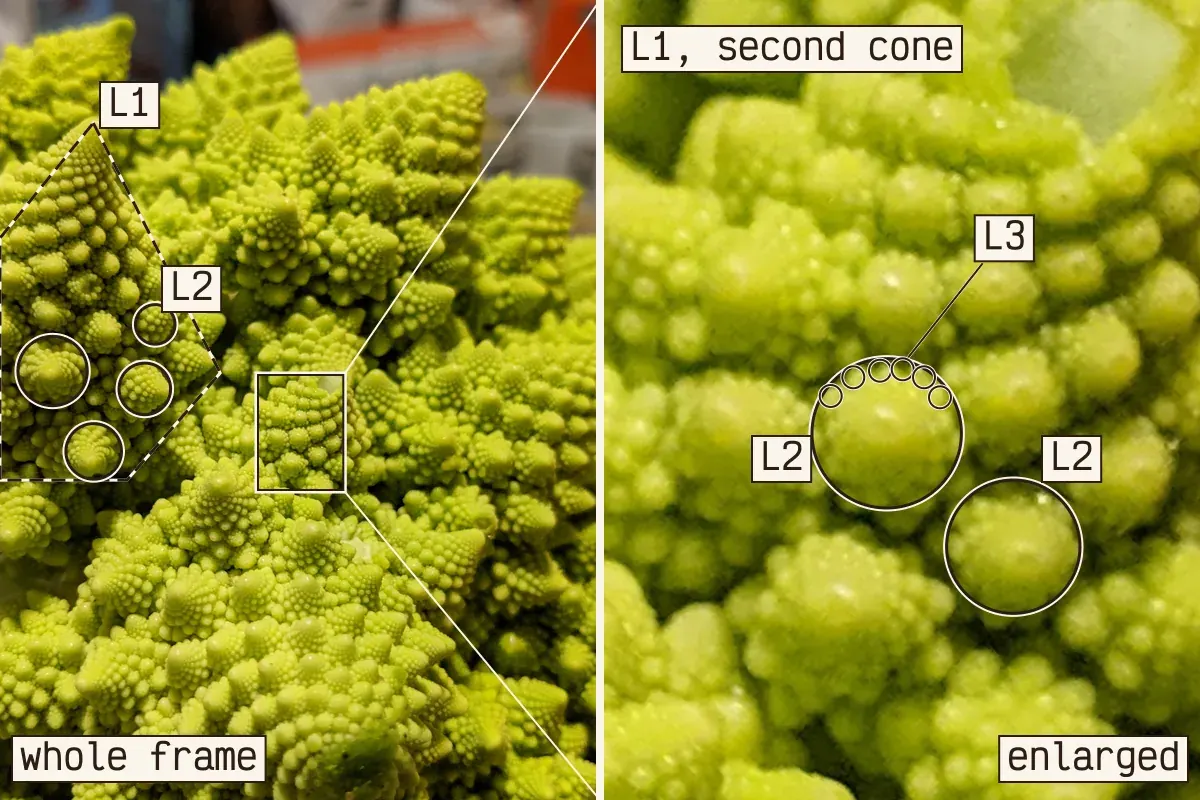
Self-similar levels counted on the cited photograph: a dashed, approximate outline of the largest cone in the frame (L1) and four cones on it (L2); the enlarged area lies on a second, smaller cone (L1), where two of its buds (L2) are marked and one shows bumps on its rim (L3).
Recipe left: full frame 3024x4032 at x0.198; right: crop x 1290-1740, y 1880-2480 at x1.333; level = at least 5 bumps on one unit, each at most 1/3 its width
Read this figure as text
- Level 1: two cones in the close-up's frame. The largest is at least 1,100 pixels wide and is outlined; the second, 540 to 620 pixels wide, does not sit on it and fills the enlarged area.
- Level 2: cones 200 to 370 pixels wide on the largest cone, 4 marked; buds 67 to 114 pixels wide on the second cone, 2 marked in the enlarged area.
- Level 3: bumps 15 to 20 pixels wide on the rim of one marked bud of the second cone, 6 marked, at the edge of what the photograph resolves. Buds 18 to 33 pixels wide on the largest cone's cones are out of focus and not marked.
- No level 4 was seen.
| Photograph | Level | Width in pixels | Times narrower than the level above |
|---|---|---|---|
| Close-up, largest cone | 1 | at least 1,100 | |
| Close-up, largest cone | 2 | 200 to 370 | at least 3.8 |
| Close-up, largest cone | 3 | 18 to 33, out of focus, coarse | 11.2 |
| Close-up, second cone | 1 | 540 to 620 | |
| Close-up, second cone | 2 | 67 to 114 | 6.4 |
| Close-up, second cone | 3 | 15 to 20, at the resolution limit | 5.2 |
| Whole head | 1 | about 640 | |
| Whole head | 2 | 57 to 160 | 5.9 |
| Whole head | 3 | 8 to 32 | 5.4 |
"Self-similar levels counted on a Romanesco close-up" by Spiral, Fern & Honeycomb, https://spiralfernandhoneycomb.com/branching/romanesco/, licensed under CC BY 4.0 (https://creativecommons.org/licenses/by/4.0/). Base layer: "Romanesco Broccoli Close Up" by Mds08011 — https://commons.wikimedia.org/wiki/File:Romanesco_Broccoli_Close_Up.jpg — CC BY 4.0 (https://creativecommons.org/licenses/by/4.0/); modified: resized from 3,024 x 4,032 to 1,200 x 1,600 pixels, count marks and labels overlaid, right half enlarged from a 450 x 600 pixel crop.
Data: Level count by this site on Romanesco Broccoli Close Up by Mds08011, CC BY 4.0
This table as CSV (romanesco-levels.csv) (file notes: source and license) Data: Level count by this site on Fractal Broccoli by Jon Sullivan (public domain) and Romanesco Broccoli Close Up by Mds08011 (CC BY 4.0)
Across both photographs, each level is about 4 to 11 times narrower than the one it sits on, taking the middle of each width range within one cone; the 11.2 rests on the out-of-focus buds and is the coarsest.
The largest cone's ratio is only a floor, because its width is itself a lower bound. Judged against its full width, estimated by symmetry at about 1,250 to 1,300 pixels, each marked cone on it is at most a third as wide. Because the close-up starts at the cones in its frame rather than at the whole head, the head it came from may hold more levels than the 3 in this count.
What does self-similar mean on a Romanesco head?
Self-similar means that a part, enlarged, looks like the whole. On a Romanesco head the part is a cone: one cone carries smaller cones on its surface, and an enlarged view of one of those looks much like the cone it came from.
This site tracks how far that resemblance holds with the cutoff pair. The observed layer is the range of levels actually counted, with the photograph and the counting rule beside it; here it is 3 levels. The physical layer is the scale at which a measured source says the repetition stops, and it is filled in only when such a source exists.
The site keeps the two layers apart. A count on one photograph says nothing, by itself, about where a head's buds stop branching.
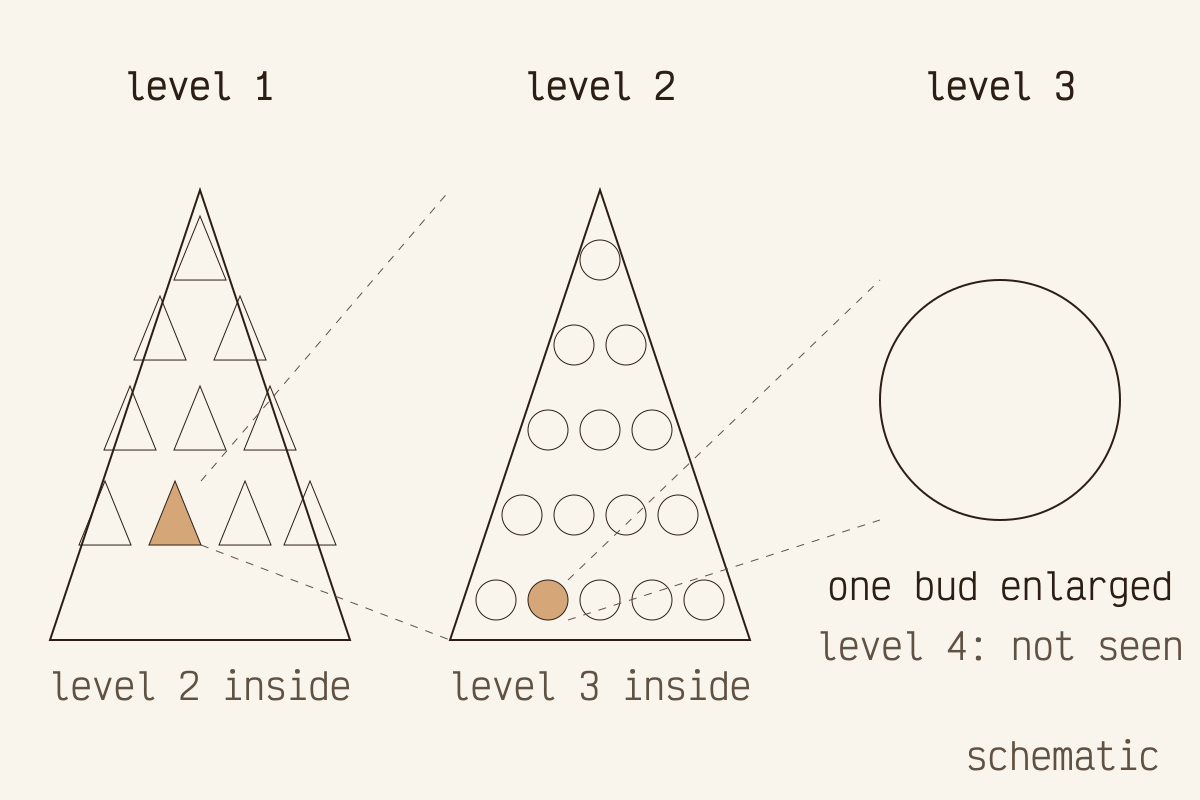
A schematic of the three levels counted on the photographs: a cone carrying cones, one of those carrying buds, and one bud enlarged; a fourth level was not seen, and the drawing is not to scale.
Recipe levels=3 shown; units drawn per panel: 10 cones, 15 buds, 1 enlarged bud; not to scale; level 4 marked not seen
"Self-similar levels on a Romanesco head, schematic" by Spiral, Fern & Honeycomb, https://spiralfernandhoneycomb.com/branching/romanesco/, licensed under CC BY 4.0 (https://creativecommons.org/licenses/by/4.0/).
Data: Levels from this site's count on two Commons photographs: Fractal Broccoli by Jon Sullivan (public domain) and Romanesco Broccoli Close Up by Mds08011 (CC BY 4.0)
Is Romanesco a fractal, then? A mathematical fractal keeps repeating however far it is enlarged, while Romanesco repeats over a few levels before the detail runs out, at least on the photographs counted here. This site makes no fractal-dimension estimate for it and does not measure one by box counting.
The working recipe on the Pattern card writes the shape as 1 rule with 1 parameter: give each cone smaller copies of itself on its surface, with the width ratio set at about 4 to 11 per level from the counts above. That working recipe describes the shape. It is not a model of how the plant grows.
How the plant grows its cones is a separate question. A 2021 paper in Science by Eugenio Azpeitia and colleagues, Cauliflower fractal forms arise from perturbations of floral gene networks, takes it up. According to the abstract, which is an editor's summary of the paper, the study combined modeling with experiments and ties the cones of the Romanesco form to drift in the size of the growing tips that make new parts abstract or record.
Other branching bodies stop at their own depths. Leonardo's tree rule is a branching rule Leonardo wrote down for trees, and crown shyness is the gap that opens where neighboring treetops stop short of touching.
Is Romanesco a broccoli or a cauliflower?
The taxonomic records read for this page do not separate broccoli from cauliflower at all. In the Integrated Taxonomic Information System (ITIS), the accepted name is the single species Brassica oleracea L., with the common name cabbage abstract or record. ITIS lists the variety names Brassica oleracea var. botrytis and var. italica as synonyms of that species rather than as accepted names, and gives their common names as broccoli and sprouting broccoli.
Romanesco itself does not appear in those records. According to the file page of the card photograph, it is Brassica oleracea italica, a Romanesco cultivar, while the 2021 paper named above uses the word cauliflower in its title.
On the records read here, the safe answer is that Romanesco is a cultivated form of the same species as broccoli and cauliflower, and its common name does not settle which group it belongs to.
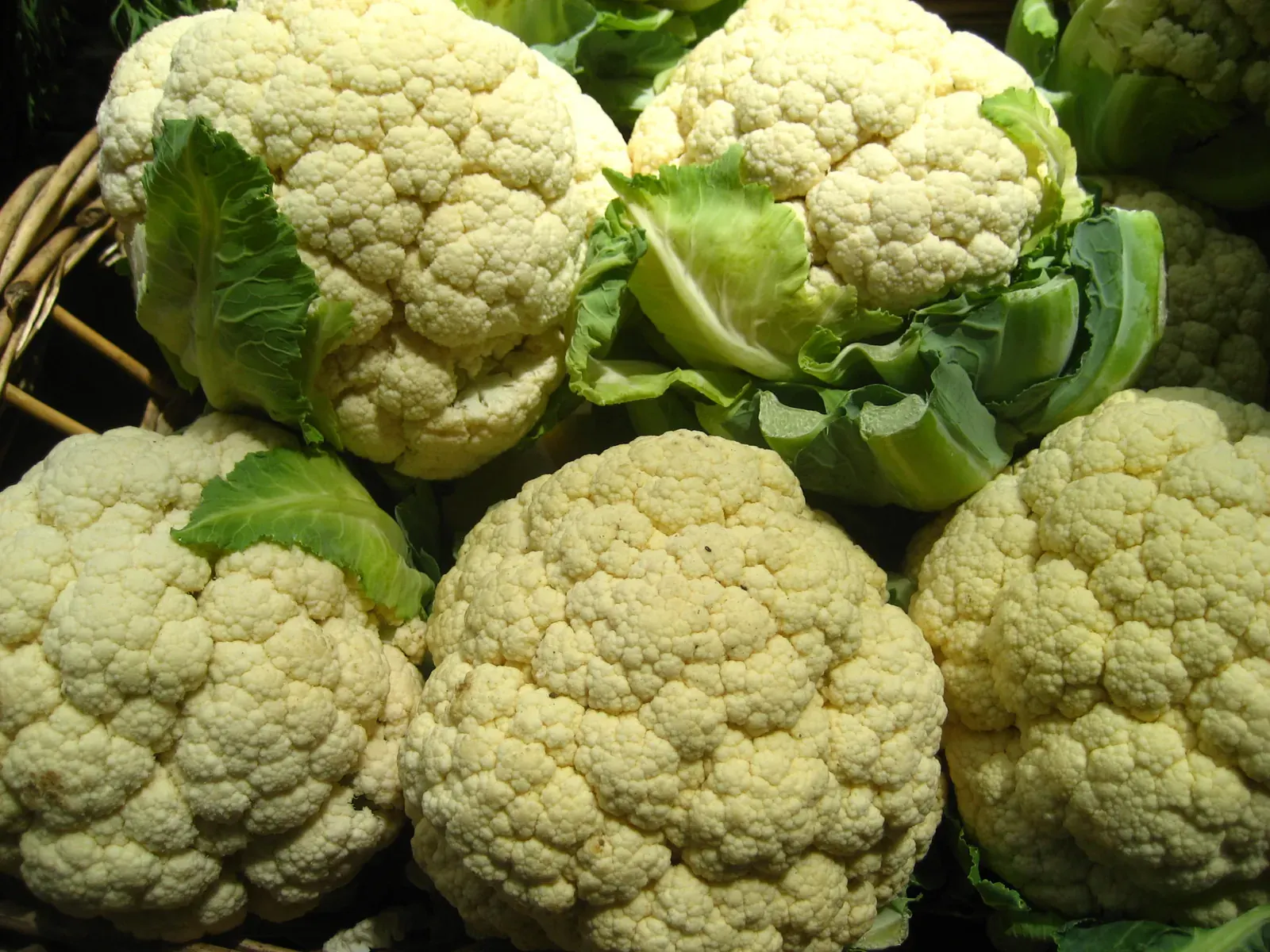
Cauliflower heads for comparison; on this photograph their curds are built of rounded lumps rather than the pointed cones of Romanesco.
"Cauliflower" by Jeremy Keith from Brighton & Hove, United Kingdom — https://commons.wikimedia.org/wiki/File:Cauliflower_(4701349936).jpg — CC BY 2.0 (https://creativecommons.org/licenses/by/2.0/); modified: resized from 2,272 x 1,704 to 1,600 x 1,200 pixels
The lumps on a cauliflower curd also sit on larger lumps. This page has not counted their levels, so it gives no number for them.
Sources
- Azpeitia E, Tichtinsky G, Le Masson M, Serrano-Mislata A, Lucas J, Gregis V, Gimenez C, Prunet N, Farcot E, Kater MM, Bradley D, Madueño F, Godin C, Parcy F (2021). Cauliflower fractal forms arise from perturbations of floral gene networks. Science 373(6551):192–197. doi:10.1126/science.abg5999 doi.org/10.1126/science.abg5999Read: abstract or record; the editor's summary given as its abstract; the paper itself not read
- Integrated Taxonomic Information System (ITIS). Brassica oleracea L., TSN 23062; Brassica oleracea var. botrytis L., TSN 530957; Brassica oleracea var. italica Plenck, TSN 530961. CC0. itis.gov/servlet/SingleRpt/SingleRptRead: abstract or record; species record and two variety records
Cite this page
Spiral, Fern & Honeycomb. “Romanesco Broccoli: Three Levels of Cones on Two Photos.” Published November 23, 2026. https://spiralfernandhoneycomb.com/branching/romanesco/ (accessed the day you read it).
- How each figure and source is checked
- Retunings: every correction, dated
- Report an error on this page (contact@spiralfernandhoneycomb.com)
More from Branching
Tree Branching Pattern: Wind May Explain Leonardo’s Rule
Picture credit
"Birch copse (red chalk drawing, about 1500), upper part of the sheet" by Leonardo da Vinci — https://commons.wikimedia.org/wiki/File:Leonardo_da_vinci,_Birch_copse.jpg — Public domain (EU: Leonardo da Vinci d. 1519 per PG catalog record; US: published before 1931 (PD-old-100 and PD-Art on the file page); faithful reproduction via the Web Gallery of Art, upstream not traced); modified: cropped to the upper part of the sheet showing the copse (box 120, 0, 726, 404 of 726 x 919, about the top 44 %, with a little paper margin); original not altered, saved as WebP, not enlarged
Crown Shyness: Swaying Branches May Wear the Gaps Open
Picture credit
"Dryobalanops aromatica canopy" by Patrice78500 — https://commons.wikimedia.org/wiki/File:Dryobalanops_Aromatica_canopy.jpg — Public domain (released into the public domain worldwide, including the US and the EU, by the copyright holder, Patrice78500 (PD-self on the file page); no term of protection relied on); modified: saved as WebP at the original 1,020 x 765 pixels
L-System Plants: One Rewrite Rule Draws a Branching Weed
Picture credit
"Starr 070308-5329 Capsella bursa-pastoris" by Forest & Kim Starr — https://commons.wikimedia.org/wiki/File:Starr_070308-5329_Capsella_bursa-pastoris.jpg — CC BY 3.0 (https://creativecommons.org/licenses/by/3.0/); modified: resized from 2,112 x 2,816 to 900 x 1,200 pixels and saved as WebP