Crown Shyness: Swaying Branches May Wear the Gaps Open
Mechanism deep dive Spiral, Fern & Honeycomb Published
In brief
Crown shyness is a pattern in some forest canopies where neighboring tree crowns stop short of each other and leave narrow channels of sky, like the seams of a jigsaw puzzle. The explanation with the most support here, from earlier studies reported in a 2021 paper by van der Zee, Lau and Shenkin, is that wind makes crowns sway and collide and that broken outer twigs may leave lasting gaps; the paper also reports that earlier studies found tree slenderness plays a role. Other ideas, such as shade thinning crown edges, remain unresolved here, read only as citations.
Pattern card
- Pattern
- Narrow, connected channels of sky between neighboring tree crowns (crown shyness)
- Where
- Some tree canopies, among them Dryobalanops aromatica in Malaysia and tropical trees scanned in Guyana
- Made by
- branching: candidate (abrasion of swaying crowns, as reviewed by van der Zee et al. 2021 full text) · growth: unresolved (light and shade)
- Working recipe
- 2 rules / 1 parameter: each patch of sky goes to the nearest crown center; each crown is pulled back from each border by half the gap width (draws the look, not the cause)
- Key source
- van der Zee, Lau and Shenkin 2021, Annals of Botany 128(6):725-736 full text
This card as CSV file notes: source and license
Data: van der Zee, Lau and Shenkin 2021, Annals of Botany 128(6):725-736, CC BY 4.0
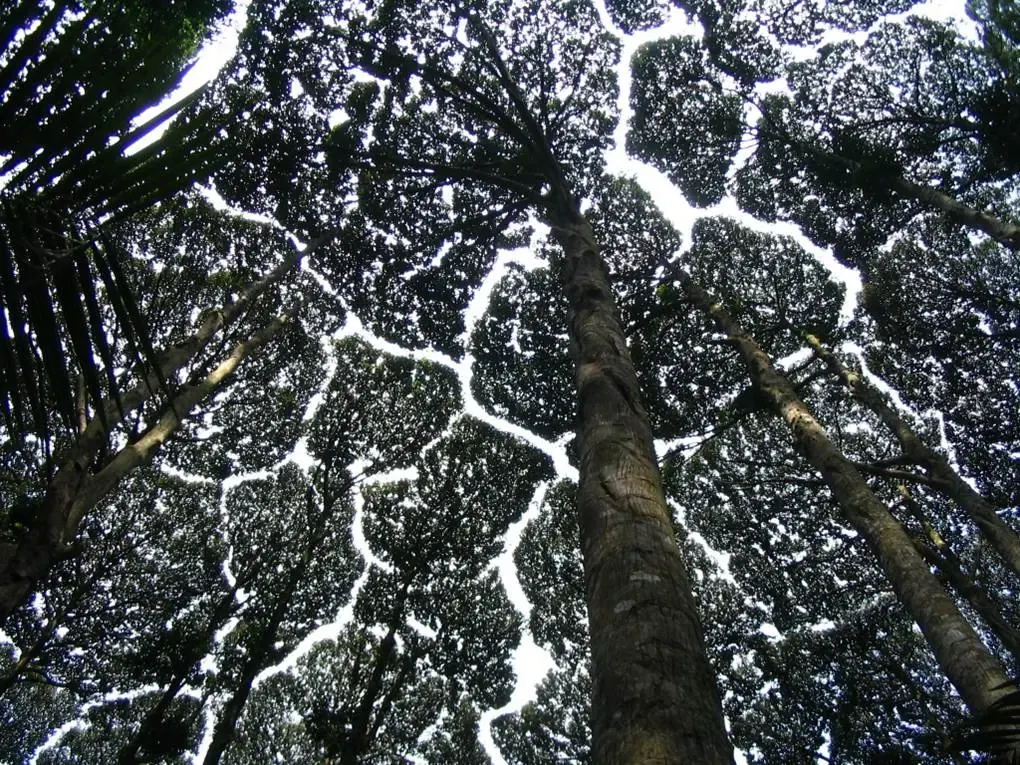
Crowns of Dryobalanops aromatica at a forest research center in Kuala Lumpur, according to the file page, seen from below; each crown is edged by a pale seam of sky.
"Dryobalanops aromatica canopy" by Patrice78500 — https://commons.wikimedia.org/wiki/File:Dryobalanops_Aromatica_canopy.jpg — Public domain (released into the public domain worldwide, including the US and the EU, by the copyright holder, Patrice78500 (PD-self on the file page); no term of protection relied on); modified: saved as WebP at the original 1,020 x 765 pixels
Stand under a stand of tall trees on a windy day and look straight up. In some woods the crowns do not mesh, and each one is outlined by a thin line of sky. The line is not a border the trees keep on purpose: one earlier study, as a 2021 paper describes it, linked the spacing between neighboring crowns to signs of damage on their twig tips. Watch from a path, not when a storm or thunder is near, and keep your feet on the ground.
What does crown shyness look like from below?
Crown shyness is the name for this pattern of crowns that do not touch. The 2021 study by Jens van der Zee, Alvaro Lau and Alexander Shenkin in Annals of Botany full text describes a canopy that does not close completely, with “small channel-like gaps between their crowns.” Seen from the ground, each crown looks like one piece of a jigsaw, and the sky shows through along the joins.
The same paper gives a reason the pattern is easiest to see in particular places. Until recently, it says, crown shyness could be observed only in “structurally simple and flat canopies, where the backlighting of the sky reveals the gaps.” By that reasoning, a forest with several layers of crowns gives the seams no clean backdrop of sky.
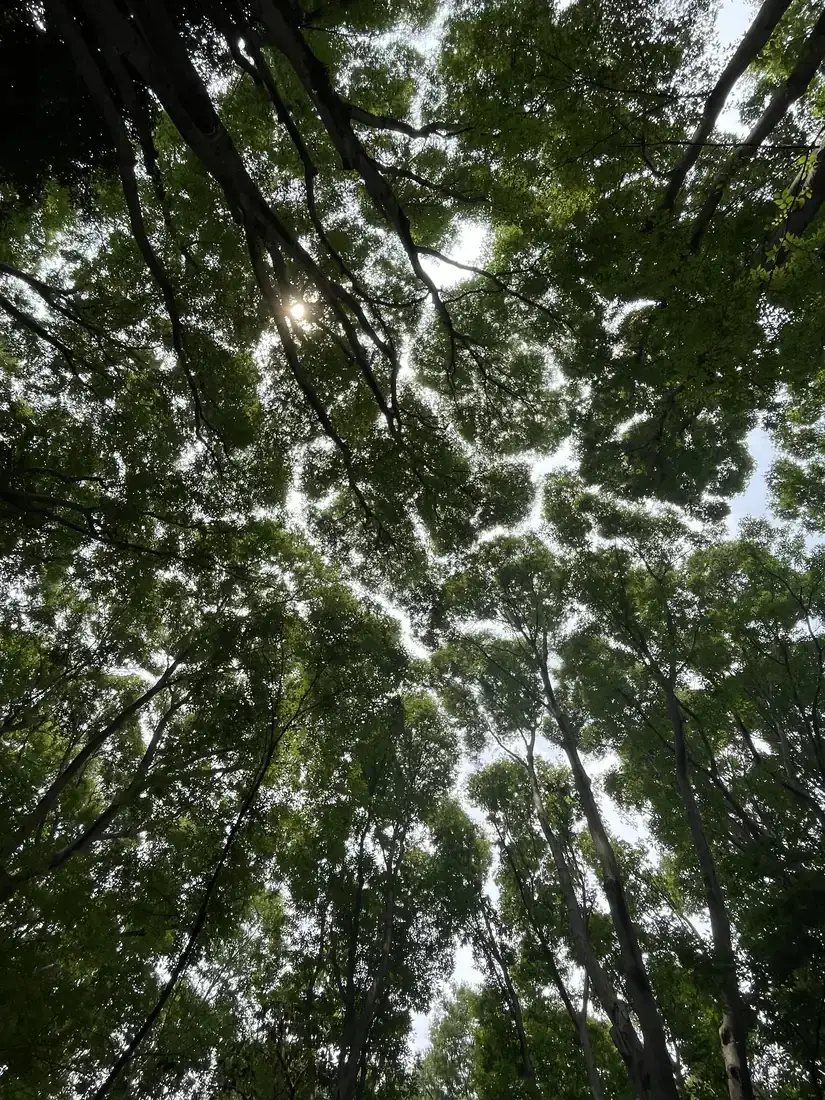
Broadleaf crowns in a park in Tokyo, according to the file page, seen straight up; the channels of sky are faint where the crowns are thin and clear where they meet.
"Crown Shyness phenomena in the park of Tokyo, Japan" by Mimk0205 — https://commons.wikimedia.org/wiki/File:Crown_Shyness_phenomena_in_the_park_of_Tokyo,_Japan.jpg — CC BY 4.0 (https://creativecommons.org/licenses/by/4.0/); modified: rotated upright per the camera orientation tag, resized to 825 x 1,100 pixels and saved as WebP (quality 60, to keep the web copies under 250,000 bytes)
A photograph like this one shows the pattern, not its cause. From one picture there is no telling a gap made by broken twigs from a gap made by branches that simply grew in another direction.
How do the gaps join into a network?
Look at the gaps rather than the crowns. On the cited card photograph at the top of this page, the pale seams link up across the frame instead of ending as separate holes inside single crowns.
A web like that is a property of how the crowns are arranged, not of any one tree. Suppose each crown fills the space nearest its own trunk and then stops a short distance from each border it shares with a neighbor. The space left over is a web of narrow channels, one along each shared border, and in the drawing below the channels meet three at a time.
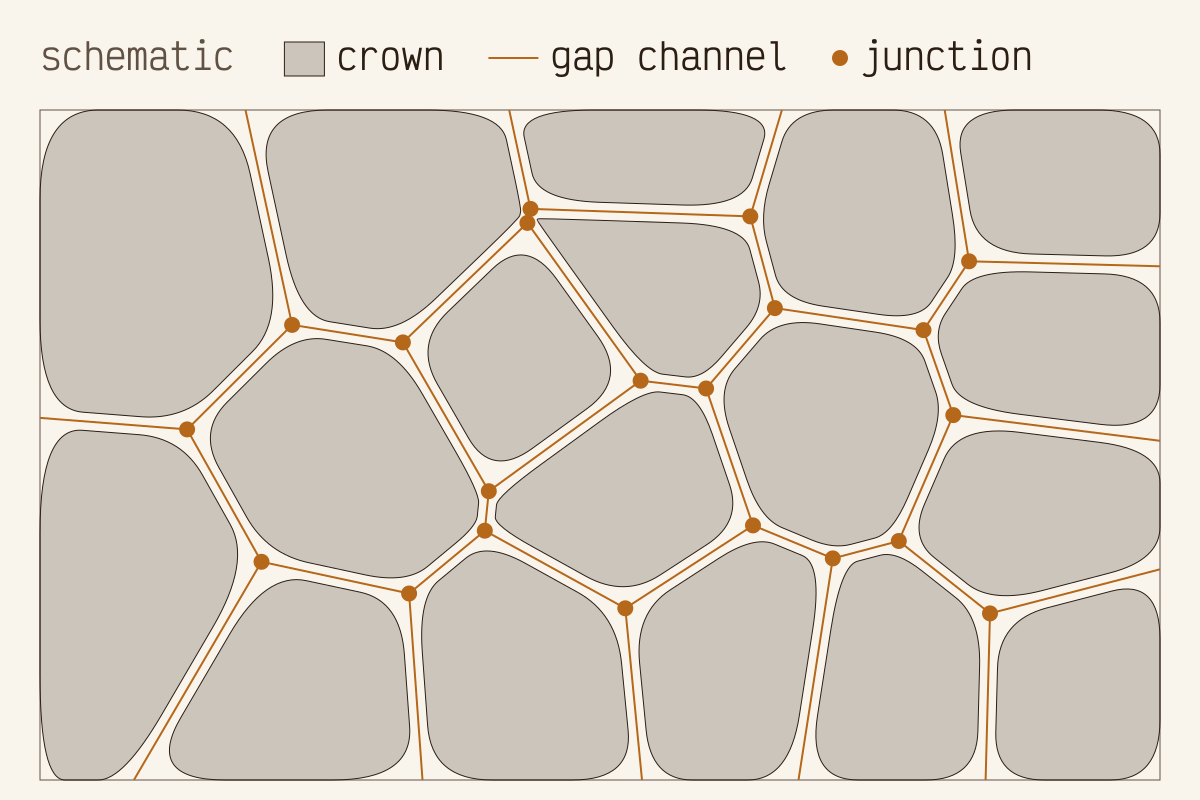
A schematic of a canopy seen from below: 18 crowns, each pulled back from its neighbors, leave channels of sky that join into one network and meet three at a time at 21 junctions in this drawing.
Recipe crowns=18; seed=10; Lloyd rounds=4; frame 1120 x 670; start points uniform, 30 units in from the edges; each patch of sky goes to the nearest crown center; each crown pulled back 9 units from each border (gap 18); corners rounded 0.3
"Gaps between tree crowns, schematic" by Spiral, Fern & Honeycomb, https://spiralfernandhoneycomb.com/branching/crown-shyness/, licensed under CC BY 4.0 (https://creativecommons.org/licenses/by/4.0/).
Data: Pattern described in van der Zee, Lau and Shenkin 2021, Annals of Botany 128(6):725-736 (CC BY 4.0); drawn from a nearest-center rule, no published figure redrawn
The drawing rule is a nearest-center rule, which also defines a Voronoi diagram. That the result resembles a canopy shows only that a short rule can draw the shape. It says nothing about how real crowns acquire their edges, and this page does not claim that trees follow the rule.
Do swaying branches wear the gaps open?
The explanation with the most support here is mechanical. In its introduction, the 2021 study reviews earlier work and states that “abrasion of the outer twigs can create lasting gaps between tree crowns.” It credits that finding to Putz, Parker and Archibald in 1984, Meng and colleagues in 2006 and Hajek and colleagues in 2015, as reviewed by van der Zee et al. (2021) bibliographic. This page has read those three studies only as entries in the 2021 paper's reference list.
The proposed sequence is short. Wind pushes the trees, the crowns sway, and twigs at the edge of one crown strike twigs at the edge of the next. Where twigs break, the 2021 introduction says, the gap can last, so a seam may remain between the crowns long after the wind drops.
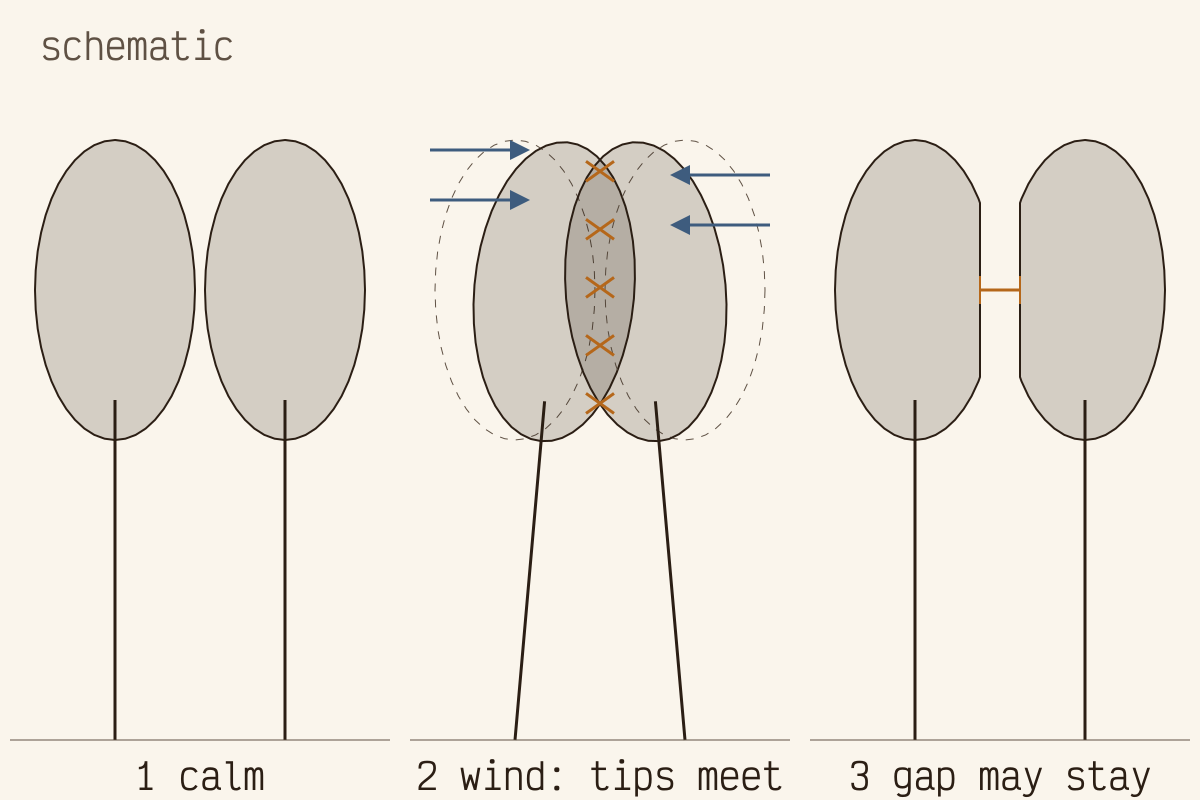
A schematic of the abrasion explanation: two crowns stand close in calm air, lean together and meet in wind, and may keep a gap after the outer twigs break.
Recipe 2 trees per panel; crown ellipses with semiaxes 80 and 150 (48-point outlines); trunks 170 apart and 340 tall; crown centers 110 above the trunk tops; lean 5 deg toward each other about the trunk base in panel 2; panel 3 crowns cut back 20 units each side of the midline (gap 40)
"Swaying crowns and broken twigs, schematic" by Spiral, Fern & Honeycomb, https://spiralfernandhoneycomb.com/branching/crown-shyness/, licensed under CC BY 4.0 (https://creativecommons.org/licenses/by/4.0/).
Data: Idea as reported in van der Zee, Lau and Shenkin 2021, Annals of Botany 128(6):725-736 (CC BY 4.0), from earlier studies it cites; drawn independently, no published figure redrawn
The 2021 introduction also reports that the effect is stronger in slender trees, which the paper describes as trees with a large height for their trunk diameter. Earlier studies, the paper states, found these effects more pronounced among slender trees “because they sway more in windy conditions and are thus more likely to collide with neighbouring trees.” It cites Rudnicki and colleagues in 2003, Fish and colleagues in 2006 and Goudie and colleagues in 2009, as reviewed by van der Zee et al. (2021) bibliographic.
What did 3-D scans of tree pairs find?
The 2021 study added measurements of its own. In January and February 2017, in a newly granted logging concession in Guyana, the team scanned trees with a ground-based laser scanner, an instrument that records a tree as a dense cloud of points in three dimensions. Among 106 scanned trees, the paper counts 14 pairs whose crowns were close enough to interact.
For each pair, the study borrowed a measure from protein chemistry called surface complementarity. It describes how well two surfaces fit together, with bulges on one surface matching hollows on the other. The score is an average of values that run from minus 1 to 1, and wherever two surfaces overlap they pull the score down.
To get the surfaces, the team first separated each crown from its trunk by the density of points in a vertical profile. Then the team wrapped the points of each crown in a surface called an alpha shape, which can follow both the bulges and the hollows of a crown. According to the paper, the scores were stable when the alpha setting was between 1 and 2 meters.
Half of the 14 pairs had crowns that did not overlap. Those pairs scored a mean complementarity of 0.647, against 0.267 for the overlapping pairs, a difference the paper reports as significant (P = 0.001). Those two means do not quite match the paper's own Table 2, whose 14 scores average about 0.48; two equal groups averaging 0.647 and 0.267 would come to 0.457, a gap too large to blame on rounding.
The scans also found that pairs of more slender trees had more complementary crowns, with an adjusted R squared of 0.484 (P = 0.003). One tree in the sample shows the pattern. The paper reports that tree 80_22, large and not slender, scored 0.26 with a stout neighbor but 0.63 with a slender one. In the paper's words, the results suggest that “a particular tree can grow a complementary crown with one neighbour, and not with another.”
What can the scans not show?
The authors hedge the result themselves. They write that “due to the limited number of samples, no concrete conclusions can be made based on this result.” The paper also reports that slenderness alone does not explain all the variation, and it notes that the original survey had deliberately chosen isolated trees, so few neighboring pairs were available. The finding fits the idea that physical contact plays a role; it does not test the abrasion step directly.
What else might keep the crowns apart?
Abrasion is not the only idea in the 2021 paper. Its introduction adds that “even non-destructive contact can lead trees to direct branch growth away from adjacent tree crowns,” citing Jaffe and colleagues in 1985, as reviewed by van der Zee et al. (2021) bibliographic. In that version, touching changes the direction of growth without breaking anything.
Light is the other idea the paper names. Its discussion notes that light conditions were not part of the 2021 study, and that shaded crowns “can show increased mortality of lateral branches and inhibited bud expansion,” citing Schoonmaker and colleagues in 2014, as reviewed by van der Zee et al. (2021) bibliographic. A crown edge shaded by a neighbor might therefore thin out for reasons that have nothing to do with collisions.
One cited title takes a side. A 2015 study by Hajek, Seidel and Leuschner, cited in the 2021 paper bibliographic, is titled “Mechanical abrasion, and not competition for light, is the dominant canopy interaction in a temperate mixed forest.” The 2021 discussion adds that this study measured distances between neighboring crowns from laser scans and related them to signs of mechanical damage on terminal twigs. This page has read only the title and that description, so it records the claim and not the evidence behind it.
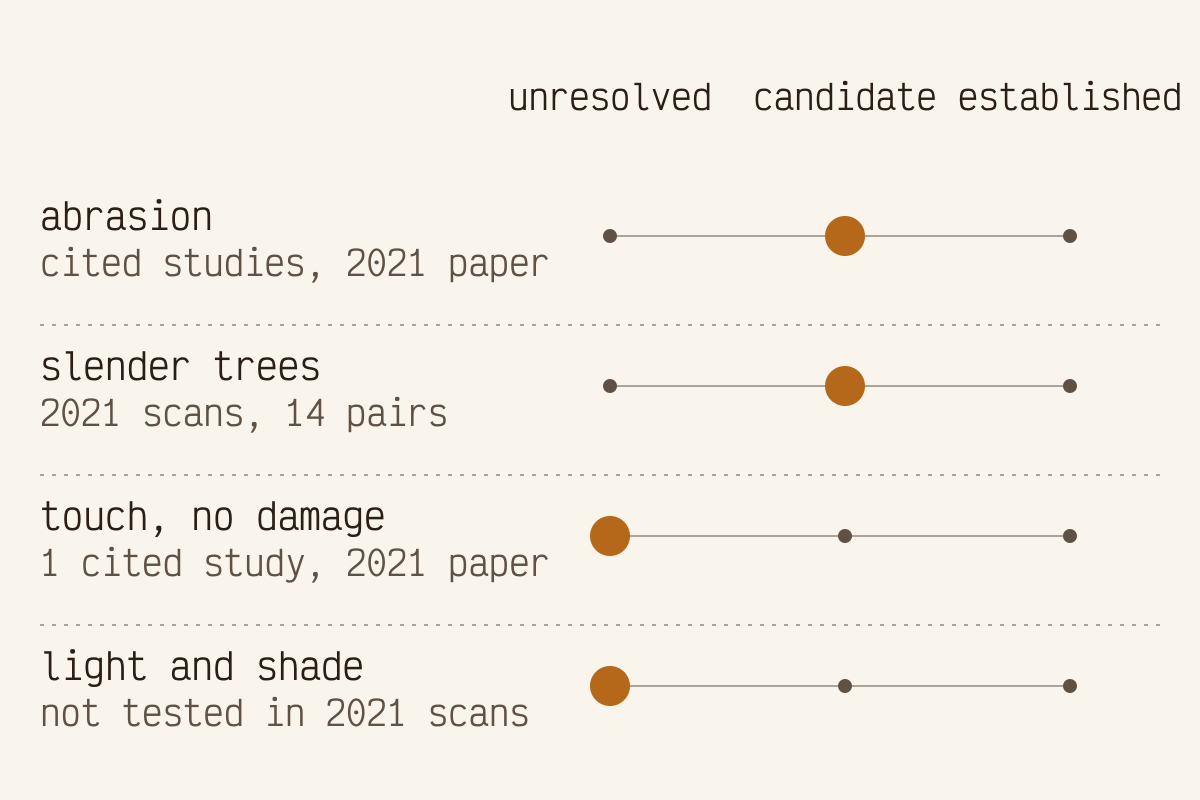
Four explanations for crown shyness and the grade this page gives each, based on the 2021 study by van der Zee, Lau and Shenkin and the earlier work it cites.
Recipe rows=4 explanations; grades: unresolved, candidate, established; grades assigned by this site from van der Zee et al. 2021 [full text], with the earlier studies it cites read only as citations [bibliographic]
"Explanations for crown shyness by evidence grade" by Spiral, Fern & Honeycomb, https://spiralfernandhoneycomb.com/branching/crown-shyness/, licensed under CC BY 4.0 (https://creativecommons.org/licenses/by/4.0/).
Data: van der Zee, Lau and Shenkin 2021, Annals of Botany 128(6):725-736 (CC BY 4.0); grades are this page's reading
| Explanation | What supports it | Read here | Grade on this page |
|---|---|---|---|
| Abrasion: swaying crowns collide and broken twigs leave gaps | Earlier studies reported in the 2021 paper's introduction | 2021 paper full text; earlier studies bibliographic | candidate |
| Slender trees: the effect is stronger where trees sway more, as earlier studies reported | Earlier studies reported in 2021, plus the 2021 scans of 14 pairs | 2021 paper full text; earlier studies bibliographic | candidate |
| Touch without damage turns branch growth away | One earlier study reported in the 2021 introduction | 2021 paper full text; earlier study bibliographic | unresolved |
| Shade thins the crown edge near a neighbor | One earlier study named in the 2021 discussion; light not tested in 2021 | 2021 paper full text; earlier study bibliographic | unresolved |
This table as CSV (crown-shyness-explanations.csv) (file notes: source and license) Data: van der Zee, Lau and Shenkin 2021, Annals of Botany 128(6):725-736, CC BY 4.0
This page's reading: abrasion is a candidate mechanism, supported by the earlier studies that the 2021 paper reports, although this page has read those studies only as citations. The 2021 scans fit the broader idea that physical contact plays a role, without testing the abrasion step. Touch without damage and shade remain open questions.
Which trees show crown shyness?
The 2021 paper's first figure shows camphor trees, Dryobalanops aromatica, in Malaysia, the same species that the file page names for the card photograph at the top of this page. ITIS lists the name Dryobalanops aromatica C.F. Gaertn. as accepted, with the common name Borneo camphor.
Two earlier studies cited in the 2021 paper, by Fish and colleagues in 2006 and by Goudie and colleagues in 2009 bibliographic, name lodgepole pine (Pinus contorta) in their titles. The 2021 scans came from dense wet tropical forest in Guyana, with species such as Eperua falcata and Chlorocardium rodiei among the scanned trees listed in its table.
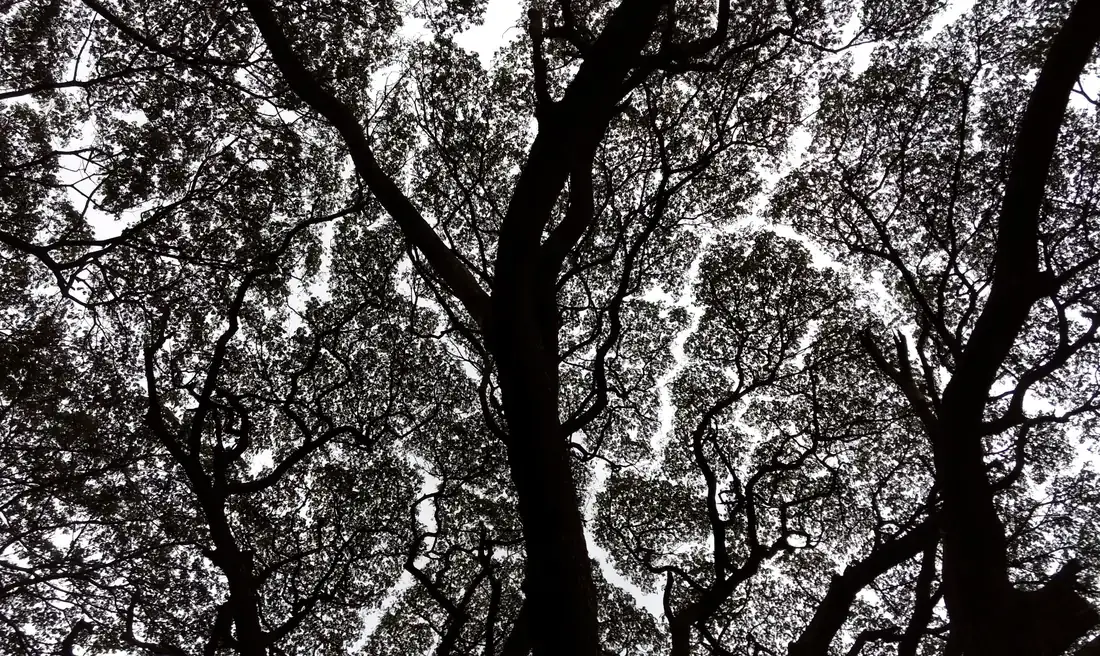
Crowns seen from below in Mysore, India, which the file page identifies as rain trees; white seams of sky run between several of the crowns.
"Crown shyness" by Akasmita — https://commons.wikimedia.org/wiki/File:Crown_shyness.jpg — CC BY-SA 4.0 (https://creativecommons.org/licenses/by-sa/4.0/); modified: resized to 1,100 x 656 pixels and saved as WebP (quality 65, to keep the web copies under 250,000 bytes)
The named examples therefore come from very different forests: Malaysia, Guyana and, going by two study titles, lodgepole pine stands in Alberta and British Columbia. The 2021 paper adds that 3-D scans reveal crown shyness through the whole height of a canopy, “suggesting that it might be more common than previously assumed.”
Crown shyness is one branching story among several on this site. An L-system uses rewrite rules to draw a branching weed on paper, and Romanesco is a vegetable that repeats its branches a few levels down. In crown shyness, the branching of one tree meets the branching of a neighbor and stops short.
Sources
- van der Zee J, Lau A, Shenkin A (2021). Understanding crown shyness from a 3-D perspective. Annals of Botany 128(6):725–736. doi:10.1093/aob/mcab035 pmc.ncbi.nlm.nih.gov/articles/PMC8557382/Read: full text; open-access article under the Creative Commons Attribution License (CC BY 4.0)
- Integrated Taxonomic Information System (ITIS). Dryobalanops aromatica C.F. Gaertn., Taxonomic Serial No. 506785, accepted; common name Borneo camphor. CC0. itis.gov/servlet/SingleRpt/SingleRptRead: abstract or record; ITIS species report, TSN 506785
Cite this page
Spiral, Fern & Honeycomb. “Crown Shyness: Swaying Branches May Wear the Gaps Open.” Published November 23, 2026. https://spiralfernandhoneycomb.com/branching/crown-shyness/ (accessed the day you read it).
- How each figure and source is checked
- Retunings: every correction, dated
- Report an error on this page (contact@spiralfernandhoneycomb.com)
More from Branching
Tree Branching Pattern: Wind May Explain Leonardo’s Rule
Picture credit
"Birch copse (red chalk drawing, about 1500), upper part of the sheet" by Leonardo da Vinci — https://commons.wikimedia.org/wiki/File:Leonardo_da_vinci,_Birch_copse.jpg — Public domain (EU: Leonardo da Vinci d. 1519 per PG catalog record; US: published before 1931 (PD-old-100 and PD-Art on the file page); faithful reproduction via the Web Gallery of Art, upstream not traced); modified: cropped to the upper part of the sheet showing the copse (box 120, 0, 726, 404 of 726 x 919, about the top 44 %, with a little paper margin); original not altered, saved as WebP, not enlarged
Romanesco Broccoli: Three Levels of Cones on Two Photos
Picture credit
"Fractal Broccoli" by Jon Sullivan (PD Photo.org) — https://commons.wikimedia.org/wiki/File:Fractal_Broccoli.jpg — Public domain (author's own public domain release (PD-author tag on the file page): in the US, released into the public domain by the author and copyright holder Jon Sullivan; in the EU and other countries, the same release applies worldwide, and where that is not legally possible the author grants anyone the right to use the work for any purpose without conditions; the quoted source page adds a CC0 designation for non-US use); modified: background behind the table replaced to remove a basket by Commons user David.Monniaux (retouched upstream, according to the file page); not altered here
L-System Plants: One Rewrite Rule Draws a Branching Weed
Picture credit
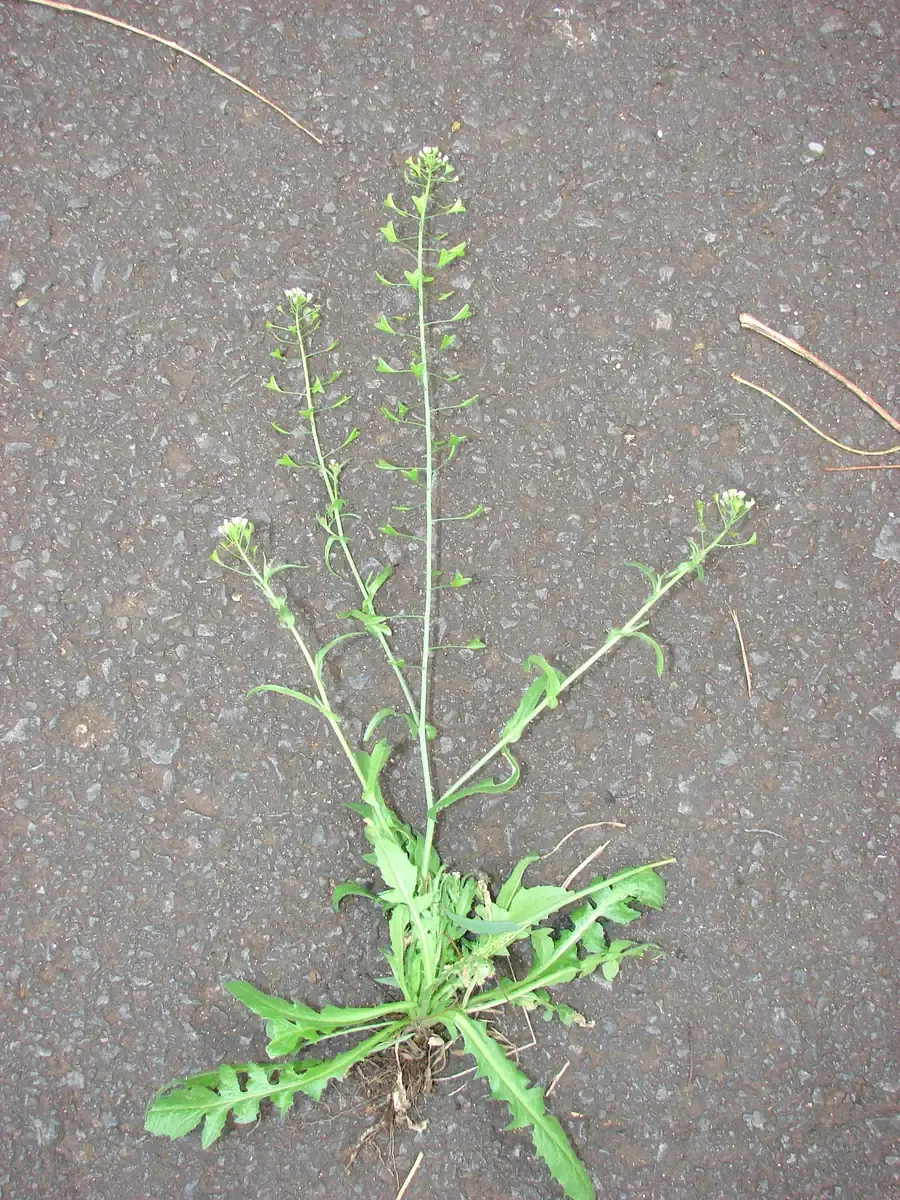
"Starr 070308-5329 Capsella bursa-pastoris" by Forest & Kim Starr — https://commons.wikimedia.org/wiki/File:Starr_070308-5329_Capsella_bursa-pastoris.jpg — CC BY 3.0 (https://creativecommons.org/licenses/by/3.0/); modified: resized from 2,112 x 2,816 to 900 x 1,200 pixels and saved as WebP