Giraffe Spots: Are Patch Shapes Passed From Mother to Calf?
Pattern entry Spiral, Fern & Honeycomb Published
In brief
A 2018 study of wild Masai giraffes in Tanzania measured 11 spot traits, and across 31 mothers and their calves only two, both about shape, were significantly alike: circularity and solidity. Spot number, size, the other shape measures and color showed no significant mother–calf match, and the authors note that this kind of comparison cannot separate genes from maternal or shared environmental effects. The 2018 paper does not say how the spots form; Voronoi and reaction-diffusion models can draw spot-like layouts, but nothing read for this page shows that either one is how a giraffe's coat is laid down.
Pattern card
- Pattern
- Dark, irregular spots on a pale coat, from nearly round with smooth edges to elongated with lobed or notched edges
- Where
- Giraffes; the measured population is wild Masai giraffes in the Tarangire ecosystem, northern Tanzania
- Made by
- growth: unresolved · reaction-diffusion: simulation-only
- Working recipe
- 3 rules / 3 parameters: give each point to its nearest seed (Voronoi); move each seed to the center of its cell and redraw (2 Lloyd rounds); shrink each cell to 0.84 about its centroid; parameters: 30 seeds, 2 rounds, 0.84; draws spot-like cells, not shown to make giraffe spots
- Key source
- Lee, Cavener & Bond 2018, PeerJ 6: e5690 full text
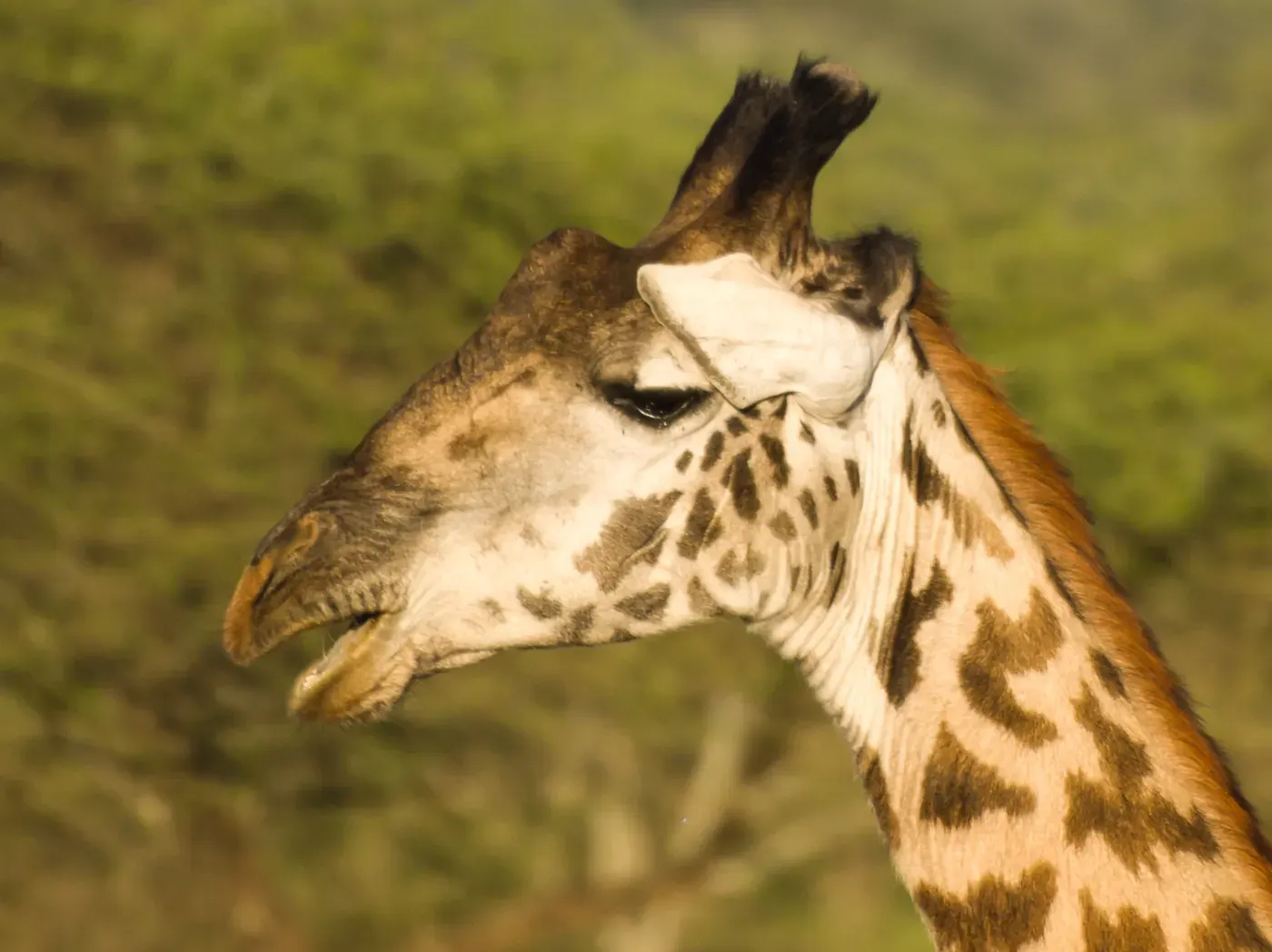
A Masai giraffe in Serengeti National Park, Tanzania, according to the file page; the spots on the neck have notched, lobed edges, while those on the face are small and close together.
"Giraffe Close-up" by William Warby from London, England — https://commons.wikimedia.org/wiki/File:Giraffe_Close-up_(2405302450).jpg — CC BY 2.0 (https://creativecommons.org/licenses/by/2.0/); modified: resized to 1400 px on the long edge and saved as WebP
Pick one dark spot on this giraffe's neck and trace its edge on the screen with a fingertip. Some stretches run smooth; others fold into notches and lobes. That edge can be turned into a number, and in one wild population the number for a calf tended to follow its mother's.
How are a giraffe's spots measured?
Derek Lee, Douglas Cavener and Monica Bond described their method in PeerJ (volume 6, e5690) in 2018 full text. Over 26 surveys between January 2012 and February 2016, the 2018 study photographed wild Masai giraffes from the right side in the Tarangire ecosystem of northern Tanzania.
Each photo was cropped to a rectangle over the shoulder and ribs, then turned into black and white. Spots cut off by the rectangle's edge were left out. Sizes were given in “giraffe units,” where 1 unit is the height of that rectangle, so a calf and an adult can be compared on the same scale.
The study used 11 measures: the number of spots, their area, perimeter and angle, circularity, maximum caliper, Feret angle, aspect ratio, roundness, solidity, and the most common color. Four of them carry most of the shape story:
- Circularity is 4 × pi × area divided by the perimeter squared. It equals 1.0 for a true circle and falls as a spot gets longer.
- Solidity is the spot's area divided by the area of its convex hull, the outline a rubber band would make if stretched around it. Smooth, entire edges score high; lobed or incised edges score lower. The authors also call it tortuousness.
- Aspect ratio compares the long and short axes of an ellipse fitted to the spot.
- Maximum caliper is the longest distance between any two points on the edge, also called the Feret diameter.
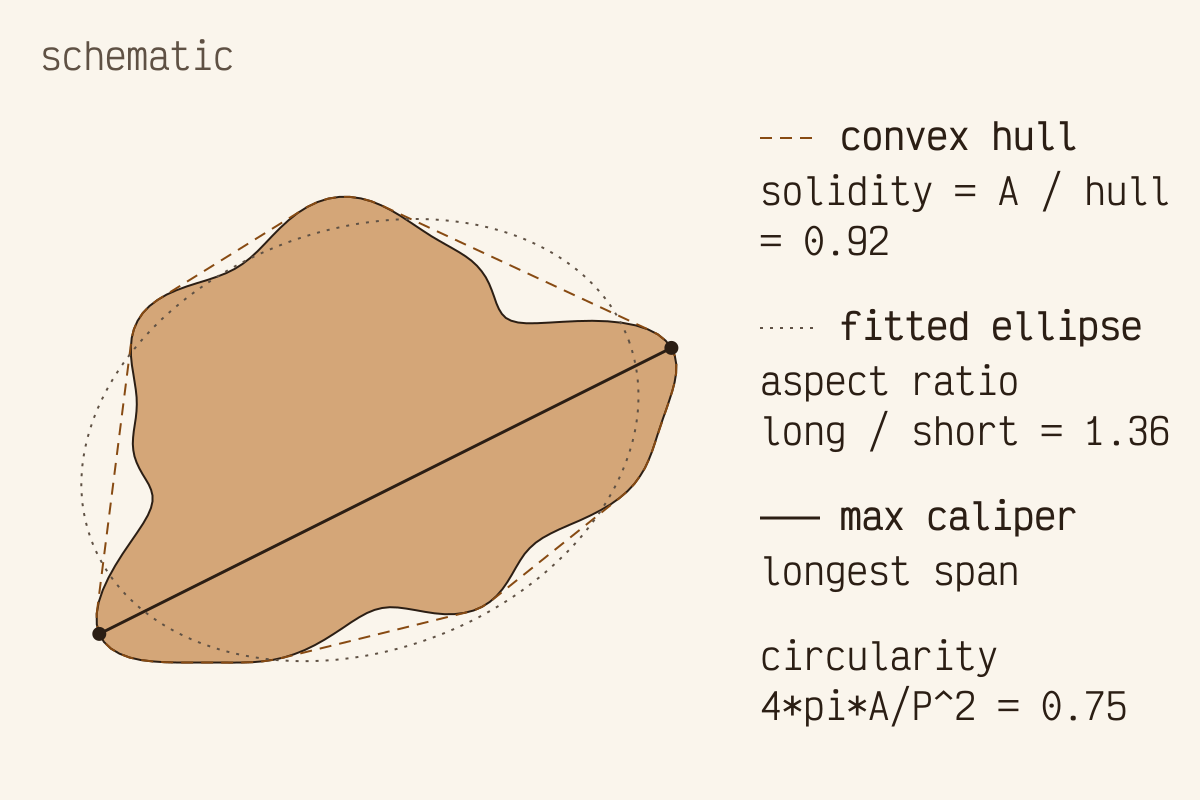
A schematic of one drawn spot with the shape measures defined by Lee and colleagues: the dashed outline is the convex hull used for solidity, the dotted ellipse gives the aspect ratio, and the straight line is the maximum caliper; the numbers belong to this drawn shape, not to a real giraffe.
Recipe spot = 1 schematic drawn polygon, 180 vertices; solidity = A / hull area = 0.92; aspect ratio = ellipse long / short axis (same second moments) = 1.36; circularity = 4*pi*A/P^2 = 0.75; max caliper = longest pair of hull vertices
"Four spot measures on one drawn spot" by Spiral, Fern & Honeycomb, https://spiralfernandhoneycomb.com/stripes-and-spots/giraffe-spots/, licensed under CC BY 4.0 (https://creativecommons.org/licenses/by/4.0/).
Data: Definitions from Lee DE, Cavener DR, Bond ML (2018) Seeing spots: quantifying mother-offspring similarity and assessing fitness consequences of coat pattern traits in a wild population of giraffes (Giraffa camelopardalis). PeerJ 6: e5690, https://doi.org/10.7717/peerj.5690, CC BY 4.0
The measures held up from photo to photo. For 30 giraffes with more than two photos each, repeatability ranged from 0.74 to 0.96, where 1 would mean the same reading from each photo.
The same study identified each giraffe by its coat, which it describes as unique and unchanging. As of 2018, Lee and colleagues noted that two genetic studies had placed Masai giraffes as a species of their own, while giraffe classification as a whole remained unsettled.
Do calves share their mothers' spot shapes?
The study found 31 mother–calf pairs by watching for extended suckling, longer than 5 seconds. For each trait it fitted a line through the 31 pairs, calf against mother. A steeper slope means calves look more like their mothers.
Because 11 traits were tested at once, the cut-off for a significant result was tightened from the usual 0.05 to 0.0045. Two traits passed: circularity, with a slope of 0.52 (P = 0.0037), and solidity, with 0.53 (P = 0.0041).
The other nine did not, including spot number, area and aspect ratio. Neither did two summary scores from a principal components analysis, a method that folds several traits into one number (P = 0.07 and 0.30).
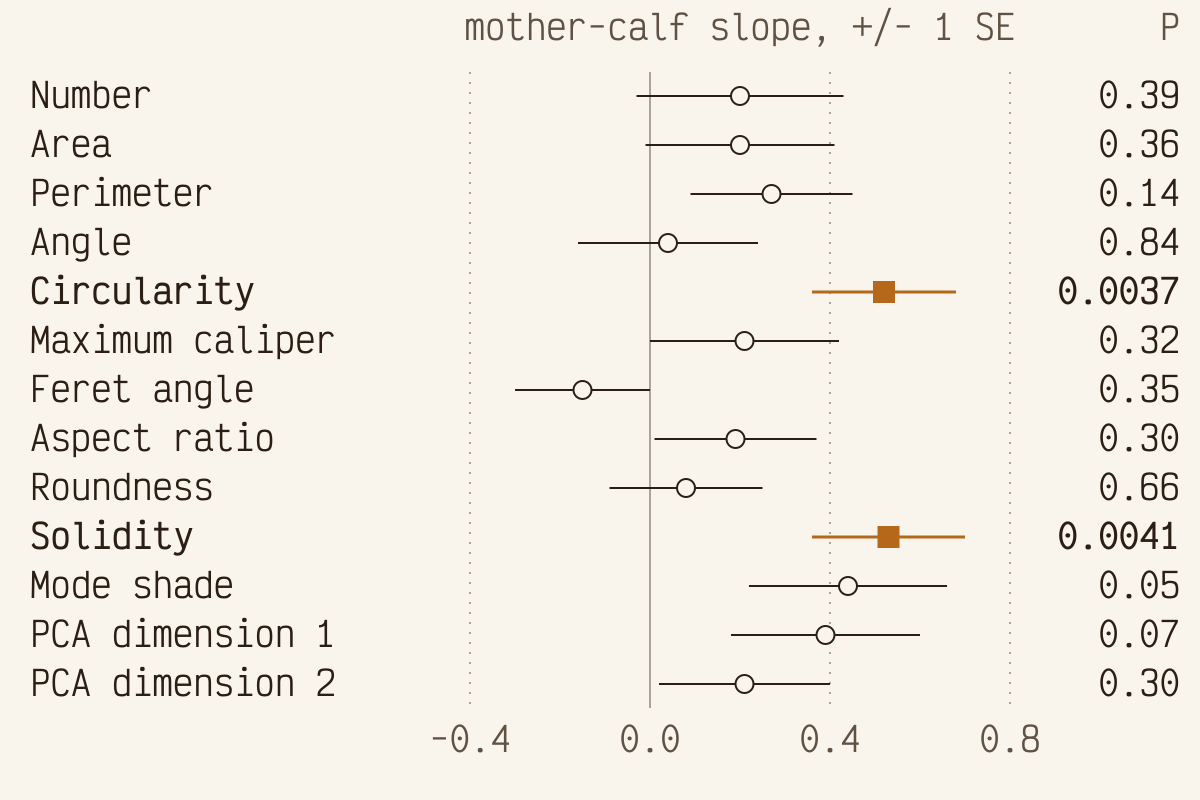
Slopes of calf on mother, plus or minus one standard error, for 11 spot traits and two summary scores in 31 Masai giraffe pairs, redrawn from Table 1 of Lee and colleagues; filled squares mark the two traits below the adjusted cut-off of 0.0045.
Recipe x = calf-on-mother regression slope +/- 1 SE; 13 rows; filled square = P < 0.0045 (Bonferroni, 11 tests); values from Lee et al. 2018, Table 1
"Mother-calf similarity of giraffe spot traits" by Spiral, Fern & Honeycomb, https://spiralfernandhoneycomb.com/stripes-and-spots/giraffe-spots/, licensed under CC BY 4.0 (https://creativecommons.org/licenses/by/4.0/).
Data: Lee DE, Cavener DR, Bond ML (2018) Seeing spots: quantifying mother-offspring similarity and assessing fitness consequences of coat pattern traits in a wild population of giraffes (Giraffa camelopardalis). PeerJ 6: e5690, https://doi.org/10.7717/peerj.5690, CC BY 4.0
| Trait | Slope (SE) | P | Alike at 0.0045? |
|---|---|---|---|
| Number of spots | 0.20 (0.23) | 0.39 | No |
| Area | 0.20 (0.21) | 0.36 | No |
| Perimeter | 0.27 (0.18) | 0.14 | No |
| Angle | 0.04 (0.20) | 0.84 | No |
| Circularity | 0.52 (0.16) | 0.0037 | Yes |
| Maximum caliper | 0.21 (0.21) | 0.32 | No |
| Feret angle | -0.15 (0.15) | 0.35 | No |
| Aspect ratio | 0.19 (0.18) | 0.30 | No |
| Roundness | 0.08 (0.17) | 0.66 | No |
| Solidity | 0.53 (0.17) | 0.0041 | Yes |
| Most common color | 0.44 (0.22) | 0.05 | No |
| Summary score 1 (mainly size) | 0.39 (0.21) | 0.07 | No |
| Summary score 2 (mainly shape) | 0.21 (0.19) | 0.30 | No |
Spot traits, slopes and survival links (CSV) (file notes: source and license) Data: Lee DE, Cavener DR, Bond ML (2018) Seeing spots: quantifying mother-offspring similarity and assessing fitness consequences of coat pattern traits in a wild population of giraffes (Giraffa camelopardalis). PeerJ 6: e5690, https://doi.org/10.7717/peerj.5690, CC BY 4.0
The paper is careful about what a slope can show. “PO regression studies cannot distinguish among phenotypic similarity due to genetic heritability, maternal effects, or shared environmental effects,” the authors write, PO meaning parent–offspring. They argue that environmental effects should be small, since the calves were born in the same area over a short span. The caveat stands all the same.
The question is old. Lee and colleagues credit Dagg with a 1968 suggestion, based on a small captive group, that spot shape, number, area and color may be heritable.
Are the spots linked to a calf's survival?
The team followed 258 calves first seen at 0 to 3 months old. When the calves were grouped by their overall spot traits, the groups' estimated survival differed by 0.04 to 0.07 per four-month season in the first season of life, and those gaps shrank greatly by ages 1 and 2. The method measures apparent survival, so a calf that died and one that left the area for good look the same, though the authors expected few young calves to leave.
Two single traits stood out in that first season. Calves with more spots, which means smaller spots, and calves with more elongated spots survived less well. No other trait showed a clear effect at any age, and the authors add that “model selection uncertainty was high.”
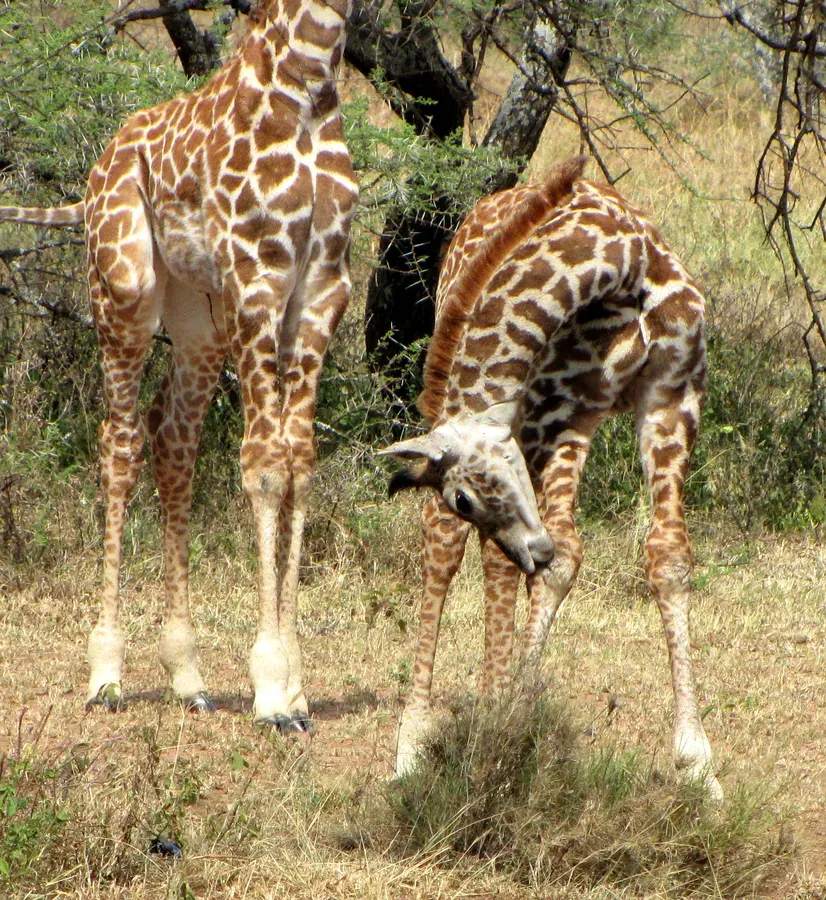
Two Masai giraffes about a week old in Serengeti National Park, Tanzania, according to the file page; spot size and shape are already set out across the whole coat.
"Young Maasai Giraffes" by D. Gordon E. Robertson — https://commons.wikimedia.org/wiki/File:Young_Maasai_Giraffes.jpg — CC BY-SA 3.0 (https://creativecommons.org/licenses/by-sa/3.0/); modified: resized to 900 px on the long edge and saved as WebP
The study offers camouflage among trees and bushes as one possible reason. It also names other routes: a gene that affects several traits at once, a maternal effect, or a shared environment. For the other roles proposed for the spots, such as temperature control and recognizing individuals or kin, its introduction states: “To date, no evidence has been presented for any of these hypotheses.”
What a coat pattern is for has been tested more directly elsewhere, as with zebra stripes.
What makes the spots in the first place?
The 2018 paper does not say. Lee and colleagues cite a hypothesis, from Eizirik and colleagues in 2010, that patterned coats come from two steps: one process lays out a pattern in the skin, and another reads that layout to make pigment.
Two short rules can draw something spot-like on a screen. A Voronoi diagram splits a plane so that each point belongs to its nearest seed; shrink each cell a little and pale gaps open between dark patches.
The Gray–Scott model is a reaction-diffusion model, two substances that react with each other while spreading at different speeds; at the setting below it leaves round dark spots. Its equations and its two spreading rates come from John Pearson's 1993 paper on the model full text; the setting itself is a site-chosen point, not one taken from that paper.
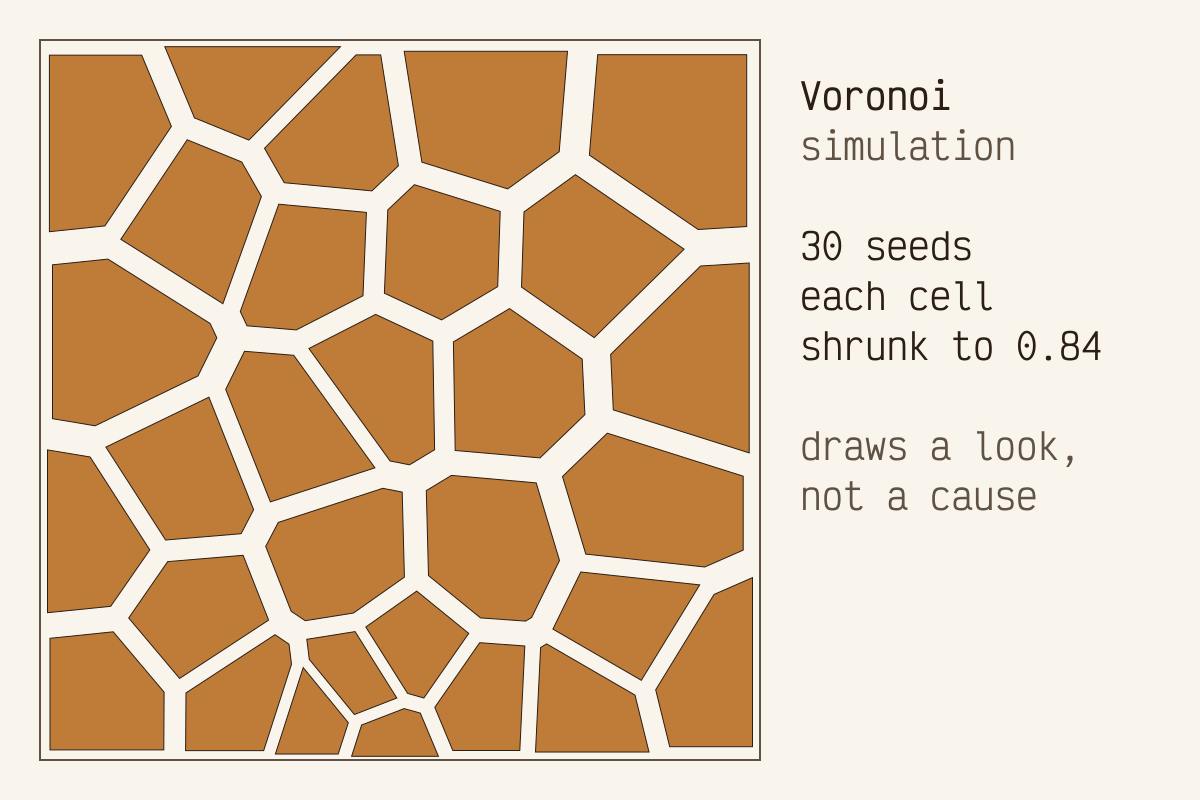
"Two models that draw spot-like layouts" by Spiral, Fern & Honeycomb, https://spiralfernandhoneycomb.com/stripes-and-spots/giraffe-spots/, licensed under CC BY 4.0 (https://creativecommons.org/licenses/by/4.0/).
Data: site computation
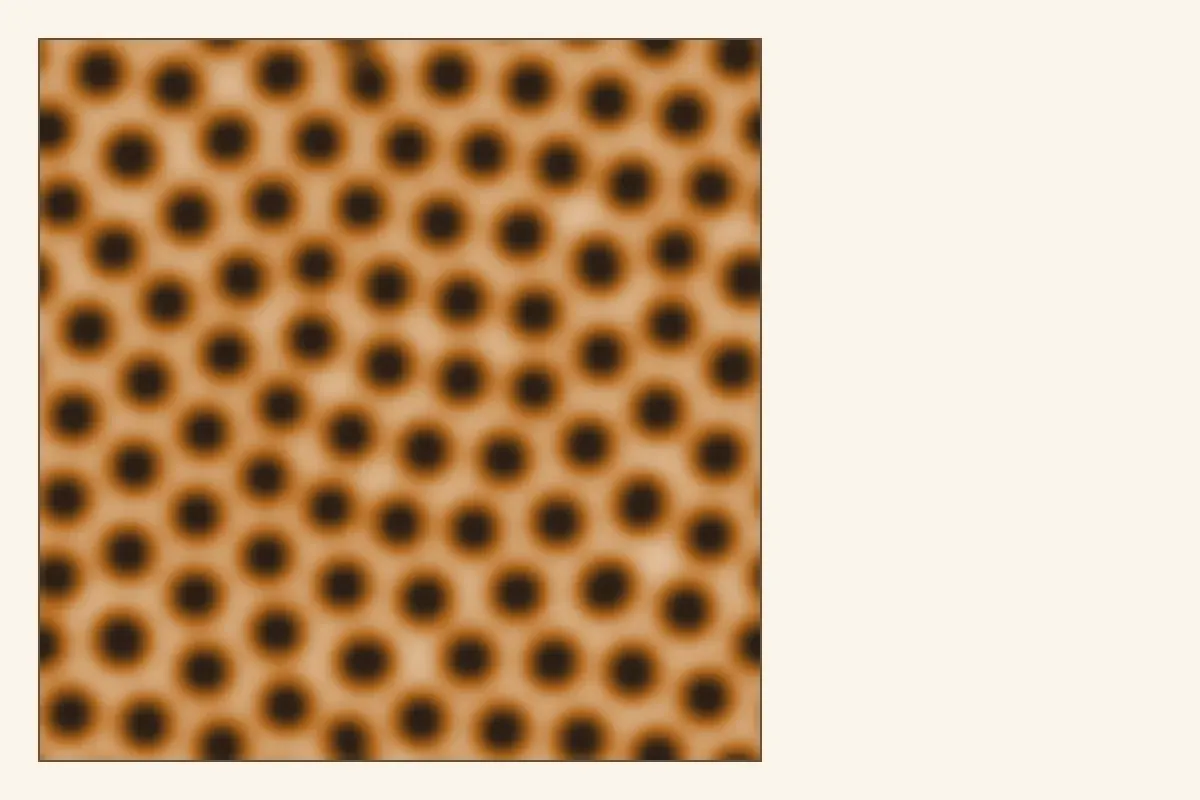
"Two models that draw spot-like layouts" by Spiral, Fern & Honeycomb, https://spiralfernandhoneycomb.com/stripes-and-spots/giraffe-spots/, licensed under CC BY 4.0 (https://creativecommons.org/licenses/by/4.0/).
Data: Model, Du and Dv: Pearson 1993, Complex Patterns in a Simple System, arXiv patt-sol/9304003; the F 0.03, k 0.061 point chosen by Spiral, Fern & Honeycomb
Two model simulations, not giraffes: first, a Voronoi diagram of 30 seeds with each cell shrunk toward its center; second, the Gray–Scott reaction-diffusion model, with the equations and spreading rates of Pearson 1993, at a site-chosen point after 20,000 steps. Each draws a spot-like layout; neither is shown to make a giraffe's spots.
Recipe first: Voronoi, seeds=30 drawn uniformly in a 720 x 720 square, seed=15, Lloyd rounds=2, each cell scaled 0.84 about its centroid; second: Gray-Scott, F=0.03, k=0.061 (site-chosen point), Du=2e-5, Dv=1e-5 (Pearson 1993), dt=1, h=2.5/256, grid=128 (periodic edges), start square 20x20 (U=1/2, V=1/4, noise ±1%), steps=20000, seed=1993
Neither drawing is evidence. The Voronoi cells have straight edges, while the neck spots in the photo at the top of this page are notched and lobed; the Gray–Scott spots are small and round. In these models, a rule draws a look and says nothing about giraffe skin. Cone shell patterns are another animal pattern with two rival models and the same open question.
Sources
- Lee DE, Cavener DR, Bond ML (2018). Seeing spots: quantifying mother-offspring similarity and assessing fitness consequences of coat pattern traits in a wild population of giraffes (Giraffa camelopardalis). PeerJ 6: e5690. doi:10.7717/peerj.5690. CC BY 4.0. pmc.ncbi.nlm.nih.gov/articles/PMC6173159/Read: full text; Introduction, Methods, Results (Tables 1 to 3), Discussion and ConclusionsText license: CC BY 4.0 (terms)
- Pearson JE (1993). Complex patterns in a simple system. Science 261(5118):189. doi:10.1126/science.261.5118.189; preprint arXiv:patt-sol/9304003 arxiv.org/abs/patt-sol/9304003Read: full text; arXiv v1 (1993-04-17), Eq. 2 and pages 2–6
Cite this page
Spiral, Fern & Honeycomb. “Giraffe Spots: Are Patch Shapes Passed From Mother to Calf?.” Published November 23, 2026. https://spiralfernandhoneycomb.com/stripes-and-spots/giraffe-spots/ (accessed the day you read it).
- How each figure and source is checked
- Retunings: every correction, dated
- Report an error on this page (contact@spiralfernandhoneycomb.com)
More from Stripes & Spots
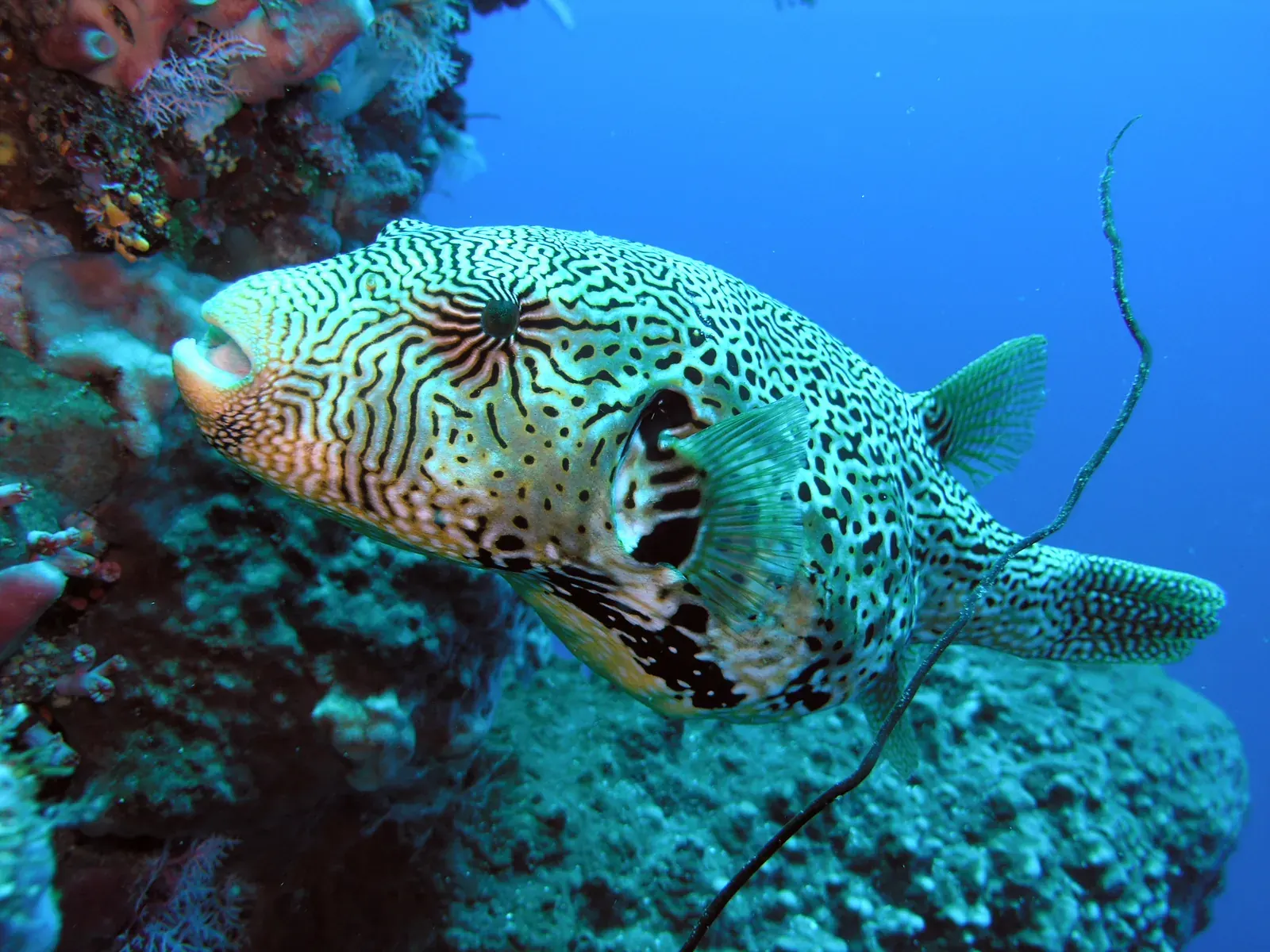
Turing Patterns: A Related Model Turns Spots to Stripes
Picture credit
"Arothron mappa" by Jens Petersen — https://commons.wikimedia.org/wiki/File:Arothron_mappa.JPG — CC BY 2.5 (https://creativecommons.org/licenses/by/2.5/); modified: resized to 1600 px wide and saved as WebP
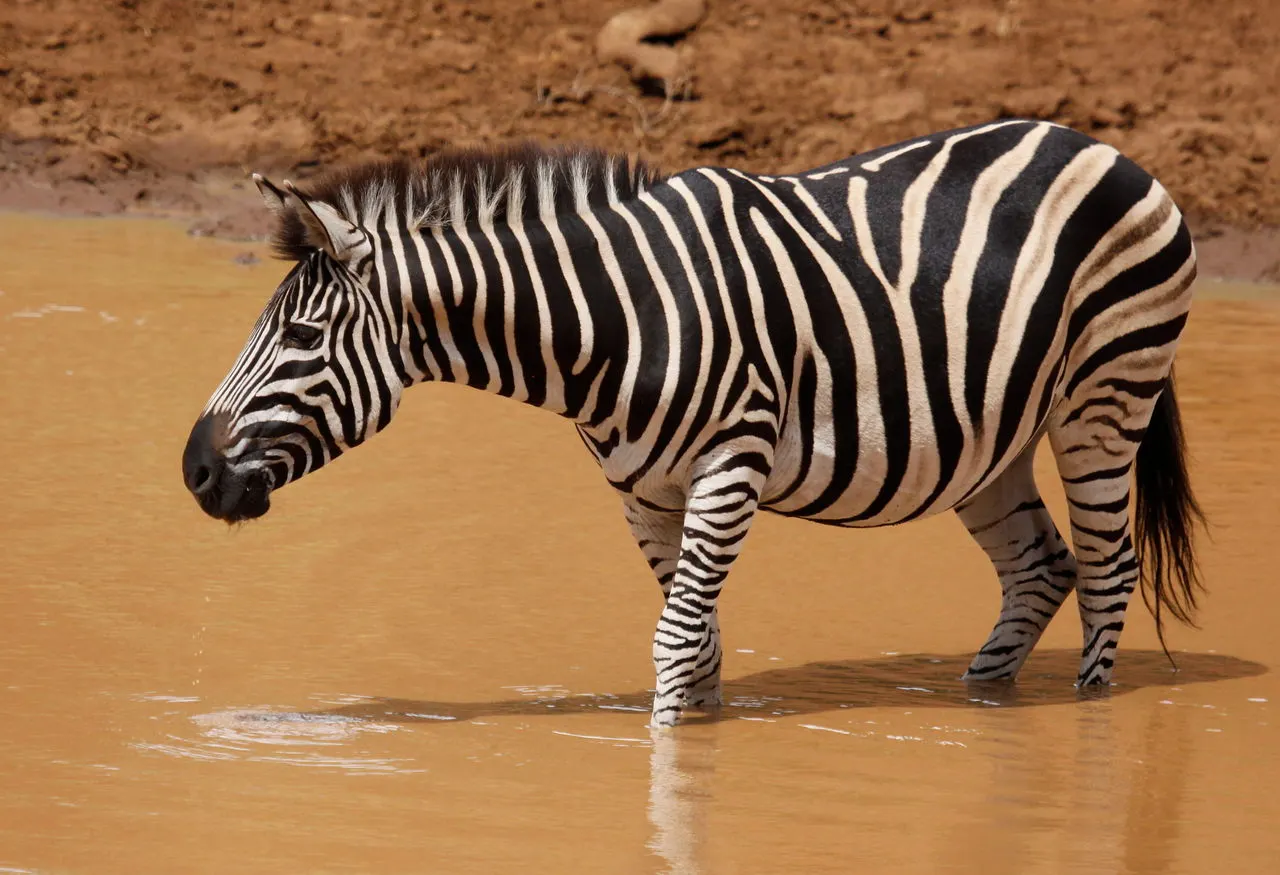
Why Do Zebras Have Stripes? The Ideas Have Unequal Evidence
Picture credit
"Plains zebra (common zebra or Burchell's zebra), Equus quagga at Pilanesberg National Park, Northwest Province, South Africa" by Derek Keats from Johannesburg, South Africa — https://commons.wikimedia.org/wiki/File:Plains_zebra_(common_zebra_or_Burchell%27s_zebra),_Equus_quagga_at_Pilanesberg_National_Park,_Northwest_Province,_South_Africa_(16906289242).jpg — CC BY 2.0 (https://creativecommons.org/licenses/by/2.0/)
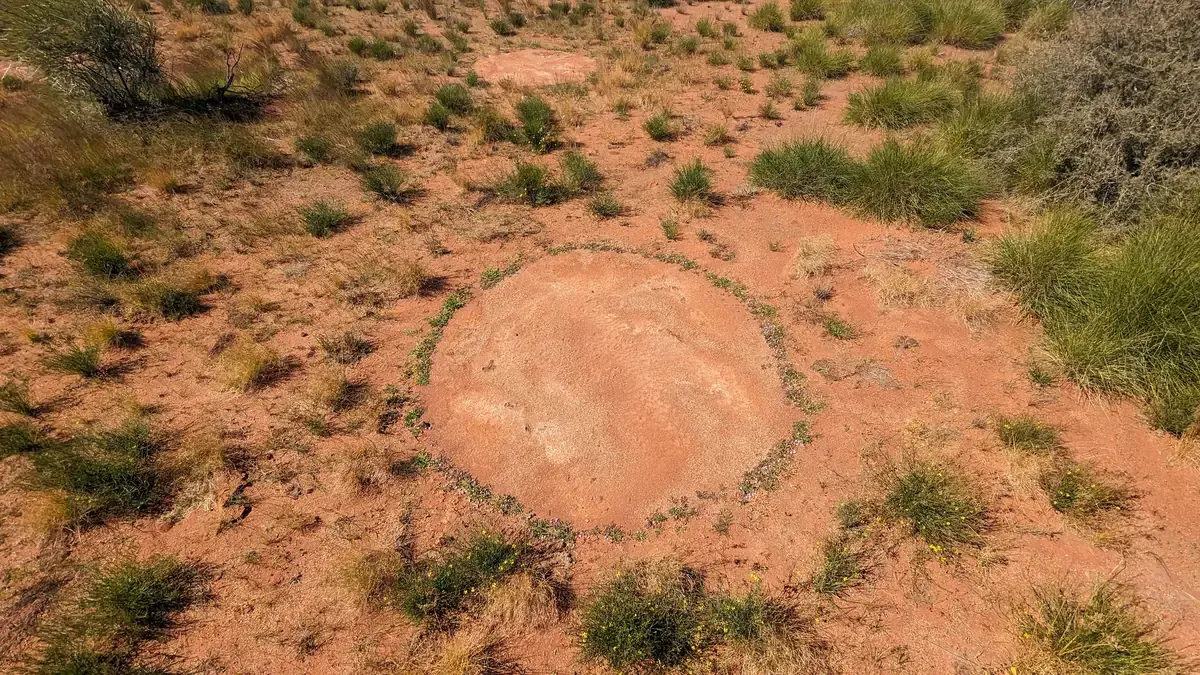
Fairy Circles: Grass Competition Leads in the Studies Read
Picture credit
"Fairy circles, Newhaven Wildlife Sanctuary" by B 897 — https://commons.wikimedia.org/wiki/File:Fairy_circles,_Newhaven_Wildlife_Sanctuary.jpg — CC0 1.0 (https://creativecommons.org/publicdomain/zero/1.0/); modified: resized to 1200 px on the long edge and saved as WebP