Fairy Circles: Grass Competition Leads in the Studies Read
Same rule, two bodies Spiral, Fern & Honeycomb Published
In brief
Fairy circles are bare, roughly round patches about 2 to 12 meters across, spread evenly through sandy grassland on the eastern edge of the Namib Desert, and a 2016 study found the same layout in Western Australia. One explanation says sand termites clear them; the other says grasses competing for scarce water leave evenly spaced gaps. Most of the studies read in full for this page favor the grass explanation, but the main termite paper on the Namib could be read only as a citation, so the two sides are not weighed equally here.
Pattern card
- Pattern
- Bare, roughly round patches about 2 to 12 m across, evenly spaced in sparse grass
- Where
- Sandy grassland on the eastern edge of the Namib Desert, southern Angola to northern South Africa; also near Newman in Western Australia
- Made by
- growth: candidate (grass competing for water; Getzin and coauthors, Cramer and Barger, Tschinkel full text) · behavior: unresolved (sand termites in the Namib, Juergens paper bibliographic; harvester termites in Australia, Walsh letter full text)
- Working recipe
- 1 rule / 2 parameters: centers on a triangular grid, each moved by up to a set share of the spacing in x and in y (spacing=1, jitter=0.15); draws the even spacing, not its cause
- Key source
- Getzin and coauthors, Discovery of fairy circles in Australia supports self-organization theory, PNAS 2016 full text
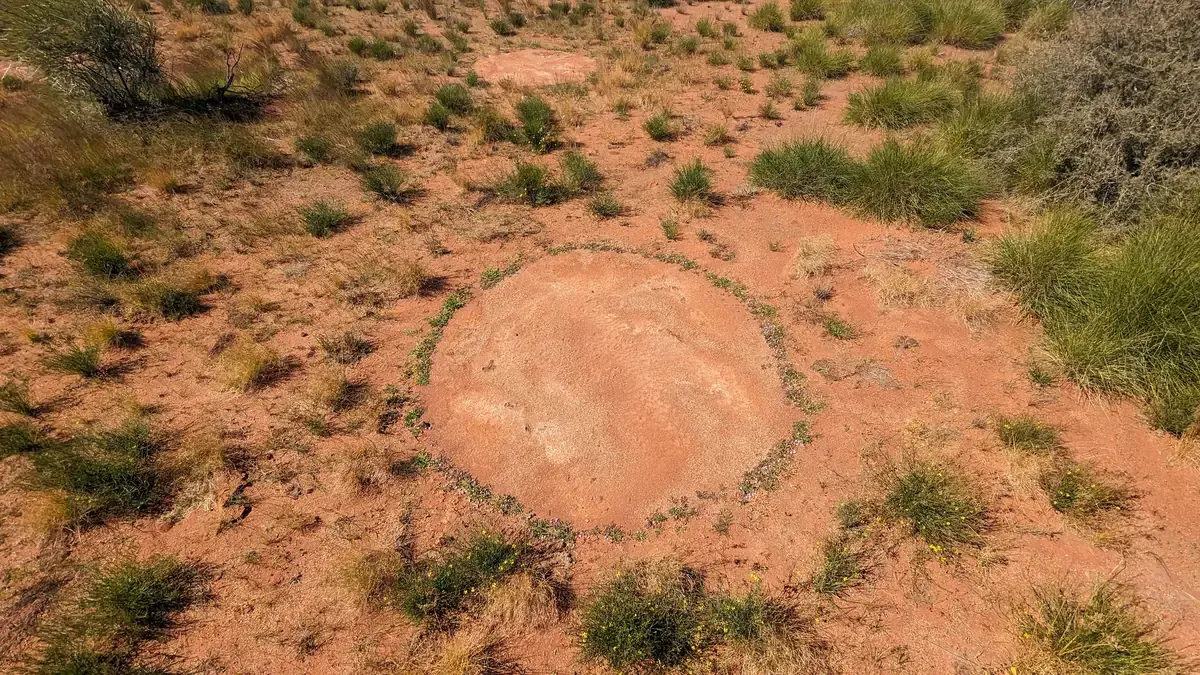
A bare, round patch edged by a thin ring of small plants, with tussock grass around it, at Newhaven Wildlife Sanctuary in the Northern Territory of Australia, labeled a fairy circle on its file page; the Australian circles described in the 2016 study lie farther west, near Newman in Western Australia.
"Fairy circles, Newhaven Wildlife Sanctuary" by B 897 — https://commons.wikimedia.org/wiki/File:Fairy_circles,_Newhaven_Wildlife_Sanctuary.jpg — CC0 1.0 (https://creativecommons.org/publicdomain/zero/1.0/); modified: resized to 1200 px on the long edge and saved as WebP
On a satellite map of the Namib's eastern grassland, measure the gaps between three neighboring bare circles. Where the circles are dense, the gaps tend to come out close to equal. A 2016 analysis of aerial images found that each circle tends to have six nearest neighbors at about the same distance, and a 2012 survey found that circles appear and fill in again over decades. Any explanation of fairy circles has to produce both the spacing and the turnover.
What are fairy circles?
Fairy circles are nearly round bare patches in a sparse cover of short grass. Walter Tschinkel's 2012 survey in PLOS ONE full text gives them as about 2 to 12 meters across, often surrounded by a halo of taller grass, and found by the hundreds of thousands in roughly regular spacing. By that survey's account, they occur from southern Angola to northern South Africa wherever the soil is sandy and rain totals 50 to 100 millimeters a year.
Michael Cramer and Nichole Barger, in a 2013 PLOS ONE study full text, sampled soil across circles in Namibia. The rim grasses stand about 0.5 meters tall, against about 0.2 meters for the grass between circles. Soil moisture inside a circle was highest at the center and fell toward the edge, which the authors suggest may mean the rim grasses send roots in to tap it.
In Namibia the circles keep to settled sand. Tschinkel found them on sand plains, whether level, undulating or holding some stones, but not on shifting dunes, gravel plains or rocky ground.
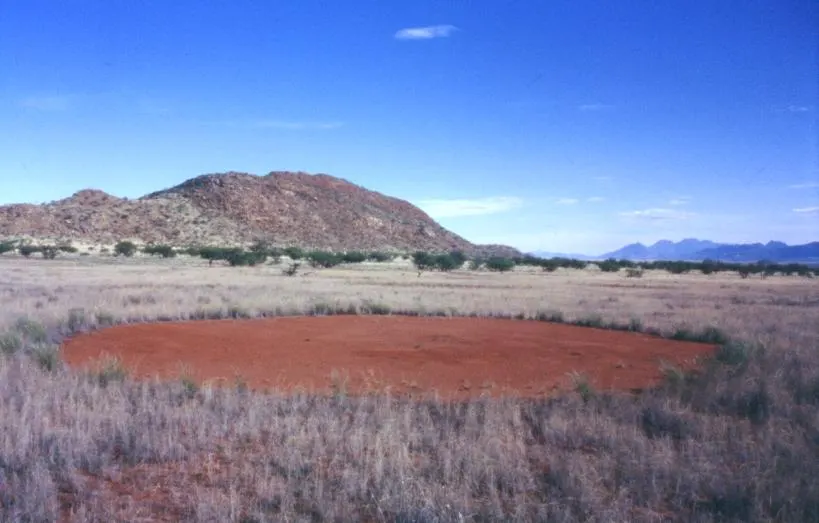
One fairy circle in the Marienfluss valley of northwestern Namibia, according to the file page: bare red sand inside, a band of grass around the edge, and short grass beyond.
"Feenkreis Marienflusstal Namibia" by Thorsten Becker — https://commons.wikimedia.org/wiki/File:Feenkreis_Marienflusstal_Namibia.jpg — CC BY-SA 2.0 de (https://creativecommons.org/licenses/by-sa/2.0/de/)
How evenly are fairy circles spaced?
Evenly enough to measure. In a 2016 paper in the Proceedings of the National Academy of Sciences full text, Stephan Getzin and colleagues applied the pair-correlation function g(r) to aerial images. The function compares how many circles sit at distance r from a typical circle with the number expected if the circles were scattered with no pattern, so a value of 1 means no pattern at that distance.
In their Australian plot, g(r) was zero at the shortest distances and peaked at about 10 meters, roughly the mean distance to the nearest circle. The authors read that high first peak as a hexagonal layout, with six nearest neighbors at about the same distance, and they report nearly identical statistics for a Namibian plot.
A second count agrees. Voronoi tiles give each circle the ground that is closer to it than to any other circle. Six-cornered tiles were the most common kind. They made up 46.9 percent on average in Australia, against 43 to 46 percent reported for three regions of Namibia.
Cramer and Barger add a condition. In their survey, circles were over-dispersed, meaning spread more evenly than chance, only where they covered a large share of the ground, a pattern the authors read as circles competing with one another for resources.
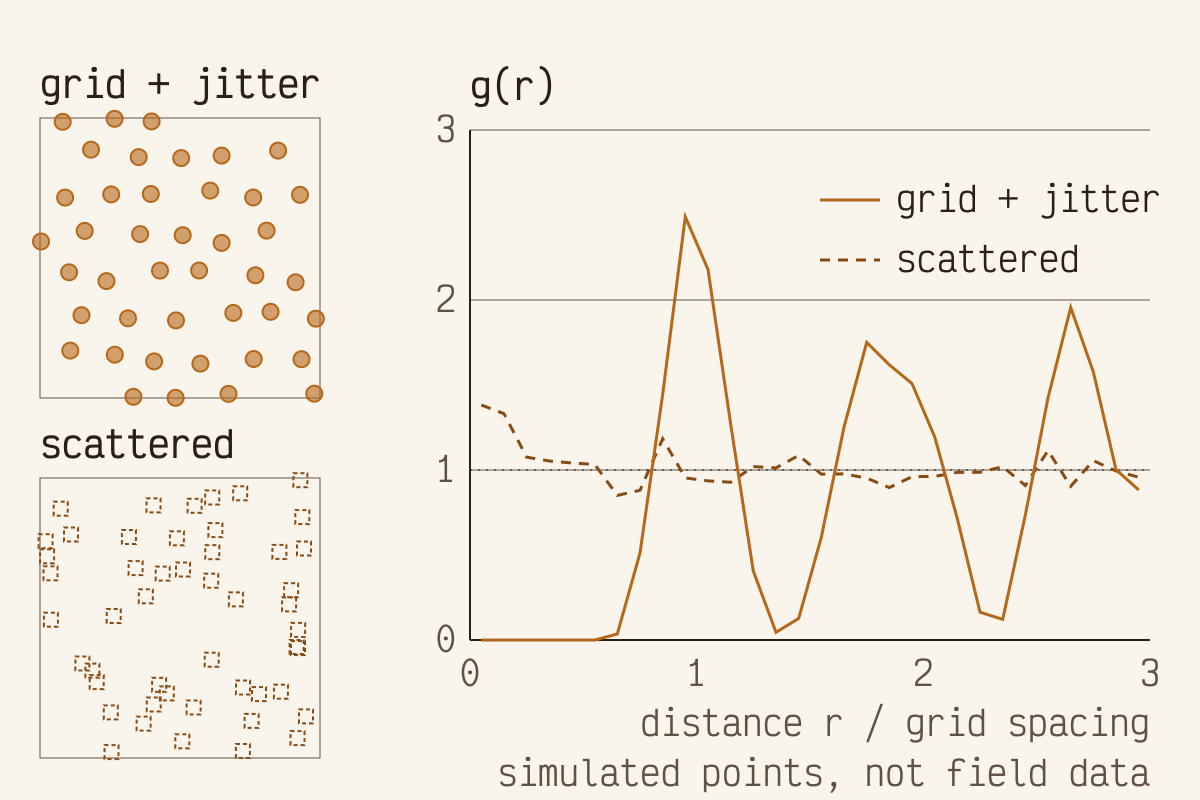
Simulated points, not field data: 360 grid centers each moved by up to 0.15 of the spacing in x and in y, beside 360 points scattered independently. Only the grid set gives g(r) a sharp first peak near one spacing, the signature the 2016 study reports; the simulation draws spacing, not its cause.
Recipe triangular grid 18 x 20, spacing=1, jitter=0.15 (seed 11); scattered n=360 (seed 12); wrapped box 18 x 17.32; g(r) bins=0.1, r=0-3
Read this figure as text
- Grid with jitter: 360 points, mean nearest-neighbor distance 0.849 spacing, g(r) zero below 0.3 and peaking at 2.49 at r = 0.95.
- Scattered: 360 points, mean nearest-neighbor distance 0.451 spacing, g(r) near 1 at almost every distance, with no clear peak.
"Even spacing in simulated points: pair correlation g(r)" by Spiral, Fern & Honeycomb, https://spiralfernandhoneycomb.com/stripes-and-spots/fairy-circles/, licensed under CC BY 4.0 (https://creativecommons.org/licenses/by/4.0/).
Data: site computation
Simulated spacing statistics (CSV) (file notes: source and license) Data: site computation
Do fairy circles move or die?
No study read for this page describes circles moving. Tschinkel's 2012 survey describes a life cycle instead: circles are born, mature, sometimes enlarge, and die as grass fills them in. He compared satellite images of the same ground in the NamibRand Nature Reserve from 2004 and 2008, then checked circles on the ground in 2009.
Most circles barely changed. Some appeared and some filled in, and new ones seemed to appear at close to their final size rather than starting small.
From the births and deaths among 605 circles on 16 grid sites, the survey estimated a mean lifespan of 41 years. With 95 percent confidence, the true mean lay between 35 and 55 years.
A second estimate came to 59 years. It started from 131 circles that had been bare when first recorded and were found again 2 to 9 years later; the 129 of them with complete records went into that estimate. Smaller circles turned over faster: those under 30 square meters lasted about 23 years on average, against about 75 years for those of 30 to 60 square meters.
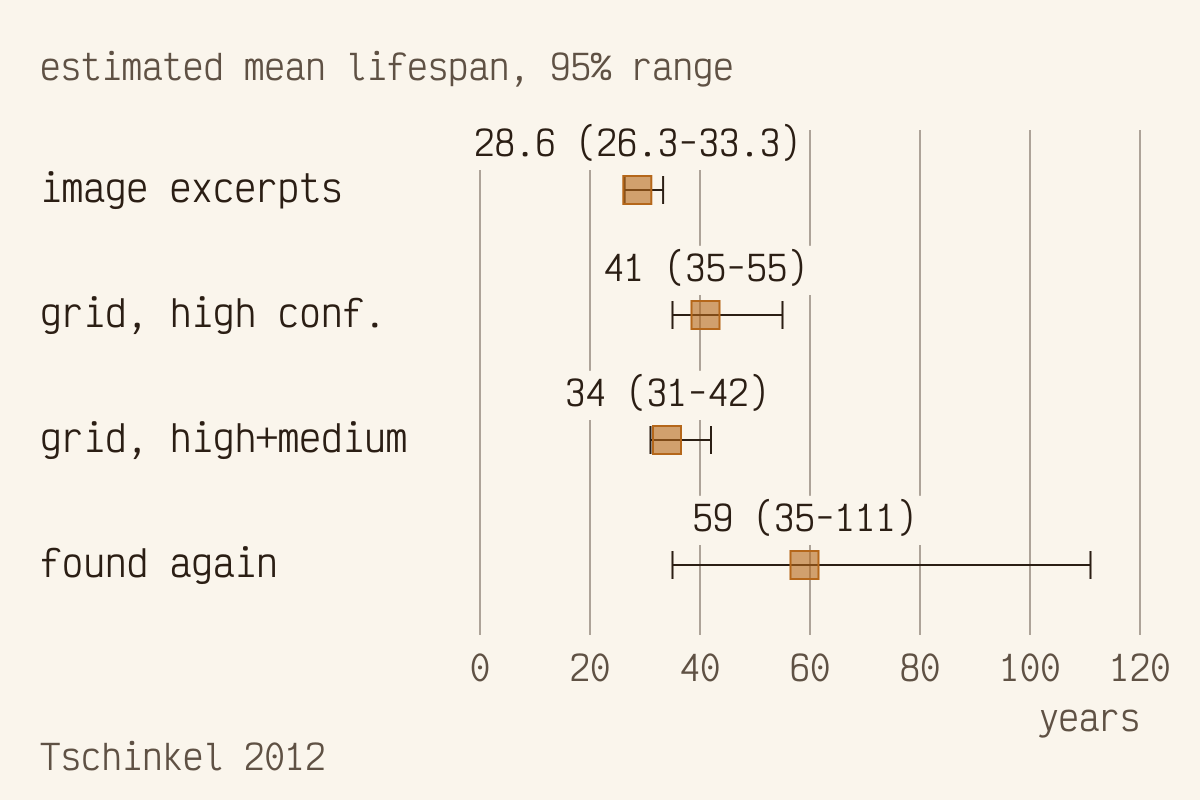
Four estimates of mean fairy circle lifespan from one survey in the NamibRand Nature Reserve, redrawn from the numbers Tschinkel reports in 2012; the excerpt estimate came from image patches chosen for their changes, and the author judges it too low.
Recipe point = estimated mean lifespan, bar = 95% range; axis 0-120 years; values from Tschinkel 2012, Results
Read this figure as text
- Image excerpts, ground-checked: 28.6 years (26.3 to 33.3), judged too low by the author.
- 16 grid sites, 605 circles at the highest confidence level: 41 years (35 to 55).
- Same grid sites, high and medium confidence: 34 years (31 to 42).
- 131 circles found again 2 to 9 years later, 129 of them with complete records: 59 years (35 to 111).
"Fairy circle lifespan estimates from one Namibian survey" by Spiral, Fern & Honeycomb, https://spiralfernandhoneycomb.com/stripes-and-spots/fairy-circles/, licensed under CC BY 4.0 (https://creativecommons.org/licenses/by/4.0/).
Data: Tschinkel WR (2012) The life cycle and life span of Namibian fairy circles. PLOS ONE 7(6): e38056, https://doi.org/10.1371/journal.pone.0038056, CC BY
The author notes that these estimates strictly apply to the changes between 2004 and 2008. Rain may drive some of the turnover. Getzin's team, citing earlier work, writes that circles shrink and vanish after wetter-than-average years and enlarge and multiply after drier ones. The team argues that only the grass explanation accounts for this.
What do the two explanations rest on?
The grass explanation treats fairy circles as self-organization, a regular pattern arising from local interactions with no plan. Grasses draw scarce water toward their roots, which favors growth close by and starves the ground in between, so bare gaps open at a typical spacing, as the 2016 paper and the 2013 survey argue.
The strongest field case comes from Australia. Near the mining town of Newman, Getzin's team found circles averaging 4 meters across in spinifex grass, Triodia basedowii. A clay-rich crust in the gaps let rain soak in slowly, so water ran off toward the grass, and a model of plants and water drew patterns that matched the mapped ones. In Namibia, the paper says, water moves through porous sand instead, and the gaps hold more water than the soil under the grass.
What does the rival explanation rest on?
The termite explanation was set out by N. Juergens in a 2013 Science paper, The biological underpinnings of Namib Desert fairy circles; only its citation could be read for this page bibliographic. Cramer and Barger report that it found a strong association between the sand termite Psammotermes allocerus and the circles, with no direct evidence yet that the insects shape them. Tschinkel's 2015 experiments paper full text notes that it rested on correlations without experiments, and writes that evidence of these insects causing the circles “currently remains weak to absent.”
In Getzin's Australian study, termite signs turned up in 47, 60 and 33 percent of gaps at three field sites. Their number did not track gap size. On one plot that held 328 circles, field mapping found 50 such signs, and the insect nests were clumped rather than evenly spread. That tests Australian insects, not the Namib species.
A 2016 letter full text to the same journal challenged that result. Fiona Walsh and colleagues argued that the Australian gaps begin as the hard nests of Drepanotermes harvester termites, which they call ecologically unlike the Namib's sand termites. Their early digs at four sites, from Newman to the Newhaven sanctuary in the top photograph, found termite chambers under each gap dug.
Getzin's team replied full text that only two of those digs lay in its Newman study area, and that in one of its plots, gaps were forming on loose sand with no buried nest to about 30 centimeters.
Tschinkel's experiments, set up in 2009 and followed until 2015, tested other proposed causes. A buried gas barrier, soil swapped between circles and grass, and added micronutrients made no difference, and cleared patches 2 or 4 meters wide beside natural circles grew back. He concluded that none of the first three explains the circles, and found no sign of plant feedbacks at the 2 to 10 meter scale.
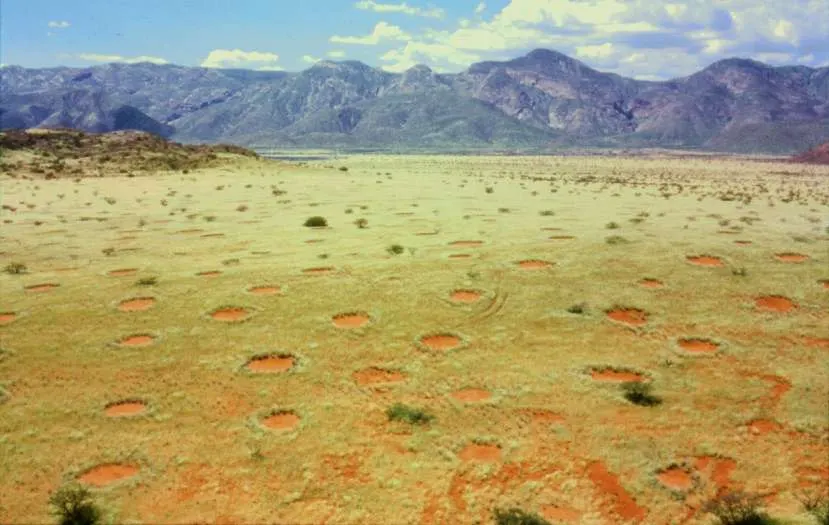
Dozens of fairy circles across grassland in the Marienfluss valley of northwestern Namibia, according to the file page, seen at a low angle with mountains behind.
"Feenkreise Namibia" by Thorsten Becker — https://commons.wikimedia.org/wiki/File:Feenkreise_Namibia.jpg — CC BY-SA 2.0 de (https://creativecommons.org/licenses/by-sa/2.0/de/)
Where does the evidence stand?
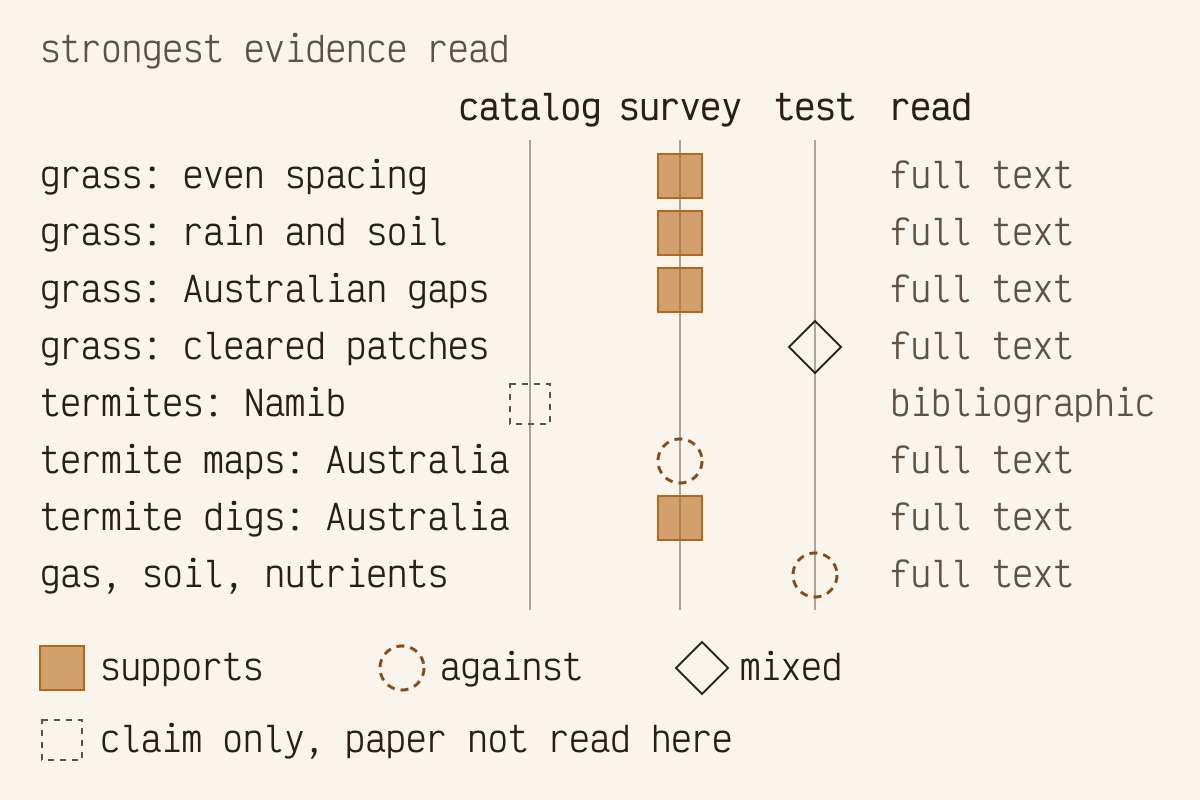
Eight claims about fairy circles, each placed by the strongest kind of evidence read for this page, from a catalog entry to a field survey to a field test, with the reading level of each source; the Namib claim sits at catalog entry because its paper was read only as a citation bibliographic.
Recipe rows=8 claims; columns=catalog entry, survey, test; marker=strongest evidence read (square supports, dashed circle against, diamond mixed, dashed square claim not read); grades assigned by this site from Getzin and colleagues 2016, Cramer and Barger 2013, Tschinkel 2015 and Walsh and colleagues 2016, with the Namib termite paper read only as a citation
"Fairy circle explanations by strongest evidence read" by Spiral, Fern & Honeycomb, https://spiralfernandhoneycomb.com/stripes-and-spots/fairy-circles/, licensed under CC BY 4.0 (https://creativecommons.org/licenses/by/4.0/).
Data: Tschinkel WR (2015) Experiments testing the causes of Namibian fairy circles. PLOS ONE 10(10): e0140099, https://doi.org/10.1371/journal.pone.0140099, CC BY; Cramer MD, Barger NN (2013) Are Namibian fairy circles the consequence of self-organizing spatial vegetation patterning? PLOS ONE 8(8): e70876, https://doi.org/10.1371/journal.pone.0070876, CC BY
| Claim | Side | Key study | Evidence read | Reading level |
|---|---|---|---|---|
| Circles sit in an even layout, about six nearest neighbors each | Grass | Getzin and colleagues, 2016 | Aerial-image statistics, Namibia and Australia | full text |
| Within one Namibian reserve, circle cover falls as rain and soil nitrogen rise; even spacing only where circles are dense | Grass | Cramer and Barger, 2013 | Soil sampling and image survey, Namibia; across the whole range, cover peaks at middling rainfall | full text |
| Australian gaps shed rain toward the grass; a plant and water model draws the pattern | Grass | Getzin and colleagues, 2016 | Field soil tests, aerial images, model | full text |
| Cleared patches beside circles grew back | Grass, local scale | Tschinkel, 2015 | Field experiment, 2009 to 2015; mixed, with no sign of plant feedbacks at 2 to 10 meters | full text |
| Sand termites clear the circles | Termites | Juergens, 2013 | Paper not read; other authors describe a field association | bibliographic |
| Insect nests do not match Australian circles | Against termites | Getzin and colleagues, 2016 | Field mapping, Western Australia | full text |
| Bare Australian gaps begin as harvester termite nests | Termites (Australia) | Walsh and colleagues, 2016 | Early digs at four sites, in a letter; disputed in a reply | full text |
| Gases, circle soil or missing micronutrients keep circles bare | Other causes | Tschinkel, 2015 | Field experiments; no effect, so against these causes | full text |
This table as CSV (fairy-circles-evidence.csv) (file notes: source and license) Data: Tschinkel WR (2015) Experiments testing the causes of Namibian fairy circles. PLOS ONE 10(10): e0140099, https://doi.org/10.1371/journal.pone.0140099, CC BY; Cramer MD, Barger NN (2013) Are Namibian fairy circles the consequence of self-organizing spatial vegetation patterning? PLOS ONE 8(8): e70876, https://doi.org/10.1371/journal.pone.0070876, CC BY
This page's reading: the grass explanation is a candidate mechanism, the better supported of the two in the studies read in full. Its support is mostly pattern matching, correlation and failed tests of rival causes. Tschinkel calls landscape-scale self-organization “a more likely cause,” and Getzin's team calls some of its own Australian results on soil water “so far less conclusive.”
The termite explanation for the Namib could not be weighed on its own terms. Its main paper reached this page only as a citation, and what it says arrived through authors who themselves favor the grass explanation; reading it in full could change this assessment. The Australian termite case was read in full, but it is a short letter on early digs, answered by the team it disputes. Unlike zebra stripes, a dispute where direct tests on live animals were read in full, this one stays uneven by reading depth.
Some questions stay open. The 2012 survey noted that no particular resource, water or nutrients, could yet be named as the one the feedbacks compete for. The 2016 paper says the effect of frequent fires on the Australian grassland patterns needs further study. For a spaced pattern on an animal rather than on the ground, giraffe spots are a coat pattern measured in one wild herd.
Sources
- Getzin S, Yizhaq H, Bell B, Erickson TE, Postle AC, Katra I, Tzuk O, Zelnik YR, Wiegand K, Wiegand T, Meron E (2016). Discovery of fairy circles in Australia supports self-organization theory. Proceedings of the National Academy of Sciences USA 113(13): 3551–3556. doi:10.1073/pnas.1522130113. pmc.ncbi.nlm.nih.gov/articles/PMC4822591/Read: full text; Significance, Abstract, Results and Discussion, Materials and Methods
- Tschinkel WR (2012). The life cycle and life span of Namibian fairy circles. PLOS ONE 7(6): e38056. doi:10.1371/journal.pone.0038056. CC BY. pmc.ncbi.nlm.nih.gov/articles/PMC3384657/Read: full text; Abstract, Introduction, Results and Discussion
- Cramer MD, Barger NN (2013). Are Namibian “fairy circles” the consequence of self-organizing spatial vegetation patterning? PLOS ONE 8(8): e70876. doi:10.1371/journal.pone.0070876. CC BY. pmc.ncbi.nlm.nih.gov/articles/PMC3744476/Read: full text; Abstract, Introduction and Discussion
- Juergens N (2013). The biological underpinnings of Namib Desert fairy circles. Science 339(6127): 1618–1621. doi:10.1126/science.1222999. doi.org/10.1126/science.1222999Read: bibliographic
- Tschinkel WR (2015). Experiments testing the causes of Namibian fairy circles. PLOS ONE 10(10): e0140099. doi:10.1371/journal.pone.0140099. CC BY. pmc.ncbi.nlm.nih.gov/articles/PMC4625006/Read: full text; Abstract, Introduction and Discussion
- Walsh FJ, Sparrow AD, Kendrick P, Schofield J (2016). Fairy circles or ghosts of termitaria? Pavement termites as alternative causes of circular patterns in vegetation of desert Australia. Proceedings of the National Academy of Sciences USA 113(37): E5365–E5367. doi:10.1073/pnas.1607860113. pmc.ncbi.nlm.nih.gov/articles/PMC5027454/Read: full text; the whole letter, with Table 1 and the Fig. 1 legend
- Getzin S, Yizhaq H, Bell B, Erickson TE, Postle AC, Katra I, Tzuk O, Zelnik YR, Wiegand K, Wiegand T, Meron E (2016). Reply to Walsh et al.: Hexagonal patterns of Australian fairy circles develop without correlation to termitaria. Proceedings of the National Academy of Sciences USA 113(37): E5368–E5369. doi:10.1073/pnas.1611877113. pmc.ncbi.nlm.nih.gov/articles/PMC5027457/Read: full text; the whole reply, with the Fig. 1 legend
Cite this page
Spiral, Fern & Honeycomb. “Fairy Circles: Grass Competition Leads in the Studies Read.” Published November 23, 2026. https://spiralfernandhoneycomb.com/stripes-and-spots/fairy-circles/ (accessed the day you read it).
- How each figure and source is checked
- Retunings: every correction, dated
- Report an error on this page (contact@spiralfernandhoneycomb.com)
More from Stripes & Spots
Turing Patterns: A Related Model Turns Spots to Stripes
Picture credit
"Arothron mappa" by Jens Petersen — https://commons.wikimedia.org/wiki/File:Arothron_mappa.JPG — CC BY 2.5 (https://creativecommons.org/licenses/by/2.5/); modified: resized to 1600 px wide and saved as WebP
Why Do Zebras Have Stripes? The Ideas Have Unequal Evidence
Picture credit
"Plains zebra (common zebra or Burchell's zebra), Equus quagga at Pilanesberg National Park, Northwest Province, South Africa" by Derek Keats from Johannesburg, South Africa — https://commons.wikimedia.org/wiki/File:Plains_zebra_(common_zebra_or_Burchell%27s_zebra),_Equus_quagga_at_Pilanesberg_National_Park,_Northwest_Province,_South_Africa_(16906289242).jpg — CC BY 2.0 (https://creativecommons.org/licenses/by/2.0/)
Giraffe Spots: Are Patch Shapes Passed From Mother to Calf?
Picture credit
"Giraffe Close-up" by William Warby from London, England — https://commons.wikimedia.org/wiki/File:Giraffe_Close-up_(2405302450).jpg — CC BY 2.0 (https://creativecommons.org/licenses/by/2.0/); modified: resized to 1400 px on the long edge and saved as WebP