Why Do Zebras Have Stripes? The Ideas Have Unequal Evidence
Same rule, two bodies Spiral, Fern & Honeycomb Published
In brief
In a 2019 study on a British horse farm, horseflies circled and touched three captive zebras at rates not significantly different from horses, yet landed on them far less often, 0.26 against 1.08 landings per minute. That makes protection from biting flies the best-supported explanation in the studies read here; a barrel test found no cooling effect, a survey found lion range did not predict striping, and the camouflage and social ideas appear only as summaries that weigh against them. How stripes are laid down as a zebra grows is a separate question the papers read here do not answer.
Pattern card
- Pattern
- Black-and-white stripes across the body, narrowest on the face and legs
- Where
- The three living zebra species; plains zebra striping varies from region to region
- Made by
- reaction-diffusion: unresolved
- Working recipe
- 2 rules / 2 parameters: Gray-Scott react (U + 2V -> 3V; V removed) and spread (Du = 2e-5, Dv = 1e-5, held fixed); Stripes preset F=0.054, k=0.063 (site-chosen point); draws stripes, not shown to make zebra stripes
- Key source
- Caro et al. 2019, PLOS ONE 14(2): e0210831 full text
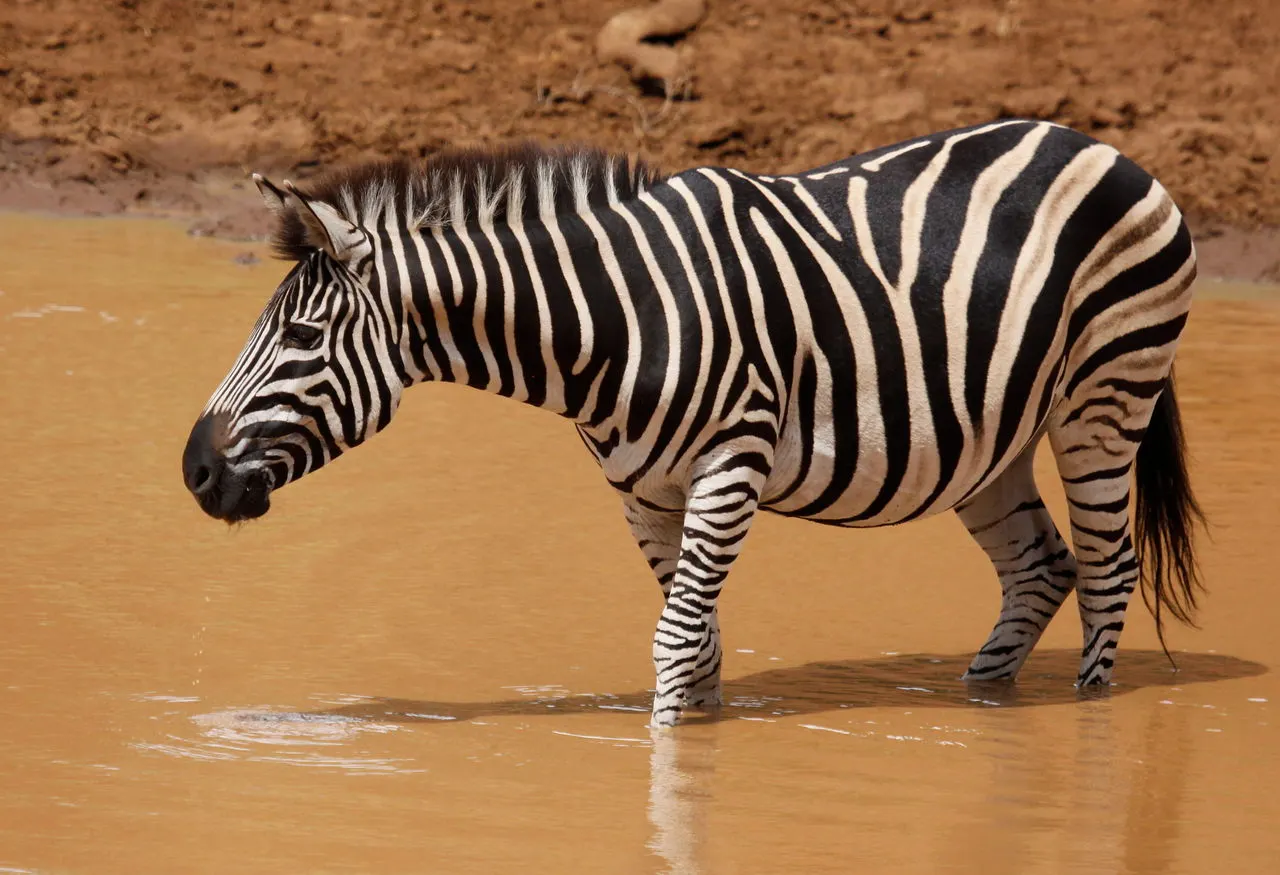
A plains zebra wading at Pilanesberg National Park, South Africa, according to the file page; the bands on the legs are thinner and packed closer than those on the flank, and faint brownish bands show between the dark stripes of the rump.
"Plains zebra (common zebra or Burchell's zebra), Equus quagga at Pilanesberg National Park, Northwest Province, South Africa" by Derek Keats from Johannesburg, South Africa — https://commons.wikimedia.org/wiki/File:Plains_zebra_(common_zebra_or_Burchell%27s_zebra),_Equus_quagga_at_Pilanesberg_National_Park,_Northwest_Province,_South_Africa_(16906289242).jpg — CC BY 2.0 (https://creativecommons.org/licenses/by/2.0/)
Count the stripes across a zebra's flank in this photo, then count them on one leg. The leg fits more bands into less width. A 2022 study notes that in all zebra species the stripes are narrowest on the face and legs. The clearest test of what stripes do turns on the last meter or two of a fly's flight.
What did the horsefly tests find?
Tim Caro and colleagues tested one claim in a 2019 PLOS ONE paper: stripes keep biting flies away. They watched three captive plains zebras and nine domestic horses grazing side by side in fields on a horse farm in Dundry, North Somerset, UK, in July 2016 and in June and July 2017.
An observer stood 1 to 2 meters away and recorded the flies for 16.3 hours. Horseflies circled the zebras 1.11 times per minute and the horses 2.25 times. The authors found that difference not significant. Touches, brief bumps of under two seconds, ran at 0.41 and 0.72 per minute, also not significantly different.
Landings were the exception: 0.26 per minute on zebras against 1.08 on horses (p = 0.041). Of the flies that came close, a larger share only touched a zebra, 21.7 percent against 14.7 percent on horses, and a smaller share landed, 9.9 percent against 27.9.
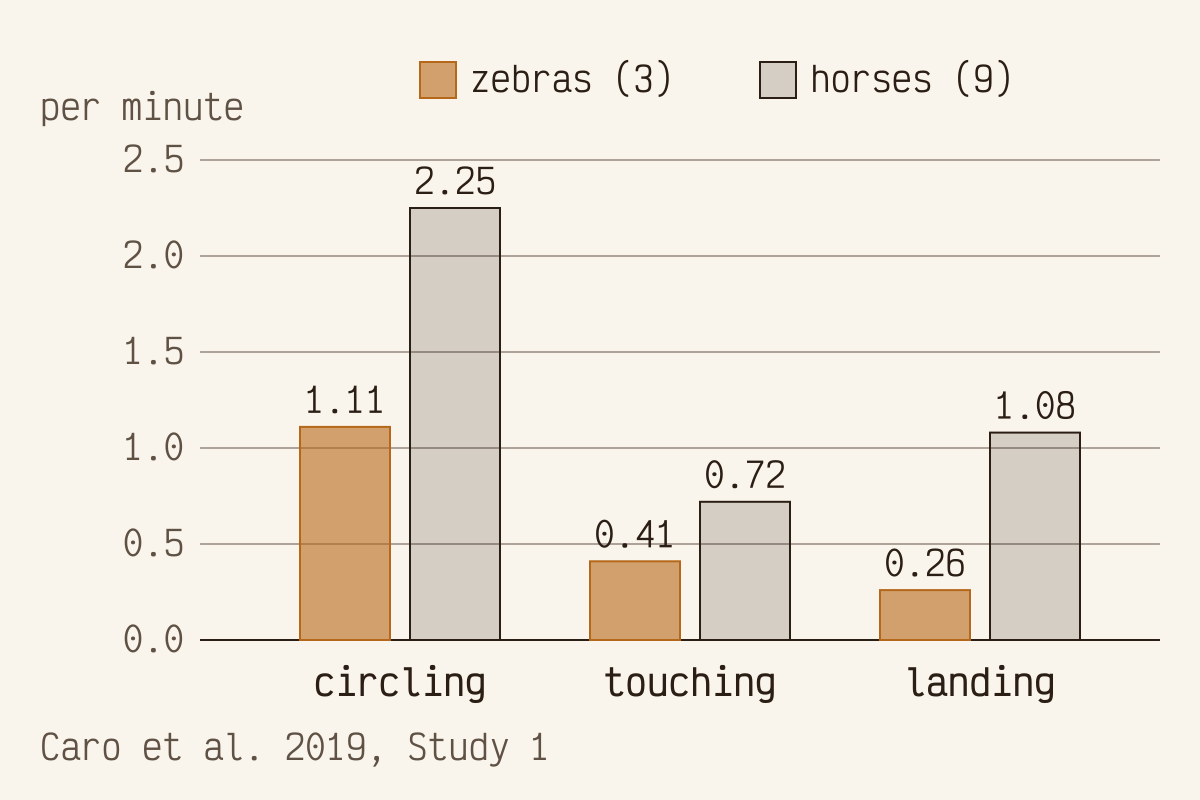
Horseflies per minute circling, touching and landing on 3 captive zebras and 9 horses in the tests reported in 2019, redrawn from the numbers Caro and colleagues report for their direct observations; only the landing difference was significant.
Recipe bars = mean flies per minute, Study 1 direct observation; zebras n=3, horses n=9; axis 0-2.5 per minute; values from Caro et al. 2019, Results
Read this figure as text
- Circling: zebras 1.11 per minute, horses 2.25 per minute; not significant (p = 0.372).
- Touching: zebras 0.41 per minute, horses 0.72 per minute; not significant (p = 0.925).
- Landing: zebras 0.26 per minute, horses 1.08 per minute; significant (p = 0.041).
"Horseflies around zebras and horses: circling, touching and landing rates" by Spiral, Fern & Honeycomb, https://spiralfernandhoneycomb.com/stripes-and-spots/zebra-stripes/, licensed under CC BY 4.0 (https://creativecommons.org/licenses/by/4.0/).
Data: Caro T, Argueta Y, Briolat ES, et al. (2019) Benefits of zebra stripes: Behaviour of tabanid flies around zebras and horses. PLOS ONE 14(2): e0210831, https://doi.org/10.1371/journal.pone.0210831, CC BY 4.0
Circling, touching and landing rates (CSV) (file notes: source and license) Data: Caro T, Argueta Y, Briolat ES, et al. (2019) Benefits of zebra stripes: Behaviour of tabanid flies around zebras and horses. PLOS ONE 14(2): e0210831, https://doi.org/10.1371/journal.pone.0210831, CC BY 4.0
Why did the flies fail to land?
Video showed how the landings failed. Flies approached zebras faster than horses, with a median speed of 17.76 against 13.21 pixels per frame. Near a horse they braked steadily; near a zebra they did not slow down in the final half second.
“In the last half second they flew faster before landing on or touching a zebra than a horse,” the authors write. They offer three possible reasons: the flies did not see the target, did not treat the striped surface as a place to land, or were confused by the pattern.
A coat test set smell and movement aside. Seven horses each wore a black coat, a white coat and a striped coat for 30 minutes, in random order. Far fewer flies touched or landed on the striped coat, yet landings on the horses' bare heads did not differ.
The authors read this as stripes working only at close range, not from a distance. Flies that did land on a zebra left quickly: on video, a fly stayed 1.20 seconds on average on a zebra (5 instances) and 10.06 seconds on a horse (886 instances).
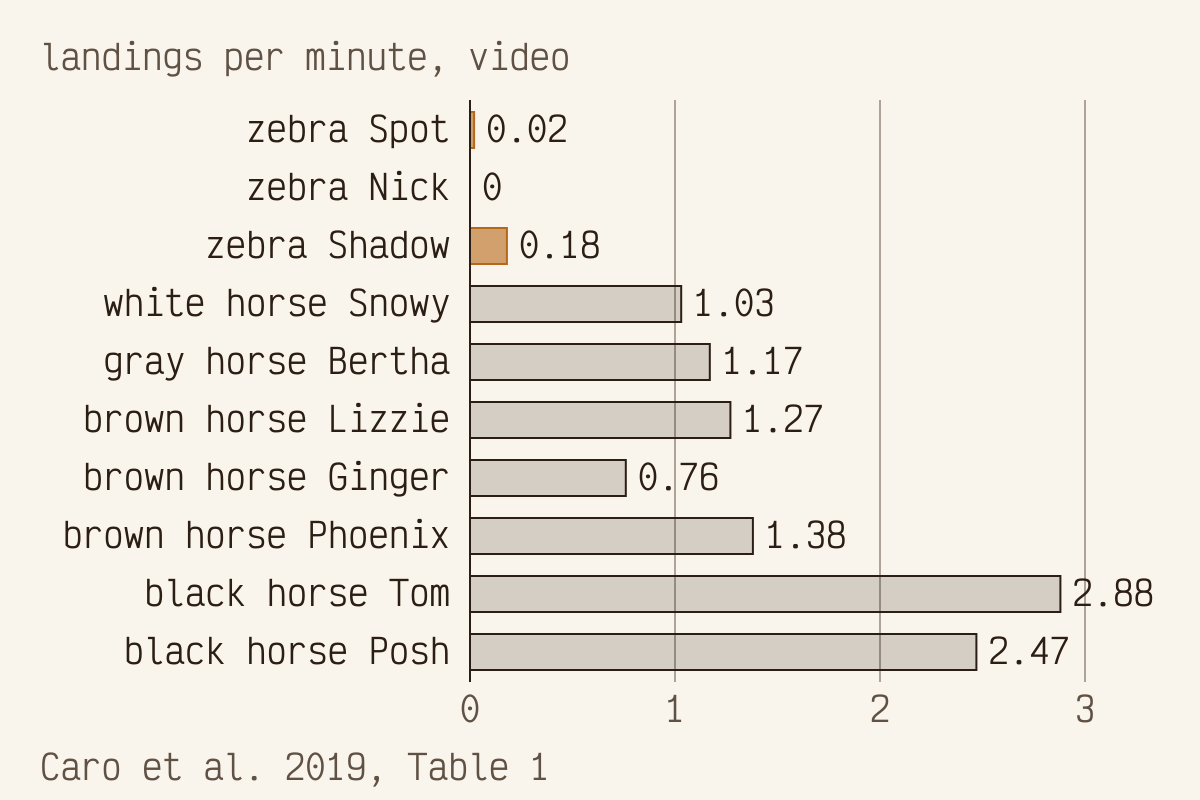
Landings per minute on each of the ten animals filmed in the 2019 study, redrawn from Table 1 of Caro and colleagues; the three zebras sit far below all seven horses.
Recipe bars = mean landings per minute on one filmed side of each animal; 3 zebras, 7 horses; 1.09-2.25 hours of video each; values from Caro et al. 2019, Table 1
Read this figure as text
- Zebras: Spot 0.02, Nick 0, Shadow 0.18 landings per minute.
- Horses: white horse 1.03, gray horse 1.17, brown horses 1.27, 0.76 and 1.38, black horses 2.88 and 2.47 landings per minute.
"Horsefly landings per minute on each filmed zebra and horse" by Spiral, Fern & Honeycomb, https://spiralfernandhoneycomb.com/stripes-and-spots/zebra-stripes/, licensed under CC BY 4.0 (https://creativecommons.org/licenses/by/4.0/).
Data: Caro T, Argueta Y, Briolat ES, et al. (2019) Benefits of zebra stripes: Behaviour of tabanid flies around zebras and horses. PLOS ONE 14(2): e0210831, https://doi.org/10.1371/journal.pone.0210831, CC BY 4.0
In 5.3 hours of direct zebra observation, the observers recorded no fly probing the skin for blood, against 239 probes in 11.0 hours on horses. The zebras also flicked their tails more often than the horses, and they walked or ran away from flies.
The study has limits. The zebras were three captive animals in England, and the authors themselves note that European horseflies may behave differently from African ones.
Which explanations have the most evidence?
The 2019 paper opens with the older ideas: camouflage, confusing predators, signals between zebras, cooling, and avoiding biting flies. Summarizing earlier work, its introduction reports three points against the first three. Lions and spotted hyenas find the stripes hard to resolve at any great distance, lions take zebras more often than expected, and grooming is no more common in striped members of the horse family.
Those three points rest on studies not read for this page. The table below lists them as known only from that summary; in the chart, predator confusion sits with the 2015 survey described below.
Cooling has a direct test. Gábor Horváth and colleagues, in a 2018 Scientific Reports paper, set out water-filled metal barrels covered with hides or painted patterns for four months. They found no significant core temperature difference between striped and gray barrels, even on many hot days.
Temperature turns up in one survey. Brenda Larison and colleagues, writing in Royal Society Open Science in 2015, scored plains zebra striping at 16 sites across Africa. Temperature predicted a substantial amount of the variation, and they found no evidence that predators or biting flies drove it. Modeled lion range failed to predict striping, though the authors note that lions live almost everywhere plains zebras do.
Caro and Theodore Stankowich answered the same year. They argued that variation within one species cannot necessarily show why stripes first evolved. The survey's authors replied that neither study had tested how abundant horseflies were, and that the temperature link fits cooling, biting flies or both.
What did later fly tests add?
Later tests narrowed the fly answer without settling how it works. Martin How and colleagues (2020, Proceedings of the Royal Society B) put patterned rugs on horses. Flies avoided checked rugs much as they avoided striped ones, which argues against one proposed visual cue, the aperture effect, because it needs parallel stripes.
Kaia Tombak and colleagues (2022, Scientific Reports) let stable flies choose between real pelts in Kenya. The flies strongly preferred impala skin to either zebra skin, with no preference between plains zebra and Grevy's zebra skins. The 2022 authors add that they did not commonly see flies “crash land” or bump off zebra skins, as the 2019 team had described anecdotally.
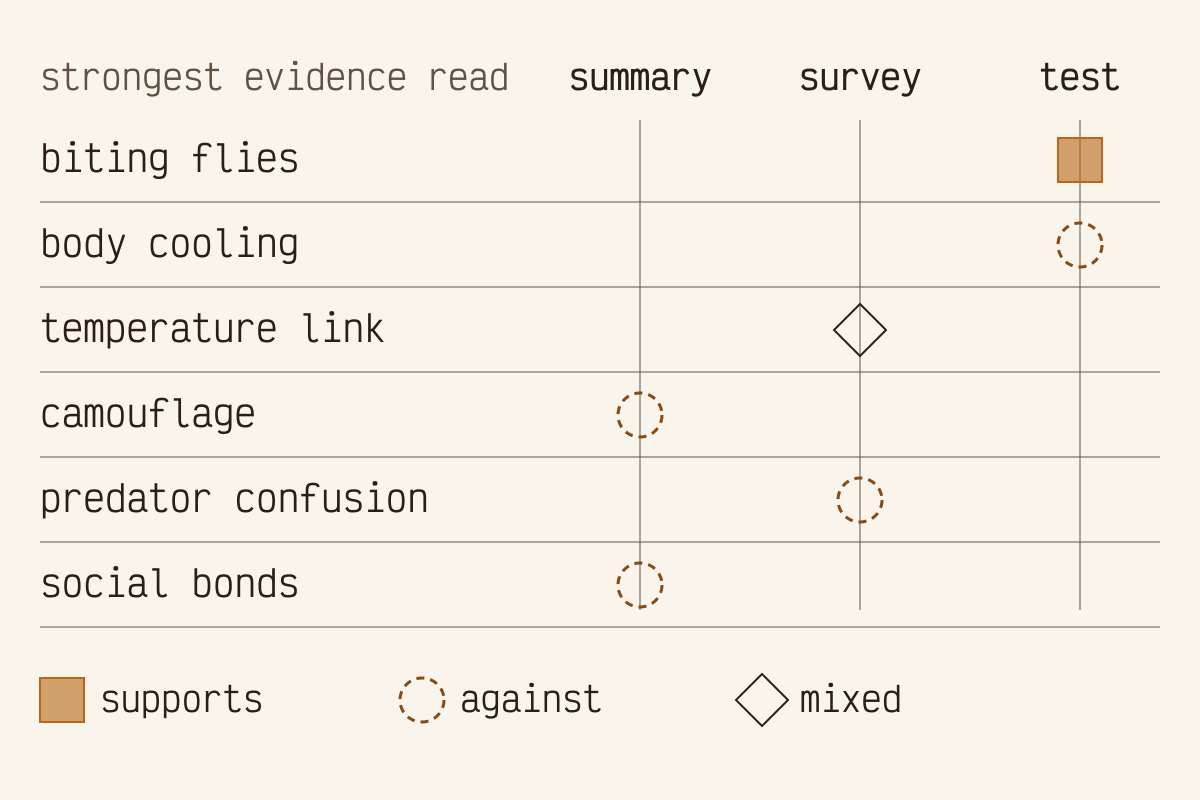
Six explanations for zebra stripes, each placed by the strongest kind of evidence read for this page, from a summary inside another paper to a field survey to a direct test; the marker shape shows whether that evidence supports the idea, goes against it, or allows more than one reading.
Recipe rows=6 explanations; columns=summary, survey, test; marker=strongest evidence read (square supports, dashed circle against, diamond mixed); grades assigned by this site from Caro et al. 2019, Tombak et al. 2022, Horváth et al. 2018 and Larison et al. 2015
"Zebra stripe explanations by strongest evidence read" by Spiral, Fern & Honeycomb, https://spiralfernandhoneycomb.com/stripes-and-spots/zebra-stripes/, licensed under CC BY 4.0 (https://creativecommons.org/licenses/by/4.0/).
Data: Caro et al. (2019) PLOS ONE 14(2): e0210831, https://doi.org/10.1371/journal.pone.0210831, CC BY 4.0; Tombak et al. (2022) Scientific Reports 12: 18617, https://doi.org/10.1038/s41598-022-22333-7, CC BY 4.0; Horváth et al. (2018) Scientific Reports 8: 9351, https://doi.org/10.1038/s41598-018-27637-1, CC BY 4.0; Larison et al. (2015) Royal Society Open Science 2: 140452, https://doi.org/10.1098/rsos.140452, CC BY 4.0
| Explanation | Strongest evidence read | Result | Reading level |
|---|---|---|---|
| Biting flies | Field observation and coat test (Caro et al. 2019); pelt choice test (Tombak et al. 2022) | Fewer landings on zebras and striped surfaces, at close range | full text |
| Body cooling | Water-barrel test (Horváth et al. 2018) | No significant core temperature difference between striped and gray barrels | full text |
| Temperature link | Survey of 16 sites (Larison et al. 2015) | Temperature predicts plains zebra striping; meaning disputed | full text |
| Camouflage | Earlier studies as summarized in Caro et al. 2019 (not read) | Stripes hard for lions and hyenas to resolve at a distance | full text |
| Predator confusion | Survey of 16 sites (Larison et al. 2015); earlier studies as summarized in Caro et al. 2019 (not read) | Modeled lion range did not predict striping; lions take zebras more often than expected | full text |
| Social bonds | Earlier studies as summarized in Caro et al. 2019 (not read) | Grooming no more common in striped equids | full text |
This table as CSV (zebra-stripes-hypotheses.csv) (file notes: source and license) Data: Caro et al. (2019) PLOS ONE 14(2): e0210831, https://doi.org/10.1371/journal.pone.0210831, CC BY 4.0; Tombak et al. (2022) Scientific Reports 12: 18617, https://doi.org/10.1038/s41598-022-22333-7, CC BY 4.0; Horváth et al. (2018) Scientific Reports 8: 9351, https://doi.org/10.1038/s41598-018-27637-1, CC BY 4.0; Larison et al. (2015) Royal Society Open Science 2: 140452, https://doi.org/10.1098/rsos.140452, CC BY 4.0
The site's reading is that biting flies are the only explanation here backed by direct tests on stripes and on live zebras. Those tests agree that the effect works at close range. Cooling has one direct test against it, and the temperature link is real in the survey but open to more than one reading.
None of the papers read here settles why flies fail to land; the 2019 paper calls the landing mechanism of horseflies “unknown.” Unlike fairy circles, another dispute where the two sides can't be read equally, the papers cited in this section were read in full. Three older lines of evidence, though, reached this page only through the 2019 summary.
Do all plains zebras carry the same stripes?
No, and the differences follow geography. The 2015 survey describes plains zebras with heavy black and white striping over the whole body in some areas. In others, stripes cover less of the body and are thinner and lighter, sometimes with faint shadow stripes between the main ones. The extinct quagga of South Africa had the least striping.
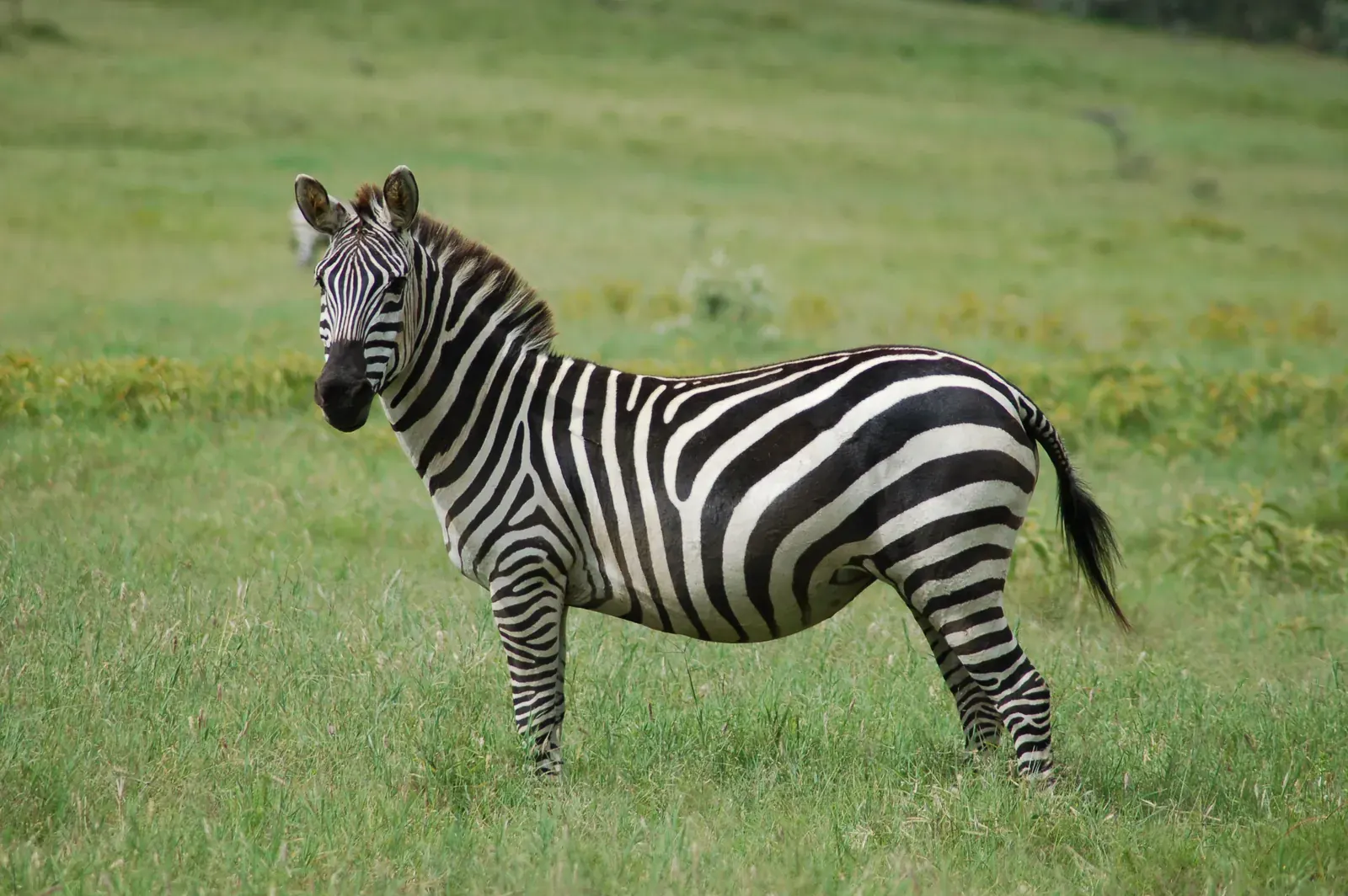
A plains zebra at Hell's Gate National Park, Kenya, according to the file page, banded down to the belly and the hooves; compare the wading zebra at the top of the page, photographed in South Africa.
"Equus quagga" by Joachim Huber — https://commons.wikimedia.org/wiki/File:Equus_quagga.jpg — CC BY-SA 2.0 (https://creativecommons.org/licenses/by-sa/2.0/); modified: resized to 1600 px on the long edge and saved as WebP
Two photographs show two animals, not a regional trend; the trend comes from the 16-site survey. Between species, the 2022 study describes Grevy's zebra as having the narrowest stripes and the plains zebra the widest. Its flies avoided both pelts about equally. Giraffe spots are another coat pattern, with a study of their own.
How do the stripes form in the first place?
That is a question about growth rather than use, and the papers read here do not answer it. J. B. L. Bard's 1977 paper in the Journal of Zoology, A unity underlying the different zebra striping patterns, argued that the zebras' patterns share one plan. Only its reference entry, as cited in later papers, was read for this page bibliographic.
The 2022 pelt study offers a growth reason for one detail. Stripes may be narrowest on the face and legs for no benefit at all: “it may simply be a matter of ontogeny,” the authors write. Ontogeny means the course of development, such as how pigment cells end up spaced between the body and the limbs.
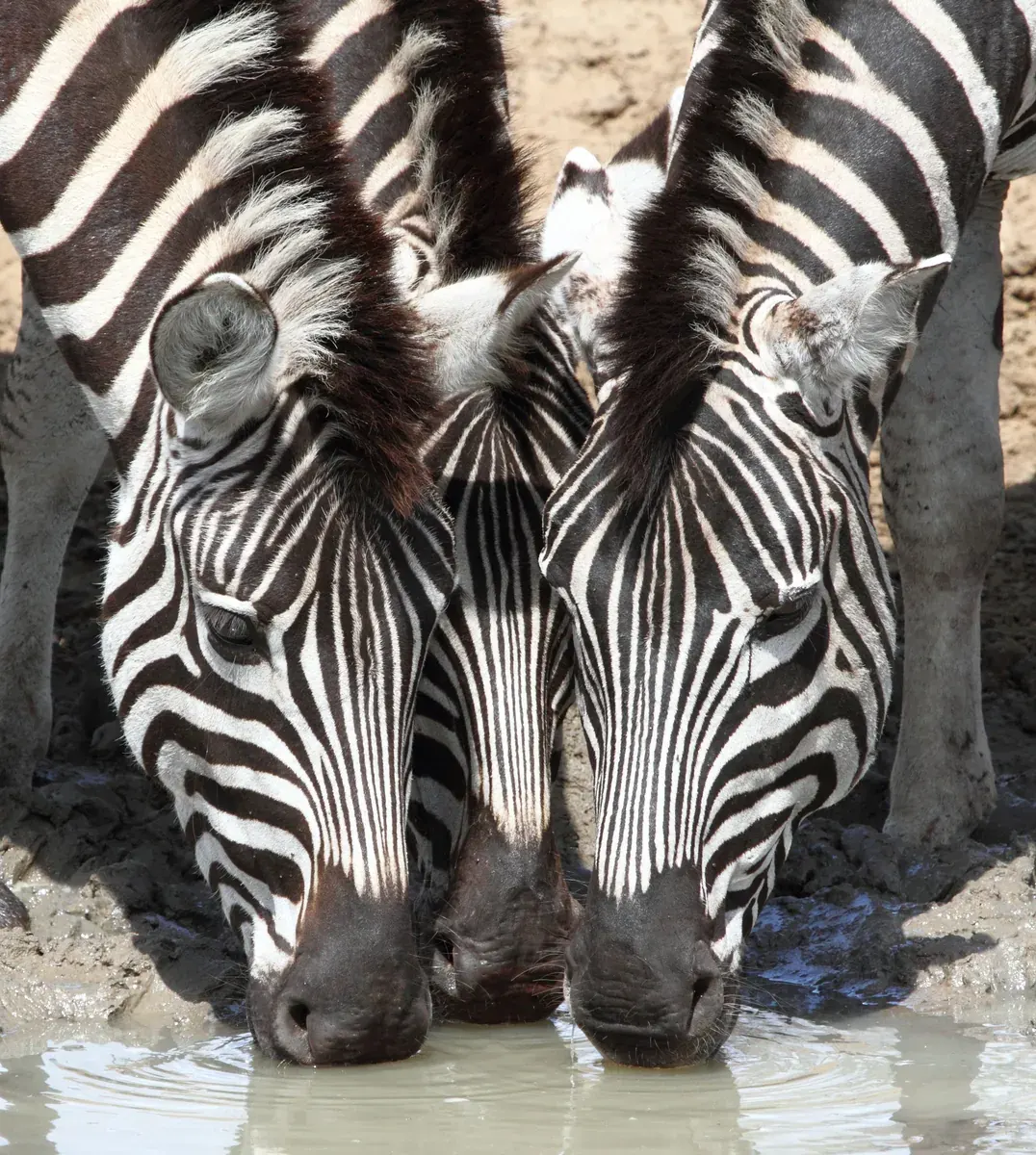
Three plains zebras drinking at a waterhole in KwaZulu-Natal, South Africa, according to the file page; the stripes are narrow on each face, and the three faces do not share one layout.
"Zebra 2013 10 06 1274" by Alandmanson — https://commons.wikimedia.org/wiki/File:Zebra_2013_10_06_1274.jpg — CC BY-SA 4.0 (https://creativecommons.org/licenses/by-sa/4.0/); modified: resized to 1200 px on the long edge and saved as WebP
Models can draw stripes. In the reaction-diffusion model behind Turing patterns, two substances react while spreading at different speeds. Some settings of its two rates leave evenly spaced bands. That model draws stripes; nothing read for this page shows that it is how zebra skin makes them.
Sources
- Tombak KJ, Gersick AS, Reisinger LV, Larison B, Rubenstein DI (2022). Zebras of all stripes repel biting flies at close range. Scientific Reports 12: 18617. doi:10.1038/s41598-022-22333-7. CC BY 4.0. pmc.ncbi.nlm.nih.gov/articles/PMC9633588/Read: full text; Abstract, Results and DiscussionText license: CC BY 4.0 (terms)
- Caro T, Argueta Y, Briolat ES, Bruggink J, Kasprowsky M, Lake J, Mitchell MJ, Richardson S, How M (2019). Benefits of zebra stripes: Behaviour of tabanid flies around zebras and horses. PLOS ONE 14(2): e0210831. doi:10.1371/journal.pone.0210831. CC BY 4.0. pmc.ncbi.nlm.nih.gov/articles/PMC6382098/Read: full text; Introduction, Methods, Results (Studies 1 to 4, Table 1) and DiscussionText license: CC BY 4.0 (terms)
- Horváth G, Pereszlényi Á, Száz D, Barta A, Jánosi IM, Gerics B, Åkesson S (2018). Experimental evidence that stripes do not cool zebras. Scientific Reports 8: 9351. doi:10.1038/s41598-018-27637-1. CC BY 4.0. pmc.ncbi.nlm.nih.gov/articles/PMC6008466/Read: full text; Abstract and ResultsText license: CC BY 4.0 (terms)
- Larison B, Harrigan RJ, Thomassen HA, Rubenstein DI, Chan-Golston AM, Li E, Smith TB (2015). How the zebra got its stripes: a problem with too many solutions. Royal Society Open Science 2(1): 140452. doi:10.1098/rsos.140452. CC BY 4.0. pmc.ncbi.nlm.nih.gov/articles/PMC4448797/Read: full text; Abstract, Introduction, Results and DiscussionText license: CC BY 4.0 (terms)
- Caro T, Stankowich T (2015). Concordance on zebra stripes: a comment on Larison et al. (2015). Royal Society Open Science 2(9): 150323. doi:10.1098/rsos.150323. CC BY 4.0. pmc.ncbi.nlm.nih.gov/articles/PMC4593687/Read: full textText license: CC BY 4.0 (terms)
- Larison B, Harrigan RJ, Rubenstein DI, Smith TB (2015). Concordance on zebra stripes is not black and white: response to comment by Caro & Stankowich (2015). Royal Society Open Science 2(9): 150359. doi:10.1098/rsos.150359. CC BY 4.0. pmc.ncbi.nlm.nih.gov/articles/PMC4593692/Read: full textText license: CC BY 4.0 (terms)
- How MJ, Gonzales D, Irwin A, Caro T (2020). Zebra stripes, tabanid biting flies and the aperture effect. Proceedings of the Royal Society B 287(1933): 20201521. doi:10.1098/rspb.2020.1521. CC BY 4.0. pmc.ncbi.nlm.nih.gov/articles/PMC7482270/Read: full text; Abstract and IntroductionText license: CC BY 4.0 (terms)
- Bard JBL (1977). A unity underlying the different zebra striping patterns. Journal of Zoology 183: 527–539. doi:10.1111/j.1469-7998.1977.tb04204.x. doi.org/10.1111/j.1469-7998.1977.tb04204.xRead: bibliographic
Cite this page
Spiral, Fern & Honeycomb. “Why Do Zebras Have Stripes? The Ideas Have Unequal Evidence.” Published November 23, 2026. https://spiralfernandhoneycomb.com/stripes-and-spots/zebra-stripes/ (accessed the day you read it).
- How each figure and source is checked
- Retunings: every correction, dated
- Report an error on this page (contact@spiralfernandhoneycomb.com)
More from Stripes & Spots
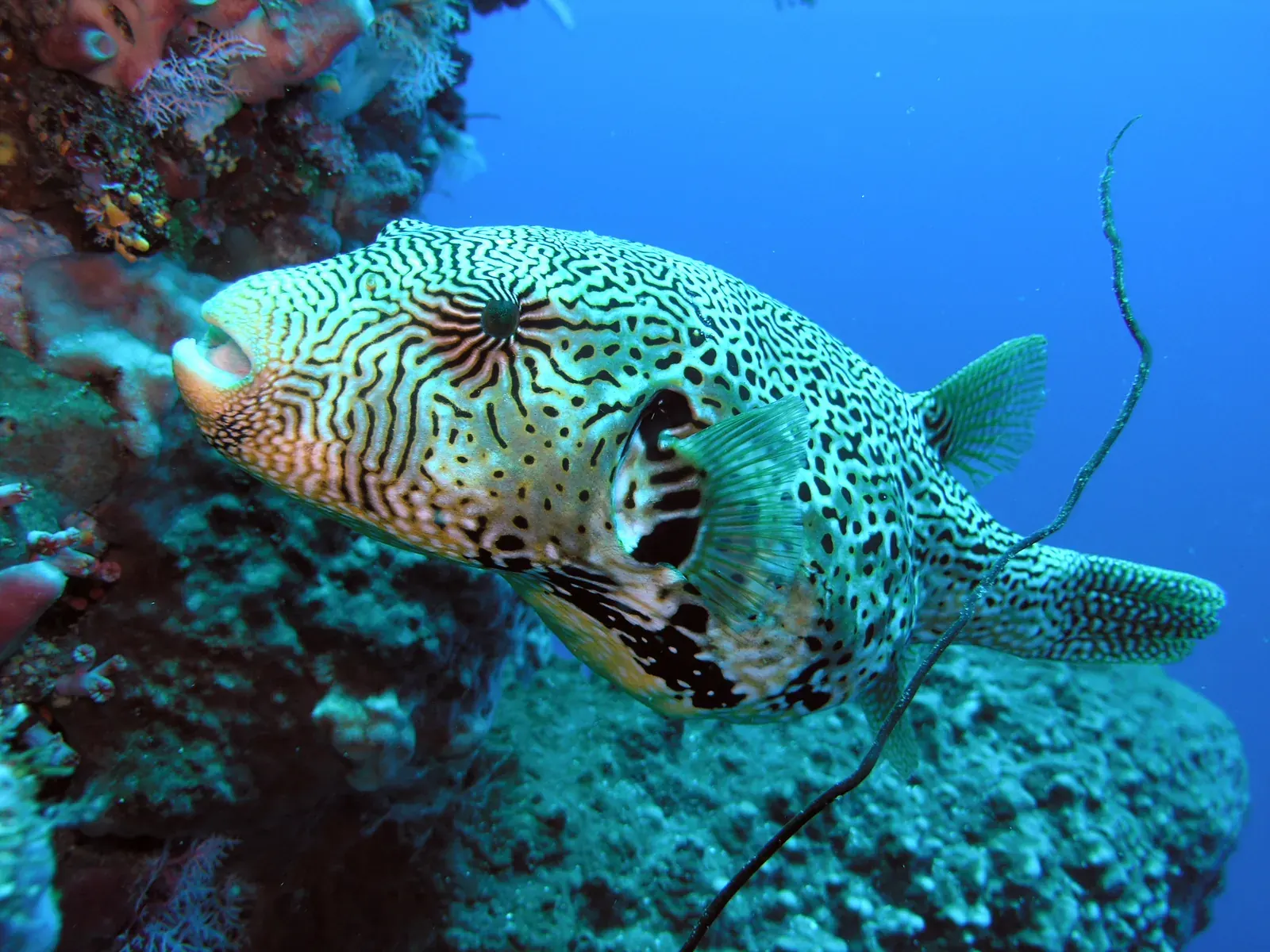
Turing Patterns: A Related Model Turns Spots to Stripes
Picture credit
"Arothron mappa" by Jens Petersen — https://commons.wikimedia.org/wiki/File:Arothron_mappa.JPG — CC BY 2.5 (https://creativecommons.org/licenses/by/2.5/); modified: resized to 1600 px wide and saved as WebP
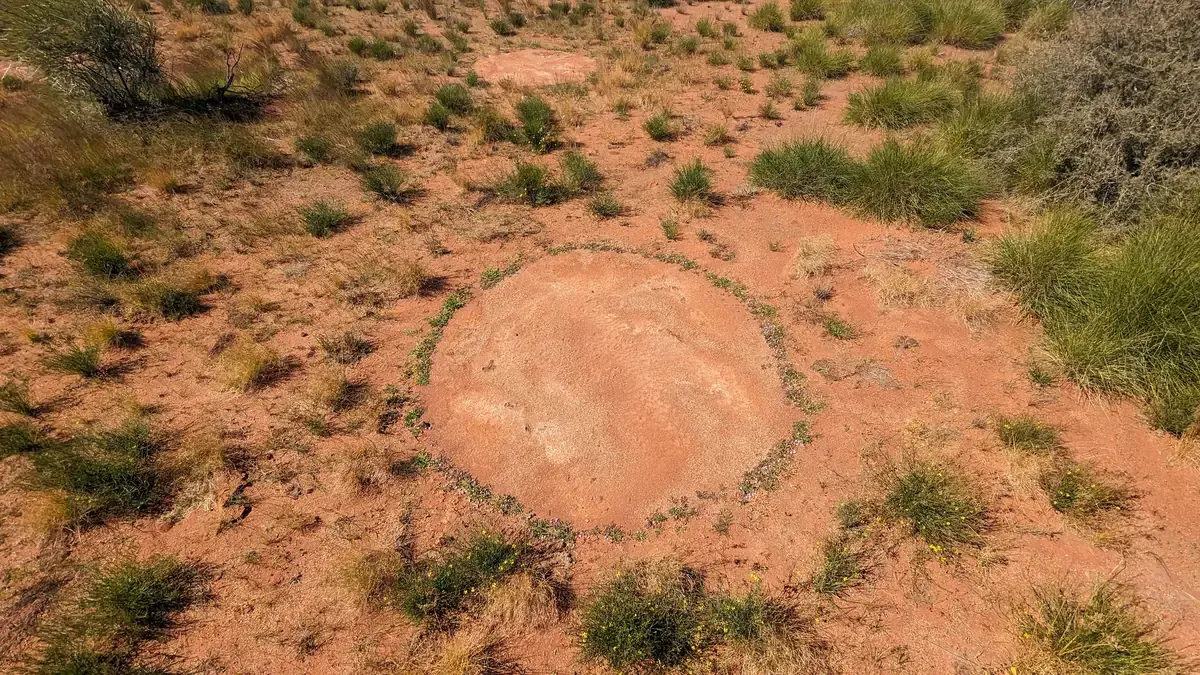
Fairy Circles: Grass Competition Leads in the Studies Read
Picture credit
"Fairy circles, Newhaven Wildlife Sanctuary" by B 897 — https://commons.wikimedia.org/wiki/File:Fairy_circles,_Newhaven_Wildlife_Sanctuary.jpg — CC0 1.0 (https://creativecommons.org/publicdomain/zero/1.0/); modified: resized to 1200 px on the long edge and saved as WebP
Giraffe Spots: Are Patch Shapes Passed From Mother to Calf?
Picture credit
"Giraffe Close-up" by William Warby from London, England — https://commons.wikimedia.org/wiki/File:Giraffe_Close-up_(2405302450).jpg — CC BY 2.0 (https://creativecommons.org/licenses/by/2.0/); modified: resized to 1400 px on the long edge and saved as WebP